
Accountability: The Defining Difference Between
a Muslim and the World
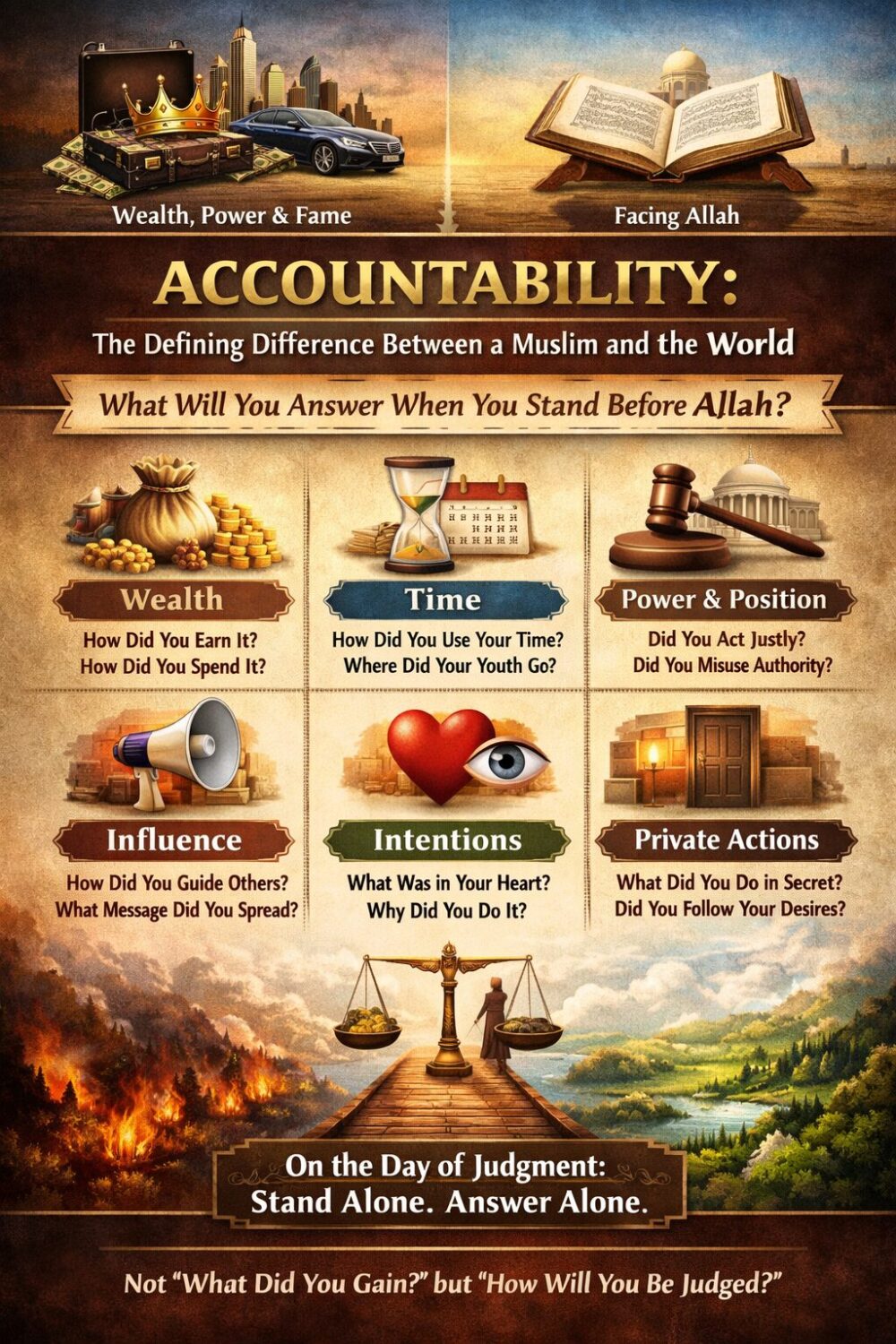
Introduction
In today’s world, success is often measured through visible markers—wealth, power, position, influence, and fame. The modern narrative glorifies accumulation: more money, higher status, broader recognition. People spend years chasing promotions, building empires, and crafting reputations. Yet, in this relentless pursuit, a critical question is frequently ignored: How was it earned, and how is it being spent? For many, the journey matters less than the outcome. If wealth comes, few question its source. If influence grows, few examine its impact. Time is consumed without reflection, and decisions are made without accountability. This mindset creates a life driven by external validation rather than internal responsibility.
However, Islam introduces a radically different framework—one rooted in accountability before Allah. The Qur’an constantly reminds believers that every action, intention, and blessing will be questioned. The teachings of Prophet Muhammad reinforce that nothing escapes divine justice—not even the smallest deed. This consciousness of accountability is what distinguishes a Muslim from others. It is not merely about believing in God, but about living every moment with the awareness that life is a test. Wealth is not just to be earned, but earned lawfully. Time is not just to be spent, but spent meaningfully. Power is not just to be exercised, but exercised with justice.
In essence, accountability transforms ordinary living into purposeful existence. It shifts the focus from “What can I gain?” to “What will I answer for?”
The Illusion of Success Without Accountability
The world celebrates outcomes, not processes. A wealthy person is admired regardless of how the wealth was accumulated. A powerful individual is respected even if their power was built on injustice. Fame often overshadows character.
This creates a dangerous illusion: that success is independent of morality.
In such an environment:
- Earning through unethical means becomes normalized
- Time is wasted in pursuits that hold no eternal value
- Power is used for personal gain rather than justice
- Relationships are exploited instead of nurtured
The absence of accountability leads to a life driven by impulse rather than principle. When there is no belief in ultimate questioning, there is little reason to restrain desires or evaluate decisions deeply.
Accountability in Islam: A Complete Framework
Islam introduces a comprehensive system where every aspect of life is subject to accountability. This is not limited to major actions but extends to intentions, habits, and even thoughts.
A Muslim believes:
- Every deed is recorded
- Every blessing is a trust (Amanah)
- Every moment is an opportunity or a liability
- Every individual will stand alone on the Day of Judgment
This belief creates a powerful internal compass. It ensures that actions are not guided by societal approval but by divine accountability.
Wealth: Not Just Earning, But Answering
Wealth is one of the greatest tests a person faces. The question is not simply how much one has, but:
- How was it earned?
- Was it halal or haram?
- Were others wronged in the process?
- How was it spent?
- Was it used for الخير (good) or indulgence?
A Muslim understands that wealth is temporary but accountability is eternal. Every transaction, every deal, every financial decision carries weight.
Unlike the world, which praises accumulation, Islam emphasizes responsibility.
Time: The Most Overlooked Accountability
Time is perhaps the most undervalued resource in modern life. Hours are spent on entertainment, distractions, and pursuits that offer no lasting benefit.
Yet, in Islam, time is a critical accountability:
- How was your youth spent?
- What did you do with your free time?
- Did your actions bring you closer to Allah or further away?
Time, once gone, cannot be reclaimed. A Muslim is conscious that every moment is being recorded and will be revisited.
Power and Position: A Heavy Responsibility
Positions of authority—whether in a family, workplace, or society—are often seen as privileges. Islam reframes them as responsibilities.
A leader will be questioned:
- Did you act with justice?
- Did you misuse authority?
- Did you protect or exploit those under you?
The higher the position, the greater the accountability.
This contrasts sharply with worldly systems where power often shields individuals from consequences. In Islam, power increases scrutiny.
Fame and Influence: A Double-Edged Sword
In the age of social media, influence is easier to gain than ever before. But influence without accountability can lead to widespread harm.
A Muslim must consider:
- What message am I spreading?
- Am I guiding people toward الخير or misleading them?
- Is my influence rooted in sincerity or ego?
Every follower, every listener, every person influenced becomes part of one’s accountability.
The Role of Intentions (Niyyah)
One of the most profound aspects of Islamic accountability is the emphasis on intention.
Two people may perform the same action:
- One may earn reward
- The other may incur sin
The difference lies in intention.
This internal dimension ensures that accountability is not superficial. It penetrates beyond actions into motives, making sincerity a central pillar of a Muslim’s life.
Private Life: Accountability Beyond Public Image
In the world, people are often judged by what is visible. Islam goes deeper—holding individuals accountable even in their private lives.
- What do you do when no one is watching?
- What choices do you make in secrecy?
- How do you behave when accountability seems absent?
A Muslim understands that true accountability is not social—it is divine.
The Day of Judgment: The Ultimate Reality
The belief in the Day of Judgment is the foundation of accountability. It is the moment when:
- Deeds are revealed
- Intentions are exposed
- Justice is perfectly established
No wealth can bribe, no status can protect, and no influence can manipulate outcomes.
Every individual stands alone before Allah.
This reality reshapes priorities. It shifts focus from temporary success to eternal success.
The Key Difference: Conscious Living
The defining difference between a Muslim and one who lacks this framework is not intelligence, ability, or opportunity—it is consciousness.
A Muslim lives with:
- Awareness of accountability
- Discipline in actions
- Responsibility in decisions
- Purpose in life
This does not mean perfection, but it means constant reflection and correction.
Conclusion
In a world obsessed with results, Islam calls for responsibility. While others may chase wealth without questioning its source, a Muslim pauses and evaluates. While others may spend time carelessly, a Muslim reflects on its value. While others may seek power for dominance, a Muslim views it as a trust.
Accountability transforms everything.
It turns wealth into a test, time into an opportunity, power into a responsibility, and life into a journey toward eternal success.
The real question is not: “What have you achieved?”
But rather: “What will you answer when you stand before Allah?”
That question alone is enough to redefine how a Muslim lives every single day.