
Barricading or Bonding in Marriage
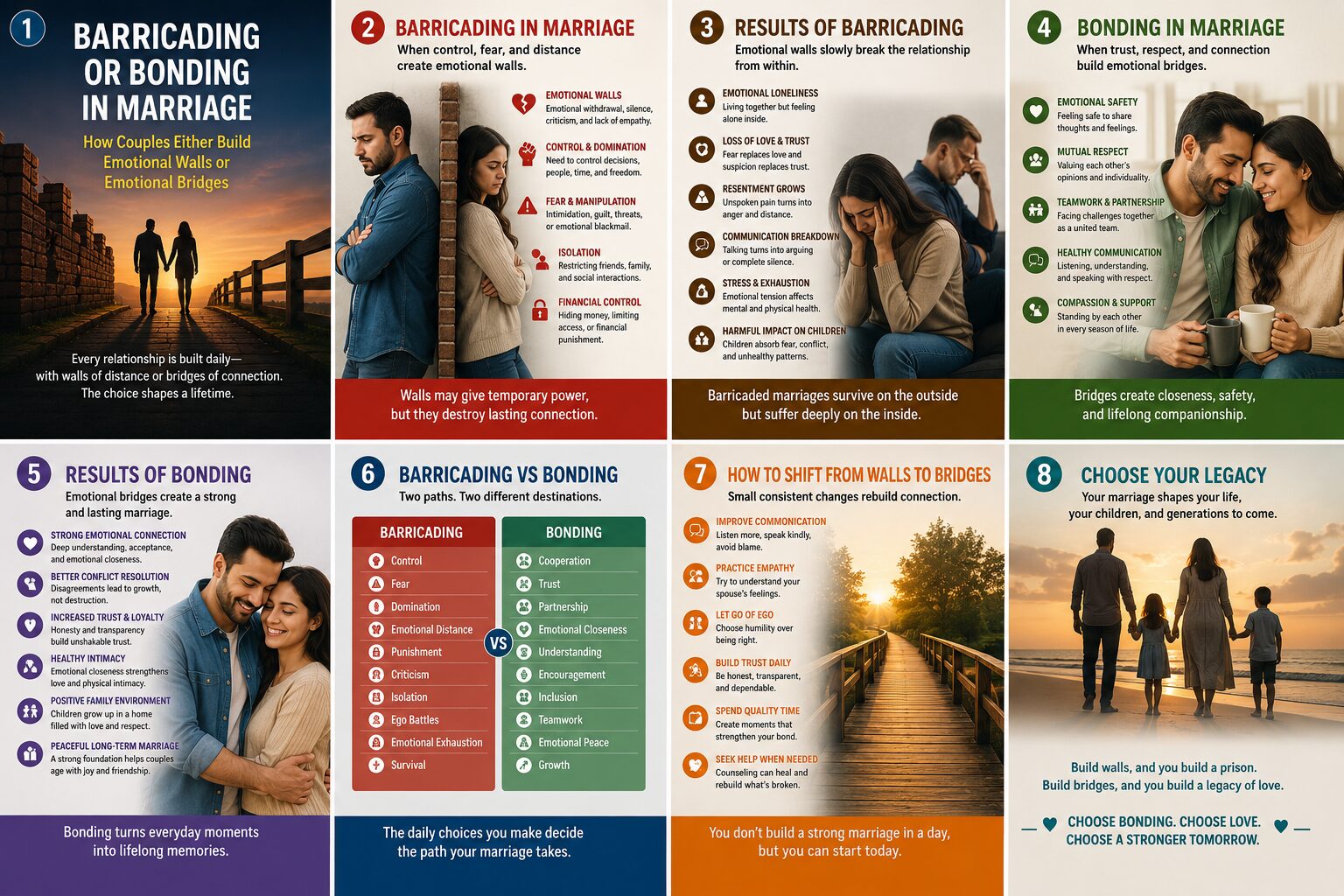
How Couples Either Build Emotional Walls or Emotional Bridges
Introduction
Marriage is one of the most delicate emotional partnerships in human life. Two individuals from different backgrounds, habits, emotional experiences, expectations, and family cultures come together with the hope of building companionship, peace, and stability. However, the early years of marriage often determine whether the relationship becomes emotionally secure or emotionally suffocating. Some couples consciously or unconsciously begin building emotional barricades of control, fear, domination, criticism, and distance. Others use the same opportunity to build bonding through trust, communication, compassion, teamwork, and emotional safety.
The difference between barricading and bonding may not appear immediately, but over time the consequences become deeply visible. One creates emotional imprisonment while the other creates emotional partnership. One weakens the soul of the marriage while the other strengthens it from within. Every interaction, argument, silence, sacrifice, and conversation slowly contributes either to walls or bridges. Understanding this difference is essential for creating healthier marriages, stronger families, and emotionally stable future generations.
Understanding Barricading in Marriage
Barricading in marriage refers to the emotional, psychological, financial, social, or spiritual walls that spouses create between each other. Instead of nurturing closeness, one or both partners begin controlling, restricting, dominating, punishing, or emotionally distancing themselves from the relationship.
Barricading often begins subtly. It may start with:
- excessive possessiveness,
- controlling behavior,
- emotional withdrawal,
- manipulation,
- constant criticism,
- jealousy,
- silent treatment,
- lack of trust,
- or domination disguised as leadership.
Some spouses believe authority means control. Others believe emotional silence is strength. Over time, these behaviors create fear rather than affection.
Marriage then slowly shifts from companionship to emotional survival.
Common Types of Barricading:
1. Emotional Barricading
Emotional barricading happens when spouses stop becoming emotionally available to each other.
Examples include:
- ignoring emotions,
- refusing healthy communication,
- emotional coldness,
- withholding affection,
- constant judgment,
- or using silence as punishment.
In such marriages, conversations become formal and emotionally disconnected.
2. Financial Barricading
Money can become a powerful tool of emotional control.
This may include:
- hiding finances,
- controlling every expense,
- humiliating the spouse financially,
- refusing financial transparency,
- or making one partner feel powerless.
Financial insecurity inside marriage often damages emotional security as well.
3. Social Barricading
Some spouses isolate their partner from family, friends, or healthy social interactions.
This includes:
- monitoring calls and messages,
- excessive suspicion,
- discouraging outside relationships,
- controlling movement,
- or creating dependency.
Instead of protection, the marriage becomes emotionally restrictive.
4. Psychological Barricading
Psychological barricading creates fear inside the relationship.
Examples include:
- threats,
- humiliation,
- gaslighting,
- emotional intimidation,
- repeated divorce threats,
- or emotional blackmail.
The spouse may remain physically present but emotionally unsafe.
Results of Barricading in Marriage
1. Emotional Loneliness
One of the greatest tragedies is feeling lonely while being married.
The couple may share a home, responsibilities, and social appearances, yet internally remain emotionally disconnected. Emotional loneliness often hurts more deeply than physical isolation.
2. Fear Replaces Love
Where control dominates, affection weakens.
A spouse may obey externally but internally disconnect emotionally. Fear can produce temporary compliance, but it cannot create genuine emotional intimacy.
Eventually:
- conversations become guarded,
- honesty decreases,
- and emotional transparency disappears.
3. Increased Resentment
Unresolved control and emotional suppression create hidden anger.
Over time, resentment accumulates through:
- repeated disrespect,
- humiliation,
- criticism,
- domination,
- and emotional neglect.
Many marriages collapse not because of one major issue, but because of years of accumulated emotional pain.
4. Communication Breakdown
Barricaded marriages struggle with healthy communication.
Simple discussions turn into:
- arguments,
- defensive reactions,
- emotional attacks,
- or complete silence.
Instead of solving problems together, spouses begin protecting themselves from each other.
5. Mental and Physical Stress
Continuous emotional tension affects mental and physical health.
Barricaded relationships may contribute to:
- anxiety,
- overthinking,
- depression,
- emotional exhaustion,
- sleep problems,
- and stress-related illnesses.
A home that should provide peace slowly becomes emotionally draining.
6. Negative Impact on Children
Children absorb emotional environments more deeply than parents realize.
When raised in emotionally barricaded homes, children may learn:
- fear instead of trust,
- control instead of compassion,
- silence instead of healthy communication,
- and emotional instability instead of emotional security.
These patterns often continue into the next generation.
Understanding Bonding in Marriage
Bonding is the intentional effort to create emotional connection, trust, understanding, cooperation, and companionship between spouses.
Bonding does not mean perfection or absence of disagreements. It means building emotional safety despite imperfections.
Bonded couples understand that marriage is not about winning against each other. It is about growing together.
They focus on:
- communication,
- emotional support,
- respect,
- teamwork,
- and mutual growth.
Instead of building walls, they build bridges.
Signs of Healthy Bonding
1. Emotional Safety
In bonded marriages, both spouses feel safe expressing thoughts and emotions without fear of humiliation or punishment.
This creates trust and emotional openness.
2. Respect During Disagreements
Healthy couples still argue, but they avoid destroying each other emotionally.
They focus on resolving issues rather than attacking personalities.
3. Teamwork Mentality
Bonded spouses function like partners instead of competitors.
They solve challenges together:
- finances,
- parenting,
- family pressures,
- emotional struggles,
- and life decisions.
The marriage becomes a cooperative partnership.
4. Healthy Communication
Communication remains honest, respectful, and constructive.
Bonded couples:
- listen actively,
- acknowledge feelings,
- apologize sincerely,
- and repair emotional damage quickly.
5. Emotional Availability
Bonding grows when spouses remain emotionally present during difficult moments.
Compassion during weakness strengthens emotional attachment more than perfection during comfort.
Results of Bonding in Marriage
1. Strong Emotional Connection
Bonding creates emotional closeness that strengthens the relationship during both good and difficult times.
The spouse feels:
- understood,
- valued,
- respected,
- and emotionally secure.
2. Better Conflict Resolution
Bonded couples do not avoid conflicts. Instead, they manage them maturely.
They focus on:
- understanding,
- repairing,
- compromising,
- and finding solutions.
Conflicts become opportunities for growth instead of destruction.
3. Increased Trust and Loyalty
People naturally become more loyal where emotional safety exists.
Trust grows when:
- transparency,
- honesty,
- consistency,
- and respect become part of daily interactions.
4. Healthier Intimacy
True intimacy is emotional before it becomes physical.
Bonding strengthens:
- affection,
- emotional attachment,
- companionship,
- attraction,
- and long-term closeness.
5. Positive Family Environment
Children raised in bonded homes usually experience:
- stability,
- compassion,
- healthy communication,
- emotional balance,
- and mutual respect.
This becomes their emotional blueprint for future relationships.
6. Peaceful Long-Term Marriage
Physical attraction changes with time. Financial conditions fluctuate. External beauty fades. Life challenges increase.
But emotional bonding allows couples to age peacefully together.
Many bonded couples eventually become best friends in later life because their relationship was built on emotional connection rather than control.
Barricading vs Bonding: The Core Difference
| Barricading | Bonding |
|---|---|
| Control | Cooperation |
| Fear | Trust |
| Domination | Partnership |
| Emotional Distance | Emotional Closeness |
| Punishment | Understanding |
| Criticism | Encouragement |
| Isolation | Inclusion |
| Ego Battles | Teamwork |
| Emotional Exhaustion | Emotional Peace |
| Survival | Growth |
How Couples Can Shift from Barricading to Bonding
Even unhealthy marriages can improve when both spouses become conscious of their emotional behaviors.
Practical Steps Include:
- improving communication,
- practicing emotional accountability,
- reducing ego battles,
- increasing empathy,
- respecting boundaries,
- spending quality time together,
- seeking counseling when necessary,
- and focusing on partnership instead of power.
Small consistent changes often rebuild emotional trust slowly.
Conclusion
Every marriage is silently being constructed each day through words, reactions, attitudes, habits, and emotional behavior. Couples are either building barricades that create emotional distance or building bonds that create emotional safety and companionship.
Barricading may temporarily provide control, but it slowly destroys emotional intimacy. Bonding may require patience, maturity, forgiveness, and effort, but it creates long-term peace, loyalty, and emotional fulfillment.
The strongest marriages are not those without disagreements or imperfections. They are the ones where both spouses consciously choose connection over control, understanding over ego, and partnership over domination.
In the end, marriage becomes either a prison of emotional walls or a sanctuary of emotional bridges. The choice is made daily through countless small interactions that shape the emotional future of the relationship.