
From Hidayah to Jahiliyah
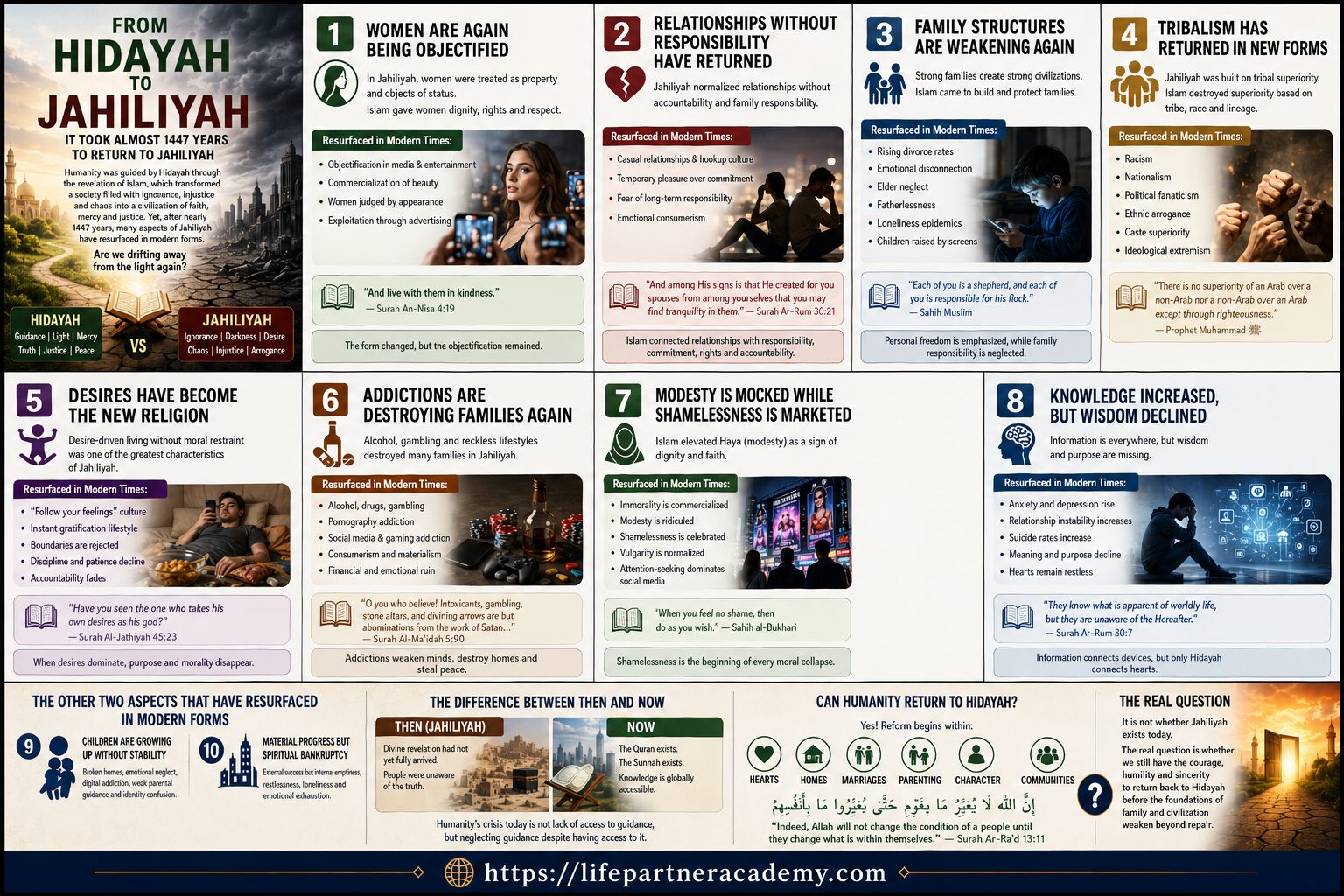
It Took Almost 1447 Years to Return to Jahiliyah
Human civilization has achieved extraordinary progress in science, technology, medicine, communication, and material development. Humanity can now travel to space, communicate globally within seconds, and build artificial intelligence capable of transforming industries. Yet beneath this impressive progress lies a troubling reality: emotional instability, broken families, declining morality, loneliness, addictions, and spiritual emptiness are increasing across the world.
This raises an uncomfortable but important question: Has humanity gradually drifted from Hidayah (divine guidance) back toward modern forms of Jahiliyah (ignorance and moral darkness)? The period before Islam during the time of Prophet Muhammad was known as Jahiliyah — a society characterized by tribal arrogance, exploitation, uncontrolled desires, family instability, injustice, and spiritual confusion. Islam transformed that society into a civilization built upon justice, mercy, family stability, morality, and accountability before Allah.
However, after nearly 1447 years, many characteristics of Jahiliyah appear to be resurfacing in modern forms — not through deserts and tribes, but through media, technology, consumerism, and hyper-individualistic lifestyles.
- The names changed.
- The packaging changed.
- But many behaviors remain strikingly familiar.
Women Are Again Being Objectified
One of the darkest aspects of Jahiliyah was the treatment of women as possessions or objects of status. Islam revolutionized society by granting women:
- Dignity
- Inheritance rights
- Consent in marriage
- Financial protection
- Spiritual equality
Allah says: “And live with them in kindness.” — Surah An-Nisa 4:19. Yet modern society often objectifies women differently:
- Entertainment industries commercialize beauty
- Social media promotes validation through appearance
- Advertising frequently exploits women’s bodies for profit
- Human worth is increasingly measured externally
The form changed. The objectification often remained.
Relationships without Responsibility Have Returned
Jahiliyah normalized relationships lacking long-term accountability and family responsibility. Today, many societies increasingly normalize:
- Casual relationships
- Temporary pleasure
- Fear of commitment
- Hookup culture
- Emotional consumerism
Marriage is often delayed while temporary intimacy is promoted. Islam connected relationships with:
- Responsibility
- Commitment
- Rights
- Family structure
- Accountability
Allah says: “And among His signs is that He created for you spouses from among yourselves that you may find tranquility in them.” — Surah Ar-Rum 30:21 Marriage in Islam was never designed merely for pleasure, but for peace, stability, mercy, and civilization-building.
Family Structures Are Weakening Again
Strong families create strong civilizations. One of Islam’s greatest reforms was stabilizing homes and strengthening family systems. Today, however, many societies face:
- Rising divorce rates
- Emotional disconnection
- Elder neglect
- Fatherlessness
- Loneliness epidemics
- Children raised by screens instead of parents
The Prophet Muhammad said: “Each of you is a shepherd, and each of you is responsible for his flock.” — Sahih Muslim. Modern culture often emphasizes personal freedom while weakening collective family responsibility.
Tribalism Has Returned in New Forms
Pre-Islamic society was deeply tribal. People supported their tribe even when wrong. Islam destroyed superiority based upon:
- Tribe
- Race
- Wealth
- Bloodline
The Prophet Muhammad declared: “There is no superiority of an Arab over a non-Arab nor a non-Arab over an Arab except through righteousness.” Yet modern Jahiliyah appears through:
- Racism
- Nationalism
- Political fanaticism
- Ethnic arrogance
- Caste superiority
- Ideological extremism
The labels changed. The arrogance survived.
Desires Have Become the New Religion
Allah warns: “Have you seen the one who takes his own desires as his god?”
— Surah Al-Jathiyah 45:23. Modern culture increasingly promotes:
- “Follow your feelings”
- “Do what makes you happy”
- “Live without boundaries”
- “No one should judge you”
As desires dominate society:
- Discipline weakens
- Patience disappears
- Sacrifice declines
- Accountability fades
One of the greatest characteristics of Jahiliyah was desire-driven living without moral restraint.
Addictions Are Destroying Families Again
Alcohol, gambling, and reckless lifestyles damaged many families during Jahiliyah. Today, the addiction crisis has expanded into:
- Alcohol
- Drugs
- Gambling
- Pornography
- Social media
- Gaming
- Consumerism
These addictions damage:
- Marriages
- Mental health
- Finances
- Parenting
- Emotional stability
Allah prohibited harmful behaviors because healthy societies require disciplined minds and stable homes.
Modesty Is Mocked While Shamelessness Is Marketed
Islam elevated Haya (modesty) as a sign of dignity and moral strength.
The Prophet Muhammad said: “Every religion has a distinct characteristic, and the distinct characteristic of Islam is modesty.” — Sunan Ibn Majah
Today:
- Immorality is commercialized
- Modesty is ridiculed
- Shamelessness is celebrated
- Vulgarity is normalized
- Attention-seeking culture dominates social media
The Prophet Muhammad warned: “When you feel no shame, then do as you wish.” — Sahih al-Bukhari. This Hadith accurately reflects the moral climate of many modern societies.
Knowledge Increased but Wisdom Declined
Humanity possesses unprecedented access to information. Yet simultaneously:
- Anxiety increases
- Depression increases
- Relationship instability rises
- Suicide rates rise
- Purpose and meaning decline
Allah says: “They know what is apparent of worldly life, but they are unaware of the Hereafter.” — Surah Ar-Rum 30:7 Modern civilization mastered information but often neglected wisdom and spiritual direction. Technology can connect devices. Only Hidayah can connect hearts.
Children Are Growing Up Without Stability
During Jahiliyah, vulnerable children often lacked protection and security. Today many children face:
- Broken homes
- Emotional neglect
- Digital addiction
- Weak parental guidance
- Identity confusion
- Lack of mentorship
Parents increasingly outsource upbringing to:
- Screens
- Schools
- Influencers
- Algorithms
But civilization cannot survive when parenting collapses.
Allah says: “Protect yourselves and your families from a Fire…” — Surah At-Tahrim 66:6
Material Progress but Spiritual Bankruptcy
Modern civilization achieved extraordinary external advancement.
But internally, humanity increasingly struggles with:
- Restlessness
- Anxiety
- Emptiness
- Loneliness
- Emotional exhaustion
Allah reminds humanity: “Indeed, in the remembrance of Allah do hearts find rest.” — Surah Ar-Ra’d 13:28. This may be the clearest sign of modern Jahiliyah: external success with internal emptiness.
Modern Jahiliyah Is More Sophisticated
Ancient Jahiliyah was visible through:
- Tribal warfare
- Idol worship
- Open oppression
Modern Jahiliyah often appears sophisticated:
- Digitized
- Glamourized
- Commercialized
- Legalized
- Socially normalized
It no longer arrives carrying swords. It arrives carrying entertainment, algorithms, addictions, ideologies, and endless distractions.
The Difference between Then and Now
There is one major difference between ancient Jahiliyah and modern humanity.
Before Islam:
- Divine revelation had not fully arrived.
Today:
- The Quran exists.
- The Sunnah exists.
- Islamic knowledge is globally accessible.
Humanity’s crisis today is not lack of access to guidance.
It is neglecting guidance despite access to it.
Can Humanity Return Back to Hidayah?
Yes — but reform must begin within:
- Hearts
- Homes
- Marriages
- Parenting
- Character
- Communities
Real change does not begin in politics first. It begins in families. Allah says: “Indeed, Allah will not change the condition of a people until they change what is within themselves.” — Surah Ar-Ra’d 13:11
Conclusion
It took centuries for humanity to drift from Hidayah toward modern forms of Jahiliyah. Today many of the same destructive patterns that Islam once reformed have resurfaced in new and sophisticated forms. Broken families, desire-driven lifestyles, emotional emptiness, addictions, weakened marriages, shamelessness, tribal arrogance, and spiritual confusion increasingly dominate modern life.
Yet the Quran and Sunnah continue to provide timeless solutions. The real question is not whether Jahiliyah exists today. The real question is whether humanity still has the courage, humility, and sincerity to return back to Hidayah before the foundations of family and civilization weaken beyond repair.