
From Wedding to Sustenance
How a Simple Shift Can Feed Families, Support Farmers, and Build a Stronger Bengaluru. Transforming Wedding Expenses into Lasting Community Nourishment
In psychology, it is often observed that when people are repeatedly told “not to do something,” they are more likely to resist — and sometimes even do it more. Whether it is a child or an adult, direct restriction often triggers resistance rather than reflection. This insight is highly relevant when we look at the issue of extravagant weddings in our communities. For years, many scholars, community leaders, NGOs, and well-meaning individuals have advised people to avoid wasteful spending and to follow the simplicity of the Sunnah. Yet, despite sincere efforts, this message has not translated into meaningful change on the ground. The challenge is not a lack of awareness — it is a lack of a compelling alternative. Instead of only saying “do not spend,” what if we offered a meaningful, positive option? What if families were given a way to redirect a small portion of wedding expenses into something lasting, beneficial, and rewarding?
This is where the idea of “From Wedding to Sustenance” emerges.
Rather than opposing celebration, it reframes it. Instead of focusing on restriction, it offers transformation. It allows families to retain the joy of weddings while simultaneously creating long-term value — feeding families, supporting farmers, and contributing to community well-being. When people are given a better alternative — one that aligns with their values, emotions, and aspirations — they are far more likely to embrace change. And perhaps, through this shift, what began as a simple suggestion can evolve into a powerful community movement.
In many communities today, weddings have become increasingly expensive. Large sums are spent on decorations, venues, catering, and one-day displays of celebration. While weddings are beautiful milestones, much of this spending disappears within hours — leaving little lasting benefit for the couple, their families, or society.
What if weddings could do more?
What if a small part of wedding expenses could be transformed into a source of fresh food, farmer livelihood, and long-term community benefit? This is the vision behind From Wedding to Sustenance — a community model that converts a modest wedding contribution into ongoing food production, farmer support, and sustainable impact. This initiative is not about reducing joy. It is about adding meaning, Barakah, and long-term value to one of life’s most important celebrations.
The Problem with One-Day Spending
Across Bengaluru and surrounding areas, wedding budgets often run into lakhs of rupees. Much of this spending goes into:
- Decorative flowers that are discarded
- Excess food that is wasted
- Luxury arrangements that leave no lasting asset
- Social pressure to “match standards”
At the same time, families face other growing challenges:
- Rising food adulteration
- High prices of quality fruits and vegetables
- Declining trust in market produce
- Financial instability among small farmers
- Reduced green cover around cities
This creates a painful contrast: extravagance on one side, and food insecurity and farmer stress on the other. From Wedding to Sustenance bridges this gap in a simple, dignified, and scalable way.
The Core Idea: Turning Celebration into Sustenance
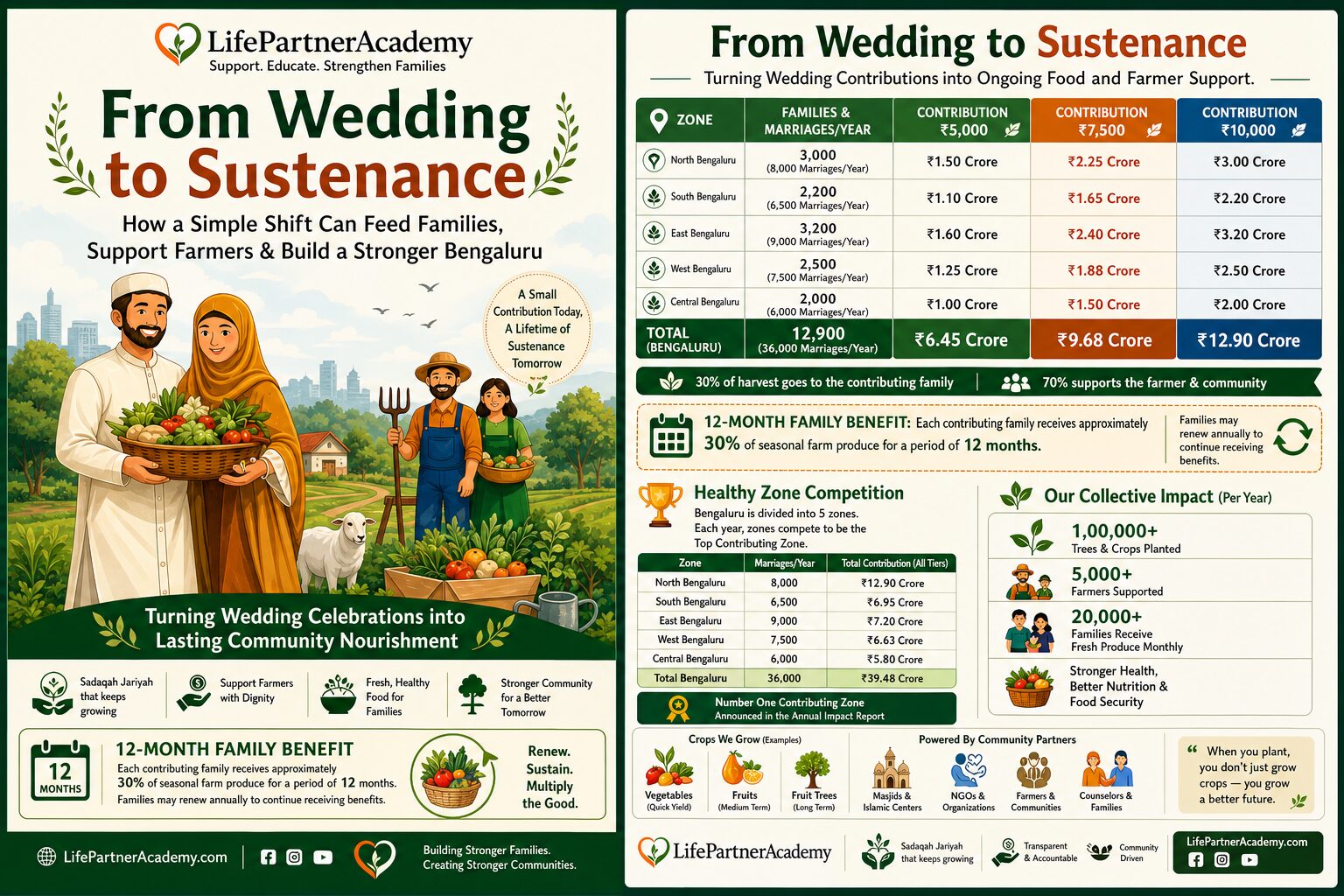
The model is straightforward: When a wedding takes place, the family voluntarily contributes a small amount — typically ₹5,000 to ₹25,000 — towards planting fruit and vegetable crops.
These funds are used to:
- Purchase saplings and seeds
- Support irrigation and soil preparation
- Partner with local farmers who manage cultivation
The harvest is then shared:
- 30% of produce goes to the contributing family
- 70% of produce supports the farmer’s livelihood and market income
“The contributing families will receive a share of fresh, seasonal farm produce for 12 months as part of a community-supported farming initiative.” “Families may renew annually to continue receiving benefits.”
Instead of one-time decoration, the wedding becomes a source of ongoing nourishment and dignity.
Why This Model Works
- Small Contribution, Long-Term Impact
Compared to total wedding budgets, ₹5,000–₹10,000 is a small amount. Yet when invested in agriculture:
- It produces food for months and years
- It supports real livelihoods
- It creates a renewable source of benefit
- It multiplies in value over time
This transforms consumption into productive capital.
- Supporting Farmers with Dignity
Small and marginal farmers face:
- Rising input costs
- Market price uncertainty
- Irregular income
- High debt risk
This model does not treat farmers as charity recipients. Instead, it treats them as partners.
Farmers:
- Manage the crops
- Retain 70% of harvest
- Sell their share freely
- Build stable, long-term production
This creates income stability, dignity, and empowerment, not dependency.
- Fresh, Unadulterated Food for Families
Urban families are increasingly worried about:
- Chemical residues
- Artificial ripening
- Storage and transport contamination
- Declining nutritional quality
Through this model, families receive:
- Fresh, seasonal produce
- Short farm-to-city supply chain
- Higher trust in food quality
- Better nutrition for children and elders
This directly improves family health and food confidence.
A New Wedding Culture
Traditionally, weddings symbolize the start of a new life. This model expands that meaning.
A wedding becomes:
- A source of food for many
- A livelihood support system
- A tree-planting initiative
- A community-building act
Instead of only remembering the wedding photos, families can say: “Our marriage planted trees. Our marriage feeds farmers. Our marriage nourishes families.” This creates a new community norm — where celebrations generate lasting benefit.
Community Motivation through Healthy Zone-Based Contribution
To further strengthen participation and long-term growth, the initiative introduces a quiet, dignified zone-based contribution tracking system across Bengaluru.
For reporting and community ownership, Bengaluru is divided into five zones:
- North Bengaluru
- South Bengaluru
- East Bengaluru
- West Bengaluru
- Central Bengaluru
Each year, the program tracks:
- Number of participating marriages in each zone
- Total contribution amount from each zone
- Total number of families enrolled per zone
The “Number One Contributing Zone” Recognition
At the end of each year, the zone with the highest total contribution is recorded in the annual impact report as: Number One Contributing Zone – [Zone Name]. There is no public fanfare, no shaming, and no marketing noise. The recognition remains factual, quiet, and dignified — appearing only in official statistics and reports.
Why This Quiet Competition Works
This approach leverages a powerful but positive motivator: community pride without ego.
Over time, this gentle system is expected to:
- Increase participation rates
- Encourage higher contribution tiers
- Strengthen local leadership involvement
- Expand total community welfare outcomes
This creates a self-reinforcing growth loop, where community motivation drives continuous improvement — without compromising values.
Islamic Social Responsibility & Barakah
For Muslim families, this initiative aligns deeply with Islamic principles:
- Ṣadaqah Jāriyah (Continuous Charity)
- Avoiding Isrāf (Waste and Extravagance)
- Supporting Livelihoods with Dignity
- Khilāfah (Stewardship of the Earth)
The Prophet ﷺ taught that whenever a person plants a tree and people or animals benefit from it, it is counted as charity. In this way, a wedding contribution becomes not just social responsibility — but a source of ongoing Barakah for the couple and their families.
Why Bengaluru Is Ideal for This Model
Bengaluru and nearby districts such as Hoskote, Doddaballapur, Devanahalli, Ramanagara, Kanakapura, Nelamangala, and Chikkaballapur offer ideal conditions:
- Active small farmers
- Short logistics distance
- Strong urban demand
- Suitable climate for mixed crops
- Existing agricultural ecosystems
This makes Bengaluru a strong pilot city for building a scalable, replicable model.
What Crops Are Grown
To ensure regular supply and long-term benefit:
- Quick-Yield Vegetables: Tomato, beans, brinjal, okra, leafy greens, gourds
- Medium-Term Fruits: Papaya, banana, guava, lemon, moringa
- Long-Term Trees (Ṣadaqah Jāriyah): Mango, sapota, jackfruit, amla, pomegranate
This creates a mix of monthly harvests and long-term legacy assets.
Transparency & Trust (Amanah)
To maintain trust and accountability:
- NGO or trust oversight
- Farmer agreements
- Monthly produce tracking
- Simple impact dashboards
- Annual community impact report
This ensures Amanah (trustworthiness) and long-term credibility.
Calls-to-Action: How Institutions Can Activate This Movement
For Masjids & Islamic Centers
Masjids are centres of moral leadership and social guidance.
Masjids can:
- Introduce the initiative during khutbahs
- Include it in Nikah and premarital programs
- Offer masjid-endorsed contribution forms
- Host annual community impact briefings
- Encourage families to dedicate contributions as Niyyah for Barakah
Suggested Masjid Message: “As you begin your married life, plant a source of sustenance that feeds others and earns ongoing reward.”
For NGOs & Community Organizations: NGOs provide structure, transparency, and scale.
NGOs can:
- Register and manage the initiative
- Partner with farmer groups and FPOs
- Track zone-wise participation
- Publish annual impact reports
- Manage produce logistics and delivery
This positions NGOs as ecosystem builders, not just fundraisers.
From One Wedding to a Movement
If even a portion of Bengaluru’s wedding families participate, crores of rupees can be redirected each year into:
- Sustainable agriculture
- Farmer livelihood
- Family nutrition
- Tree plantation
- Community food security
Over time, this can become a masjid-backed, NGO-supported, city-wide movement.
A Simple Choice with Powerful Results
Weddings will always be celebrations. But they can also be investments in the future.
By redirecting a small amount from decoration to cultivation, families can:
- Feed others
- Support farmers
- Improve their own food quality
- Earn ongoing reward
- Build a legacy of sustenance
From Wedding to Sustenance is not just a program. It is a mind-set shift.
- From spending to planting.
- From display to dignity.
- From one-day joy to years of nourishment.
An Initiative by Life Partner Academy
This initiative is supported through community education and family-strengthening frameworks developed by Life Partner Academy.
If you want to know how to proceed further, please write to: zayaf121@gmail.com