
HALAL INCOME
(A COMPLETE FRAMEWORK)
PART-01
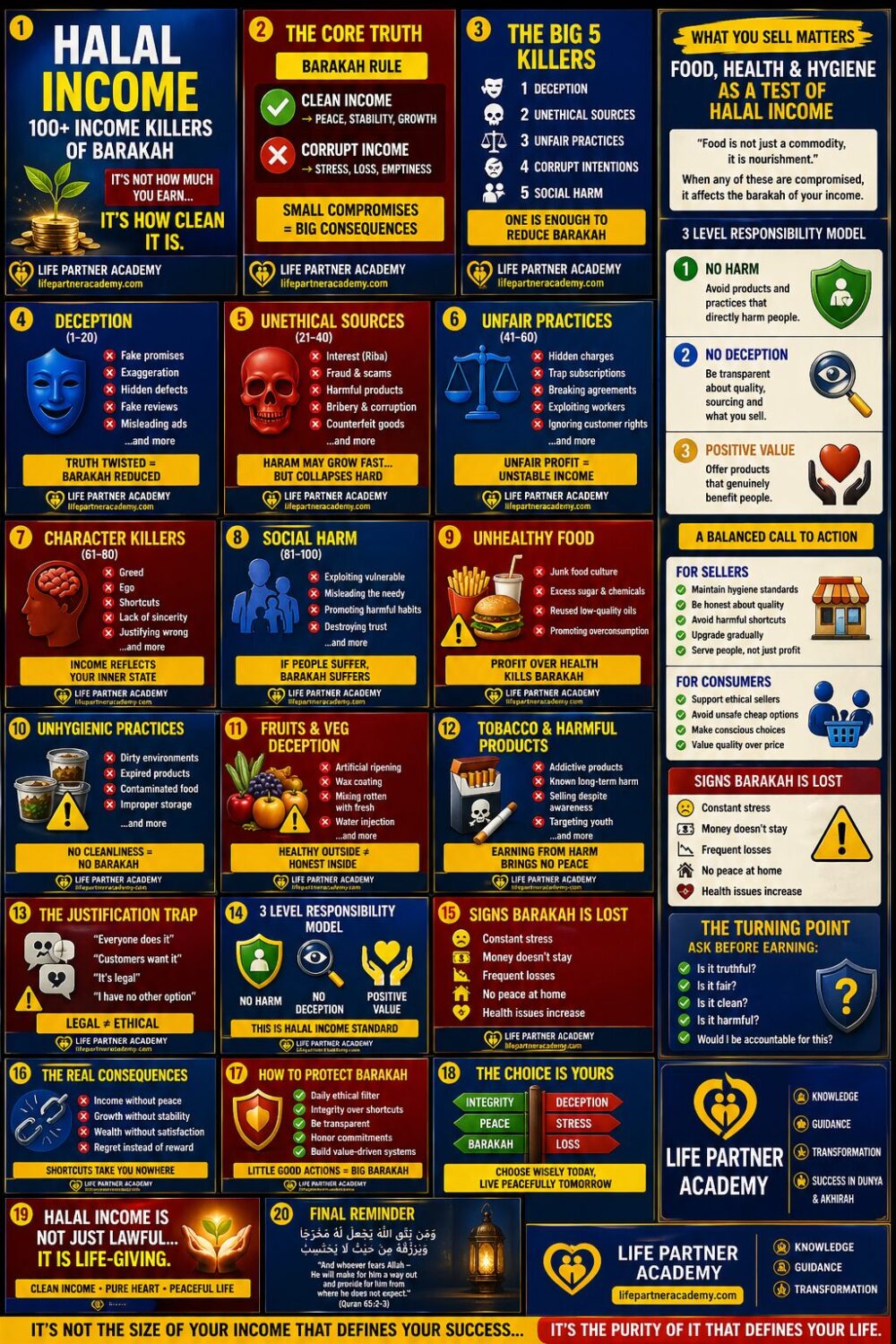
Introduction
Happiness and contentment in life go hand in hand with halal income. They are inseparable like two sides of the same reality. When what you earn is pure, the impact is not limited to your wealth; it reflects in your peace of mind, stability in relationships, and clarity in purpose.
In Islam, income is not just a financial matter—it is a moral and spiritual foundation of life. Halal earnings bring Barakah, a blessing that expands beyond numbers and creates ease, sufficiency, and inner satisfaction. On the other hand, income that is directly or indirectly haram may offer short-term pleasure, quick gains, or temporary comfort. But beneath that surface, it often carries hidden consequences—restlessness, instability, loss of trust, and a gradual erosion of peace. What appears as gain in the short term can turn into loss in the long term—both in this world (dunya) and in the hereafter (Aakhirah).
Halal income nurtures a life of peace and purpose. Haram income may entertain for a moment—but it empties life of its true value.
What Halal Income Really Means
In Islam, halal income is not just what you earn—it’s:
- How you earn
- What you sell
- How you sell
- What impact it creates
It must be free from:
- Interest (riba)
- Deception (gharar)
- Injustice (zulm)
- Harm to people
The 4 Pillars of Halal Earning1. Halal Source
- Product/service itself must be permissible
- No harmful, unethical, or exploitative industries
- Halal Method
- No lying, exaggeration, or manipulation
Full transparency in dealing
2. Halal Process
- Fair pricing
- No cheating in weights, contracts, or delivery
3. Halal Impact
- Does not harm individuals, families, or society
- Creates real value
4. The Hidden Equation of Barakah
The cleaner the income, the greater the Barakah—not always in amount, but in:
- Peace
- Stability
- Longevity
- Protection
5 Signs Your income has Barakah
- Money lasts longer than expected
- Fewer unexpected crises
- Peace in the home
- Children grow with better character
- Contentment even with less
5 Warning Signs of Compromised Income
- Constant financial stress despite earning well
- Frequent losses or sudden expenses
- Lack of peace at home
- Guilt or uneasiness in transactions
- Relationship conflicts increasing
The “Halal Filter” (Daily Decision Tool)
Before any earning decision, ask:
- Is it truthful?
- Is it fair?
- Is it beneficial?
- Is it clean in process?
- Would I be accountable for this?
If one answer is weak → Barakah reduces.
The Dangerous Illusion
People think:
- “Just this one shortcut…”
- “Everyone does it…”
- “I’ll fix it later…”
But in reality: One small impurity can block a large portion of Barakah. “Halal income doesn’t just grow wealth—it protects your life, your family, and your hereafter.”. “It’s not the size of your income that defines your success… it’s the purity of it that defines your life.”
TOP 100 INCOME KILLERS OF BARAKAH
Two Examples of Fraud & Deception as above.
“Those who indulge in fraud and sell, risk a path that leads to hell.”
A. DECEPTION & DISHONESTY
- Lying about product benefits
- Exaggeration in marketing
- Hiding defects
- Fake promises
- Misleading advertisements
- Fake testimonials
- False guarantees
- Manipulating facts
- Cheating in quality
- Selling imitation as original
- Misrepresenting services
- Overstating results
- Concealing risks
- Creating false urgency
- Half-truth communication
- Forging documents
- Data manipulation
- Fake certifications
- Copying branding to deceive
- Intentional misguidance
B. UNETHICAL EARNING SOURCES
- Interest-based income (riba)
- Fraudulent schemes
- Selling harmful products
- Exploitative business models
- Gambling-related income
- Bribery
- Corruption-based gains
- Theft or embezzlement
- Black money transactions
- Tax evasion
- Selling prohibited items
- Income through oppression
- Pyramid schemes
- Scams disguised as business
- Misuse of authority for gain
- Insider trading (unfair advantage)
- Fake charity collections
- Counterfeit product sales
- Manipulated bidding/contracts
- Earnings from injustice
C. UNFAIR BUSINESS PRACTICES
- Cheating in weights and measures
- Hidden charges
- Deliberate overpricing
- Price manipulation
- Delayed payments intentionally
- Breaking contracts
- Exploiting labor
- Underpaying workers
- Unclear terms & conditions
- Trap subscriptions
- Misleading discounts
- False scarcity tactics
- Ignoring customer complaints
- Refusing rightful refunds
- Selling defective goods knowingly
- Poor after-sales support
- Misuse of customer data
- Favoritism in business dealings
- Unethical competition practices
- Breach of trust
D. CHARACTER & INTENTION ISSUES
- Greed-driven decisions
- Lack of sincerity
- Intention to deceive
- Arrogance in business
- Dishonesty as a habit
- Lack of accountability
- Ignoring right and wrong
- Justifying unethical shortcuts
- Ego-based decisions
- Envy-driven competition
- Desire for quick money
- No concern for impact
- Breaking promises
- Lack of gratitude
- Ignoring ethical boundaries
- Carelessness in dealings
- Habitual lying
- No fear of consequences
- Normalizing wrong practices
- Rejecting correction
E. SPIRITUAL & SOCIAL CONSEQUENCES
- Neglecting obligations while earning
- Prioritizing money over values
- Hurting others for profit
- Causing harm to society
- Destroying trust
- Supporting harmful industries
- Encouraging unethical culture
- Exploiting vulnerable people
- Misleading the needy
- Creating dependency traps
- Ignoring fairness
- Lack of compassion
- Withholding rightful dues
- Consuming others’ rights
- Spreading injustice
- Causing long-term harm
- Ignoring moral responsibility
- Corrupting others through influence
- Building wealth without purpose
- Forgetting accountability to Allah
F. SUBTLE DECEPTION & MODERN PRACTICES
- Over-optimizing funnels to psychologically trap buyers
- Using AI/deep fake content to simulate trust falsely
- Data-driven manipulation of customer emotions
- Personalization used to exploit weaknesses
- Hiding behind “terms & conditions” to justify unfairness
- Creating dependency instead of solving problems
- Selling aspiration instead of actual value
- Overpromising transformation (especially in coaching/training)
- Monetizing insecurity (fear, looks, status, loneliness)
- Packaging ordinary things as “exclusive secrets”
G. TIME, TRUST & RESPONSIBILITY ABUSE
- Wasting clients’ time knowingly
- Delivering late without genuine reason
- Taking advance payment without capacity to deliver
- Ghosting clients after payment
- Overbooking beyond capability
- Lack of professionalism in commitments
- Treating small clients with neglect
- Not honoring verbal agreements
- Careless errors that harm clients
- Ignoring long-term consequences of your service
H. INTERNAL BUSINESS CORRUPTION
- Toxic workplace culture
- Exploiting employees emotionally
- Not paying salaries on time
- Favoritism instead of merit
- Overworking staff without fairness
- Taking credit for others’ work
- Internal dishonesty within teams
- Training employees in unethical selling
- Normalizing shortcuts as “smart work”
- Building a system that rewards unethical behavior
The Deeper Reality Most Miss
At this level, the issue is no longer just “haram vs halal.”
It becomes:
- Integrity vs manipulation
- Value vs exploitation
- Responsibility vs greed
CONCLUSION:
This is why we often see a striking reality across society—from those at the lowest rung to the wealthiest, even among those at the pinnacle of power. Many may have money, status, and access to every comfort, yet something essential is missing: peace, happiness, and true contentment. When the source of income is unclear, compromised, or ignored—whether knowingly or through neglect—the impact is not always immediate, but it is inevitable. Wealth may grow, but inner stability weakens. Success may appear visible, but satisfaction remains absent.
In Islam, the question is not just how much we earn, but how conscious we are about what we earn and how we earn it. Awareness is the turning point. Reflection is the beginning of change. A life filled with everything but peace is not success—it is a warning.
True success lies in:
- Earning with integrity
- Choosing what is halal with conviction
- Letting go of what compromises Barakah
Because in the end: Halal income may seem slower, but it builds a life that is stable, meaningful, and deeply fulfilling—both in this world and the hereafter.