
Marriage Reference Verification
Why We Verify Employees Better Than Life Partners
Introduction
In the professional world, hiring an employee is rarely left to chance. Organizations invest time, structure, and rigor into employment verification—checking credentials, validating past experience, speaking to previous employers, and sometimes even conducting background and behavioral assessments. A candidate may appear impressive in interviews, but companies understand a critical truth: what is seen in a short interaction is not always what is lived over time. That is why references matter. They provide insight into consistency, integrity, and conduct under real conditions.
Ironically, when it comes to one of the most consequential decisions in life—marriage—the same level of diligence is often missing. Families rely on surface impressions, informal conversations, or loosely gathered opinions rather than structured verification. A few pleasant meetings, a well-spoken personality, or a respectable family background are often taken as sufficient indicators of lifelong compatibility.
This contrast raises an uncomfortable but necessary question:
Why do we verify an employee more rigorously than a life partner? Marriage is not a short-term contract; it is a lifelong commitment that involves emotional, psychological, financial, and spiritual dimensions. If employment demands verification for stability, marriage demands it for sustainability.
From Employment Verification to Marriage Proposal References
In employment, references are not optional—they are foundational. Employers typically seek feedback from supervisors, colleagues, and HR records to understand:
- Work ethic
- Reliability
- Behavior under stress
- Interpersonal dynamics
- Ethical conduct
These references are structured, intentional, and often cross-verified. A single strong recommendation is rarely enough; consistency across multiple sources builds credibility. Now compare this with marriage proposals. In many cases, reference checks—if done at all—are informal and inconsistent. Families may speak to a distant acquaintance, a casual business contact, or someone who “knows the family.” Sometimes, even these checks are bypassed entirely in favor of assumptions based on status, education, or appearance. This shift from structured verification to casual inquiry introduces significant risk.
The Ideal Reference: The Role of the Masjid
Traditionally, the local Masjid held a central role in community life. It was not only a place of worship but also a hub of social awareness and moral observation. The Imam and regular attendees often had long-term visibility into individuals’ behavior.
A Masjid-based reference, in its ideal form, offers insight into:
- Consistency: Does the individual show up regularly or only occasionally?
- Discipline: Is there a pattern of commitment and punctuality?
- Conduct: How does the person interact with others in a shared sacred space?
- Reputation: What is the general perception within the community?
Unlike curated interactions, the Masjid reflects unfiltered patterns over time. It answers a deeper question: Who is this person when no one is evaluating them for a proposal? However, while the Masjid should be the strongest reference point, in many cases today, it is not utilized effectively.
The Shift to Informal References
Instead of structured or community-based verification, families often rely on:
- Shopkeepers
- Vendors
- Casual acquaintances
- Distant relatives
These sources are chosen because they are accessible and easy to approach. Conversations are informal, quick, and non-confrontational. But convenience comes at a cost.
A shopkeeper may describe someone as polite and respectful—but their interaction is limited to transactions. A colleague may praise professionalism—but may not know personal habits or emotional patterns. A distant relative may provide a positive opinion—but may lack recent or direct knowledge. These references answer the question: “How does this person appear?” But they fail to answer: “How does this person behave over time, especially in difficulty?”
The Risk of Surface-Level Verification:
Marriage is not lived in moments of politeness; it is lived in moments of pressure, disagreement, and vulnerability. When references are shallow, several critical areas remain unchecked:
- Emotional Regulation: How does the person handle anger, frustration, or disappointment?2.
- Conflict Behavior: Do they resolve disagreements constructively or escalate them?3.
- Responsibility: Are they consistent in fulfilling commitments beyond appearances?4.
- Hidden Habits: Are there invisible patterns—addictions, dependencies, or unhealthy coping mechanisms?
- Interpersonal Dynamics: How do they treat those they do not need to impress?
Surface-level references rarely reveal these dimensions. As a result, families may unknowingly approve proposals based on incomplete information.
Why the Gap Exists
The gap between employment verification and marriage verification is not accidental. It stems from several underlying factors:
- Social Discomfort: Asking detailed questions about a prospective bride or groom can feel intrusive. Families worry about offending others or appearing distrustful.
- Lack of Structured Frameworks: Unlike employment processes, marriage verification lacks standardized methods. Each family relies on its own approach, often without clear guidelines.
- Time Pressure: Proposals are sometimes rushed due to age, social expectations, or emotional involvement, reducing the depth of verification.
- Overreliance on Appearances: Education, income, and family status are often mistaken for character indicators.
- Weak Community Connections: In many modern settings, individuals are not deeply integrated into a single community, making it harder to find reliable long-term observers.
Towards a Structured Marriage Reference System
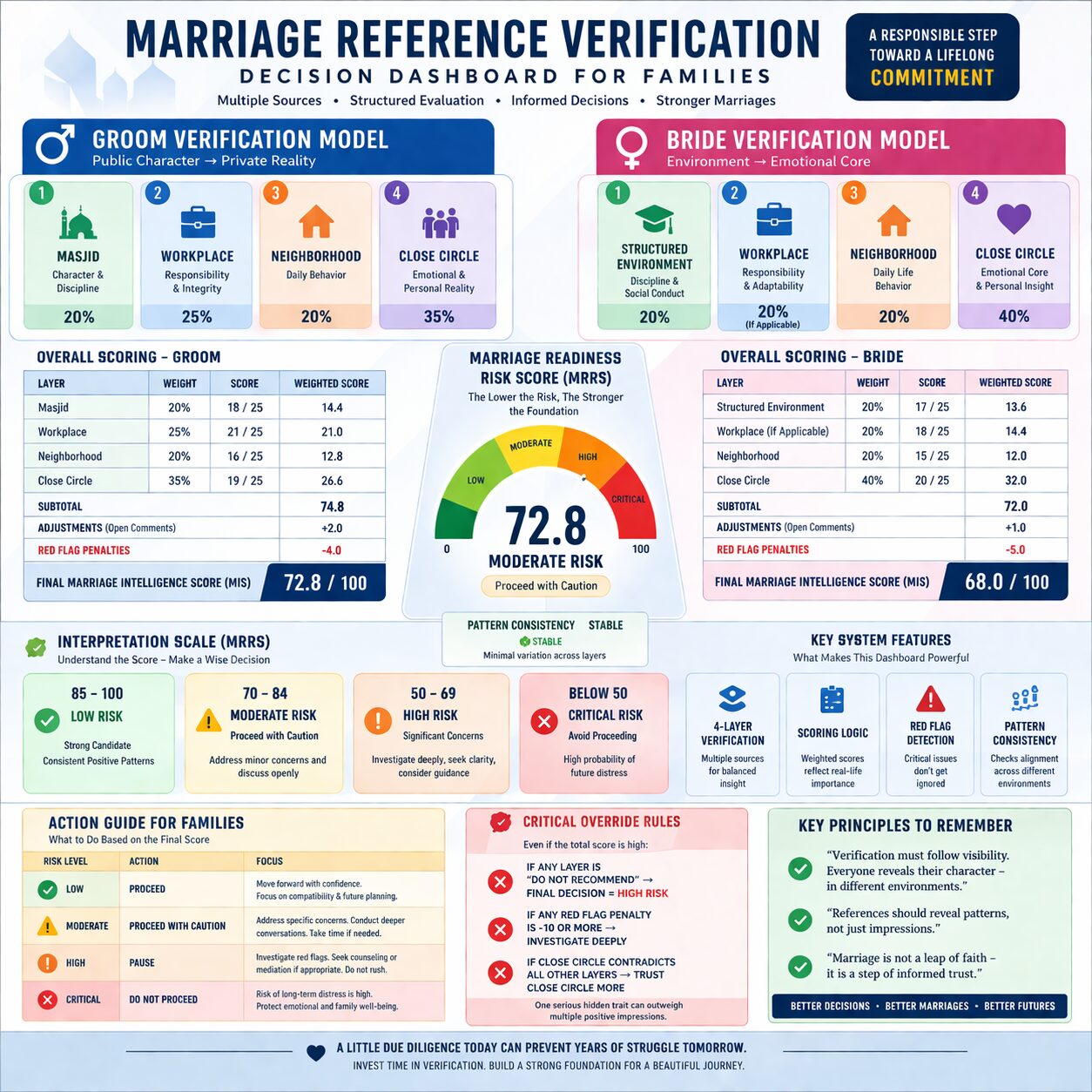
To reduce risk and improve decision-making, marriage reference verification must evolve into a multi-layered process.
Layer 1: Community Reference (Masjid or Equivalent):
This provides a baseline of consistency and public conduct.
Layer 2: Professional Reference:
Workplace insights reveal:
- Accountability
- Work ethic
- Behavior under pressure
Layer 3: Neighborhood Reference
Neighbors observe:
- Daily routines
- Family interactions
- Behavioral patterns over time
Layer 4: Close Circle Reference
Friends and close associates can provide insight into:
- Emotional maturity
- Personal habits
- Conflict tendencies
Each layer answers a different dimension of character. Together, they form a comprehensive profile.
The Cost of Neglecting Verification
When proper verification is ignored, the consequences often surface after marriage:
- Unexpected behavioral patterns
- Emotional incompatibility
- Hidden habits becoming visible
- Conflicts escalating due to poor coping mechanisms
At this stage, the cost is no longer just informational—it becomes emotional, relational, and sometimes legal. A decision that could have been strengthened through verification turns into a long-term struggle.
A Mind-set Shift: From Trust to Verified Trust
Marriage should not be built on suspicion—but neither should it be built on blind trust.
The goal is verified trust.
- Trust that is informed
- Trust that is cross-checked
- Trust that is based on patterns, not impressions
This approach does not weaken relationships; it strengthens them by ensuring that expectations are grounded in reality.
Practical Questions for Families
Before finalizing a proposal, families should ask:
- Have we spoken to someone who has observed this person consistently over time?
- Are we relying on multiple independent references, or just one?
- Have we verified behavior in different environments (home, work, community)?
- Are we evaluating character, or being influenced by comfort and convenience?
These questions act as a simple but powerful filter.
Conclusion: Raising the Standard
The contrast between employment verification and marriage verification highlights a critical imbalance. One determines a career path; the other shapes an entire life. If organizations refuse to hire without proper checks, families should be even more cautious when approving a marriage.
The solution is not complexity—it is intentionality.
- Move from casual inquiry to structured verification
- Combine multiple perspectives
- Focus on patterns, not performances
Because ultimately: A reference does not just confirm who a person is—it reveals who they are likely to be when life is no longer ideal. And in marriage, that is the reality that matters most.