
Married Toddlers: The Hidden Immaturity That Silently Destroys Adult Marriages
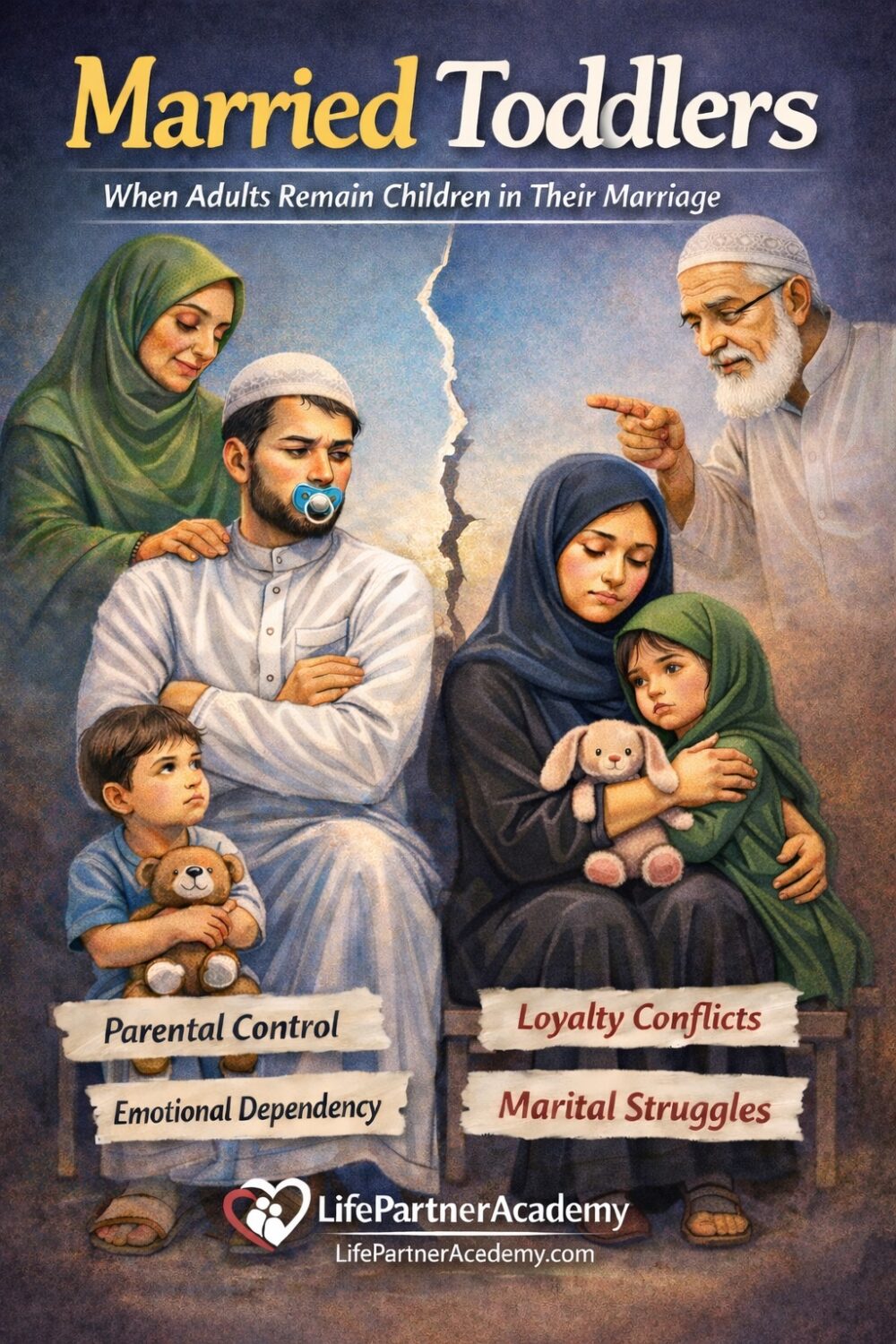
Introduction: Married in Name, Children in Psychology
Across cultures — especially in India and South Asia — marriage is seen as a major milestone of adulthood. A person is considered settled, responsible, and mature once they are married. Yet in reality, many marriages quietly suffer because one or both spouses are still emotionally functioning as children. They may have adult bodies, adult jobs, and adult responsibilities — but psychologically, they are still toddlers in their parents’ emotional world.
This phenomenon, which we can call “Married Toddlers,” is one of the most under-discussed but destructive dynamics in modern marriages. It does not always show up as open conflict. Often, it appears as silent resentment, emotional withdrawal, chronic dissatisfaction, and a sense that the marriage never truly becomes a strong, independent unit.
The tragedy is this: many couples love each other — but their marriage is slowly suffocated by emotional immaturity and misplaced loyalty.
What Does “Married Toddler” Really Mean?
A married toddler is not someone who is childish in behavior. It is someone who has not completed the psychological transition from child to adult partner.
Such a person:
- Still seeks parental approval for major decisions
- Feels guilty prioritizing their spouse over parents
- Avoids disagreeing with parents out of fear
- Allows parents to influence or control marital life
- Struggles to form an independent marital identity
In short, they are married legally — but emotionally, they are still living in their parents’ house.
The Emotional Umbilical Cord That Was Never Cut
In healthy development, emotional independence is a gradual process. Children grow into adults who can think independently, make decisions, tolerate disagreement, and carry responsibility for their own lives.
But in many families, especially highly involved or controlling ones, this emotional separation never fully happens. The adult child remains emotionally fused with their parents. Psychologists call this emotional enmeshment.
In enmeshment:
- Boundaries are weak
- Guilt is used to control behavior
- Obedience is confused with maturity
- Disagreement is seen as disrespect
- Independence is seen as rebellion
When such a person gets married, the emotional umbilical cord is still attached — and the marriage is forced to compete with it.
Why This Is Especially Common in Our Cultural Context
In Indian and South Asian societies, family bonds are strong — which is beautiful. However, strong bonds sometimes turn into unhealthy emotional dependence.
Cultural messages often include:
- “Parents know best”
- “Never say no to elders”
- “Family comes before everything”
- “Sacrifice your happiness for parents”
While respect for parents is important, these messages can prevent the psychological transition needed for a healthy marriage. Marriage is not meant to be an extension of childhood. It is meant to be the beginning of adult partnership.
The Loyalty Conflict That Slowly Kills Intimacy
Every marriage requires a clear shift in primary loyalty. Not abandonment of parents — but reordering of priorities.
When this shift does not happen:
- The spouse never feels truly chosen
- Trust weakens
- Emotional safety reduces
- Intimacy suffers
- The couple never becomes a true team
A marriage where parents have veto power over decisions is not a marriage. It is a committee. Over time, the spouse begins to feel like a secondary character in their own marriage.
How Married Toddler Behavior Shows Up in Daily Life
- Decision Paralysis
Simple and major decisions are delayed because:
- “I need to ask my parents.”
- “My parents may not like this.”
- “Let me see what my family says.”
The spouse feels married to a child who cannot lead or decide.
- Financial Infantilization
Parents control or influence:
- Salary usage
- Savings and investments
- Major purchases
- Housing decisions
This destroys financial trust and adult responsibility within the marriage.
- Family Court Marriages
Instead of resolving conflicts privately:
- Problems are shared with parents
- Parents take sides
- Private matters become public
- The marriage becomes a courtroom
This is one of the fastest ways to poison respect and emotional safety.
- Lack of Spousal Protection
The married toddler fails to:
- Stop parents from criticizing spouse
- Set boundaries
- Protect spouse’s dignity
The spouse feels exposed, unsafe, and unsupported.
5. The Silent Emotional Cost to the Spouse
Being married to a married toddler creates:
- Chronic frustration
- Emotional loneliness
- Loss of respect
- Reduced attraction
- Growing resentment
- Feeling like an outsider
Many spouses stop fighting. They emotionally withdraw. The marriage becomes polite, cold, and mechanical.
The Identity Problem: No “We,” Only “My Family”
Healthy marriages create a new identity:
- Our home
- Our rules
- Our priorities
- Our direction
Married toddlers remain stuck in:
- My parents’ way
- My family’s rules
- My house culture
Without a shared marital identity, there is no shared future vision.
The Spiritual and Universal Principle: Leaving to Build
Across faiths and cultures, a universal wisdom exists: To build a new home, you must emotionally leave the old one.
This does not mean abandoning parents. It means:
- Reordering loyalty
- Building adult responsibility
- Creating emotional independence
- Establishing marital leadership
Without this leaving, marriage remains a branch — not a tree.
Why Some Parents Struggle to Let Go
Some parents:
- Fear loneliness
- Fear loss of control
- Fear emotional abandonment
- Tie identity to child’s obedience
- Use guilt to maintain closeness
While this may come from fear or love, it is still harmful to the child’s marriage. A parent who cannot release their child is not preparing them for adulthood — they are keeping them emotionally small.
The Gendered Reality
Married Sons
May remain emotionally attached to mother:
- Mother becomes emotional partner
- Wife becomes secondary
- Boundaries blur
- Emotional triangulation becomes normal
Married Daughters
May remain emotionally controlled:
- Guilt-driven obedience
- Fear of displeasing parents
- Difficulty asserting marital needs
- Chronic internal conflict
Both patterns damage marital stability.
What Emotional Adulthood in Marriage Looks Like
A psychologically adult spouse:
- Makes decisions jointly with spouse
- Sets respectful boundaries with parents
- Protects marital privacy
- Prioritizes spouse emotionally
- Handles conflicts within marriage
- Can tolerate parental disappointment
- Takes responsibility for consequences
This is not disrespect. This is maturity.
A Hard Truth
If you are married but:
- Cannot say no to parents
- Cannot prioritize spouse
- Cannot make independent choices
- Cannot protect marital boundaries
Then you are not fully married psychologically. You are still living as a child — playing adult roles.
How to Begin the Transition from Toddler to Adult Partner
- Acknowledge the problem honestly
- Identify guilt-based control patterns
- Practice small boundary-setting
- Prioritize private conflict resolution
- Shift from “my family” to “our family”
- Accept discomfort as part of growth
- Choose marriage daily — not parents’ approval
Growth is uncomfortable. Immaturity is comfortable — but costly.
Final Thoughts: Marriage Requires Grown People
Marriage does not need perfect people.
It needs grown people.
- Two adults who choose each other.
- Two adults who protect each other.
- Two adults who build a home — not extend their childhood.
If your marriage feels stuck, cold, or powerless, ask yourself: Am I living as a spouse — or as a married toddler? Because you cannot build an adult marriage with a child’s emotional wiring.