
Obligatory Dunya, Optional Deen: The Root of Many Problems in the Muslim World
Introduction
In almost every Muslim household today, there is a clear and visible priority: academic success. From the moment a child enters school, parents begin planning the child’s educational journey. Years of schooling, tuition classes, coaching centers, competitive exams, and university degrees become part of a carefully structured path designed to secure a stable future.
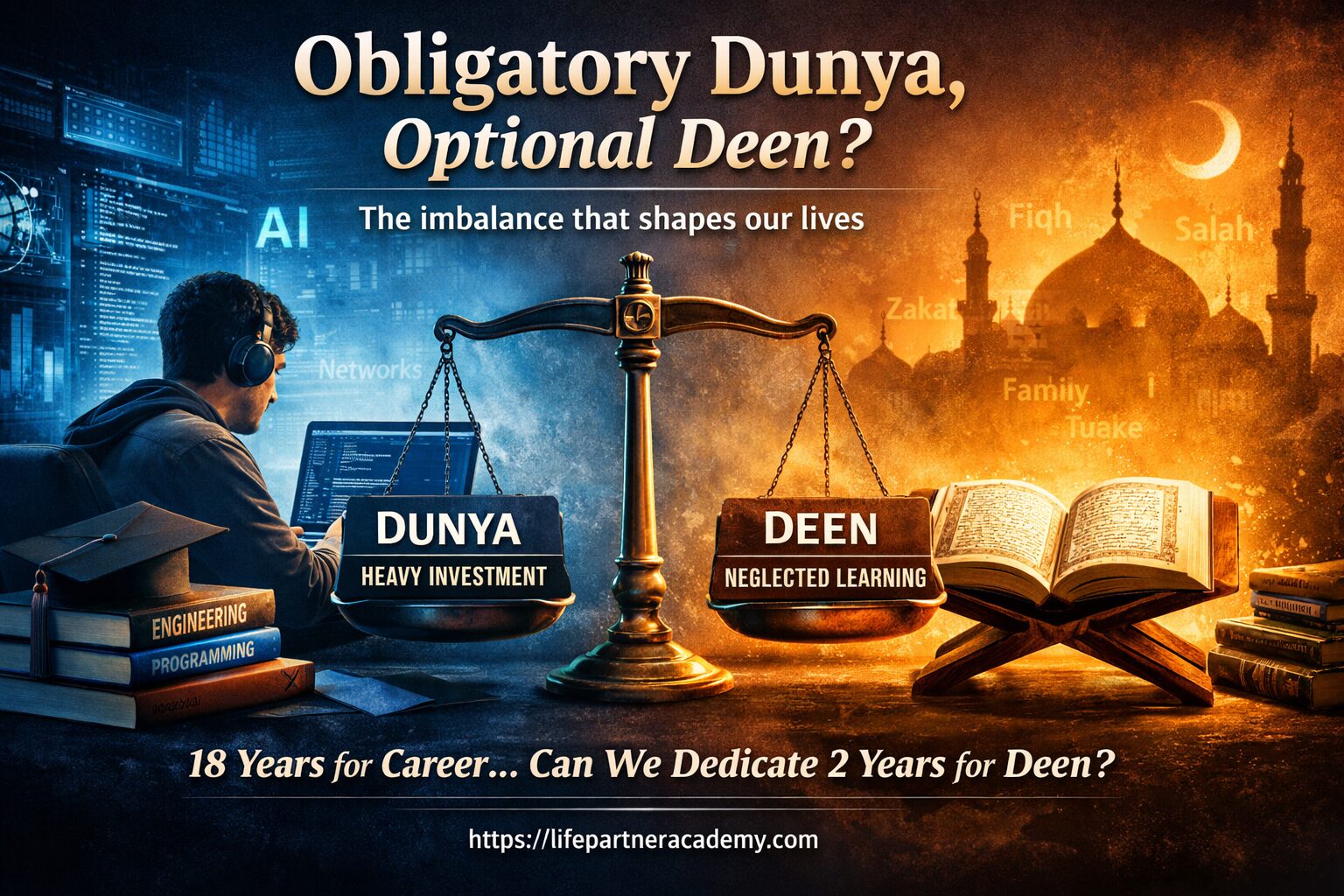
Parents invest enormous amounts of time, money, and emotional energy to ensure that their children receive the best possible worldly education. The underlying belief is simple: education leads to employment, employment leads to financial stability, and financial stability leads to a comfortable life. But an important question arises. While we treat worldly education as obligatory, why is the knowledge of Deen often treated as optional?
This imbalance between Dunya (worldly knowledge) and Deen (religious knowledge) has created serious challenges within Muslim societies. Families excel in professional achievements but often struggle with basic Islamic practices, ethical conduct, family harmony, and understanding of halal and haram.
The reality is that Islam never intended Muslims to neglect worldly education. At the same time, it never intended for the knowledge of Deen to be marginalized or treated as secondary. A balanced Muslim life requires both. Understanding this imbalance is the first step toward correcting it.
The Long Academic Journey for Worldly Success
Consider the educational path of a student who eventually becomes a computer engineer. The journey begins early in life, often at the age of three or four, when the child enters kindergarten. Over the next 15 to 18 years, the student progresses through primary school, secondary school, and higher secondary education before finally entering university. During this time, the student studies many academic subjects and develops the skills required for a professional career.
For example, a student pursuing computer engineering may study topics such as:
- Data Structures and Algorithms
- Operating Systems
- Computer Networks
- Database Management Systems
- Object-Oriented Programming
- Artificial Intelligence
- Machine Learning
- Cybersecurity and Ethical Hacking
- Cloud Computing
- Distributed Systems
- Software Engineering
- Computer Architecture
- Compiler Design
- Theory of Computation
- Digital Logic Design
- Microprocessors and Microcontrollers
- Embedded Systems
- Internet of Things
- Human Computer Interaction
- Big Data Analytics
- Blockchain Technology
- Computer Graphics
- Natural Language Processing
- Quantum Computing
- Mobile Application Development
Each of these subjects requires years of structured learning, examinations, projects, and practice. Parents willingly support this journey. They pay school fees, purchase books, arrange tutoring, and ensure that the child has every resource needed to succeed. Society collectively treats this entire journey as necessary and obligatory because it leads to professional success and financial stability. No one questions this commitment.
But when it comes to learning the fundamentals of Islam, the approach is very different.
The Casual Approach Toward Learning Deen
While worldly education receives careful planning and long-term dedication, Islamic education is often approached casually.
Many Muslims learn only a small portion of their religion, often through:
- Friday sermons
- occasional religious lectures
- Ramadan talks
- short courses
- social media reminders
Although these sources can be beneficial, they cannot replace structured learning. Islam is not a small subject that can be understood through occasional listening. It is a complete way of life that governs every aspect of human existence, including worship, family life, financial dealings, social responsibilities, and preparation for the hereafter. Yet many Muslims reach adulthood without learning the fundamental principles necessary to live according to Islamic teachings. This is not because Islam is difficult to learn. It is because we have subconsciously categorized it as optional knowledge.
The Breadth of Essential Islamic Knowledge
Islamic knowledge is vast and comprehensive. Even a basic understanding of Islamic jurisprudence reveals that there are numerous essential topics every Muslim should know in order to live according to the Qur’an and Sunnah.
These topics include areas such as:
- Aqidah (foundations of faith)
- Purification (Taharah)
- Prayer (Salah)
- Fasting (Sawm)
- Charity (Zakat)
- Pilgrimage (Hajj and Umrah)
- Halal and haram food
- Personal lifestyle and modesty
- Marriage and family life
- Divorce and separation
- Financial dealings and business ethics
- Social responsibilities
- Birth and upbringing of children
- Death, burial, and inheritance
From the moment a child is born until the moment a person is buried, Islam provides guidance for every stage of life. Without learning these teachings, many Muslims simply do not know how to live according to Islam.
Accountability: The Forgotten Responsibility of Parents
One of the most serious aspects of this discussion is accountability on the Day of Judgment. On that Day, every individual will stand before Allah and answer for the responsibilities entrusted to them. Among the greatest of these responsibilities is the religious upbringing of one’s children. Interestingly, no parent will be questioned for not making their child an engineer, doctor, or scientist. But parents will certainly be accountable if they neglect to teach their children the fundamentals of Islam.
If parents focus exclusively on academic education while treating Deen education as optional, children may grow up with professional degrees but without understanding how to live as practicing Muslims. As a result, they may unknowingly fall into serious errors such as shirk, bid‘ah, or other sins due to ignorance. This ignorance does not arise from bad intentions but from lack of knowledge.
The Central Role of Fiqh in Daily Life
Fiqh is the practical framework that helps Muslims live according to Islam.
Without knowledge of Fiqh:
- If a Muslim does not understand Taharah, their acts of worship may be invalid.
- If they do not know the rules of Wudu and Ghusl, their prayers may not be valid.
- If they lack knowledge of fasting, they may unknowingly invalidate their fasts.
- If they do not understand Zakat, they may fail to fulfill one of the pillars of Islam.
Similarly, ignorance of Islamic rulings can lead to serious problems in family life. Without understanding the Fiqh of marriage, intimacy, divorce, and Khula, individuals may unknowingly commit sins or remain in relationships that are not permissible. Without knowledge of rulings related to Ramadan, Zakat, Qurbani, Umrah, Hajj, birth, and death, how can a Muslim properly live their life?
This knowledge is not optional. It is essential.
The Qur’an Emphasizes the Importance of Knowledge
Islam places extraordinary importance on knowledge.
- The first revelation of the Qur’an began with the command: “Read in the name of your Lord who created.” (Qur’an 96:1)
- Allah also says: “Allah will raise those who have believed among you and those who were given knowledge by degrees.” (Qur’an 58:11)
- Allah further instructs the Prophet ﷺ to make this supplication: “My Lord, increase me in knowledge.” (Qur’an 20:114)
- And Allah says: “Only those fear Allah, from among His servants, who have knowledge.”
(Qur’an 35:28)
These verses show that knowledge elevates believers and deepens their awareness of Allah.
Hadith on the Obligation of Seeking Knowledge
- The Prophet ﷺ emphasized the importance of learning Deen.
- He said: “Seeking knowledge is an obligation upon every Muslim.” (Ibn Majah)
- He also said: “Whoever travels a path in search of knowledge, Allah will make easy for him a path to Paradise.” (Sahih Muslim)
- Another narration states: “The angels lower their wings for the seeker of knowledge out of pleasure with what he does.” (Abu Dawud)
- And the Prophet ﷺ said: “The superiority of the scholar over the worshipper is like the superiority of the moon over the stars.” (Tirmidhi)
These teachings clearly demonstrate that seeking knowledge of Deen is a path to Paradise.
Why Islamic Education Matters More Than Ever
In today’s world, Muslim families spend enormous amounts of money on academic education. From kindergarten to Class 12, many parents invest lakhs of rupees to ensure their children receive the best schooling possible.
In many cases the cost can reach:
- ₹30 lakhs per child for around 12 years in convent or private schools
- ₹60 lakhs or more per child in international schools
Parents willingly make these sacrifices because they believe education secures their children’s future. Yet when it comes to Islamic education, the situation is very different. Most children attend Maktab classes for only one or two years, costing only a few thousand rupees. In many cases Islamic education stops after children learn:
- basic Qur’an recitation
- a few daily duas
- elementary fiqh rules
This imbalance raises an important question: How can the Muslim community expect to live Islam, follow Islam, and transmit Islam across generations when Islamic learning is so neglected? Islam is not a culture that can simply be inherited. Islam is a complete way of life that must be learned, understood, and practiced. Without education, faith can easily become ritualistic and shallow, leaving Muslims vulnerable to adopting values that conflict with Islamic teachings.
The Current Reality
The contrast between worldly and religious education is striking.
Academic Education
Parents sacrifice:
- wealth
- time
- effort
- personal comfort
To ensure children excel academically.
Islamic Education
Islamic learning often remains limited to early childhood exposure. The result is a generation of Muslims who may become doctors, engineers, scientists, or entrepreneurs, yet struggle with essential aspects of religious life.
Many young Muslims today:
- struggle to perform prayer correctly
- do not understand marriage rights
- are unaware of halal and haram in finance
- lack knowledge of Islamic parenting
- feel disconnected from the Qur’an beyond recitation
This situation is not sustainable. A house without foundations collapses. Similarly, a community that neglects its Deen risks losing its identity.
A Step toward Structured Islamic Learning
Recognizing this need, I have compiled two books designed to provide structured Islamic learning across different stages of life.
A Deendar Muslim – Volume 01
From Birth to Age 14: This book provides a step-by-step guide for nurturing Islamic values and character in children from early childhood.
It includes guidance on:
- Qur’an learning
- daily duas
- Islamic manners
- modesty and discipline
- foundational fiqh
- family values
The aim is to build a strong Islamic foundation during childhood.
A Deendar Muslim – Volume 02
A Guide for Youth Aged 15 to 25: The second volume focuses on the important years of youth.
It offers a year-by-year Islamic development framework covering:
- Seerah of the Prophet ﷺ
- Hadith studies
- character development
- family responsibilities
- life decisions
- personal discipline and purpose
Together, these books help provide a structured pathway for learning the basics of Islam.
Conclusion: The Balance That Islam Teaches
The ideal Muslim is not someone who chooses between Deen and Dunya. The ideal Muslim combines both.
Such a person becomes:
- a skilled professional
- a responsible family member
- an ethical businessperson
- a compassionate member of society
- and a conscious servant of Allah
If Muslim families dedicate even a small portion of their lives to learning the fundamentals of Islam, the impact will be profound. Families will become stronger. Communities will become more united. And individuals will live with clarity, purpose, and obedience to their Creator. Because when knowledge of Deen enters a home, it brings guidance, stability, and blessings. And when Muslims understand their religion, they no longer wander through life in confusion. They live with purpose. They prepare for the Day when every soul will stand before Allah. On that day, our careers and degrees will not matter. What will matter is whether we lived our lives with knowledge, sincerity, and obedience to our Creator.