
Ramadan The Divine Balance of “More” and “Less”
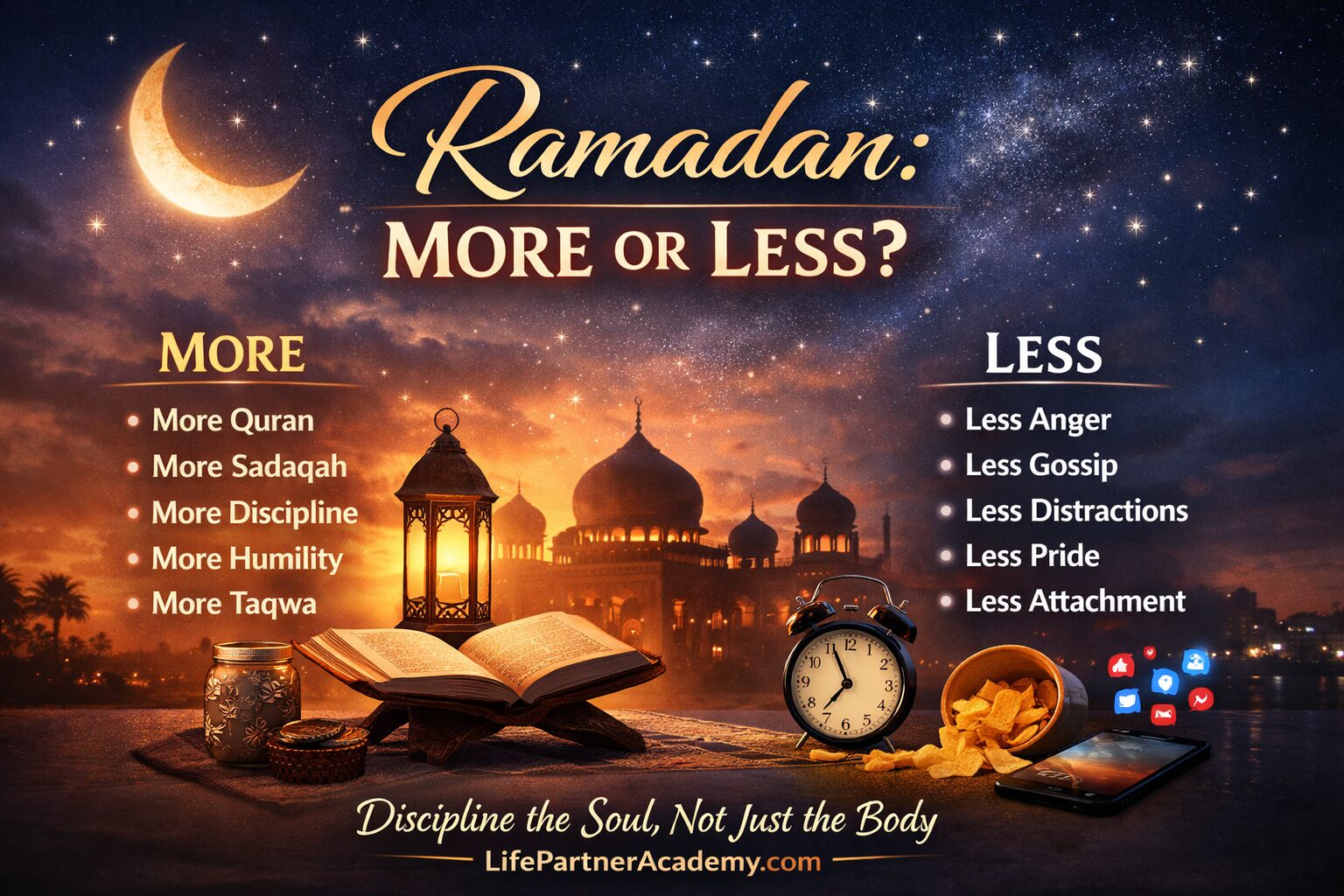
Ramadan is often described as the month of fasting. But in reality, fasting is only the doorway — not the destination. The true spirit of Ramadan lies in a powerful recalibration of life itself: more of what elevates the soul, and less of what enslaves it. Ramadan is not simply about abstaining from food and drink. It is about redesigning priorities. It is about spiritual restructuring. It is about consciously choosing “more” and “less” in the right places. This is the month where the believer learns that growth is not always about addition — sometimes it is about subtraction.
More ‘Ibadah — But With Depth
Ramadan calls for more salah, more dua, more recitation of the Qur’an, more dhikr, more night prayers. But the goal is not quantity alone. The goal is quality. Many increase their worship but forget to increase presence. Lips move, but hearts wander. Pages turn, but minds drift. The reform Ramadan demands is not mechanical repetition, but spiritual immersion.
- More khushu’ in prayer.
- More reflection in Qur’an recitation.
- More tears in private dua.
- More sincerity than show.
Ramadan teaches that true worship is not measured by how long you stand, but by how deeply you connect.
More Qur’an — Less Noise
Ramadan is the month in which the Qur’an was revealed. Yet ironically, it has become the month of maximum distraction for many.
The reform mind-set asks:
- More time with revelation.
- Less time with notification.
- More pondering verses.
- Less scrolling timelines.
The Qur’an speaks about purpose, patience, accountability, and the Hereafter. Social media speaks about trends, comparison, vanity, and instant gratification. One nourishes the soul. The other feeds the ego. Ramadan is the opportunity to shift allegiance.
More Sadaqah — Less Attachment
Generosity flows more freely in Ramadan. Hearts soften. Hands open. But charity is not only financial.
- More financial sadaqah.
- More emotional support.
- More forgiving others.
- More feeding the hungry.
- More checking on relatives.
At the same time:
- Less attachment to wealth.
- Less obsession with accumulation.
- Less pride in giving.
True charity purifies the giver before it benefits the receiver. Ramadan teaches that what we give away is what truly remains for us.
More Discipline — Less Desire
Fasting is a training ground. When a person can stay away from halal food and drink for hours, they prove they can stay away from haram all year.
Ramadan builds:
- More self-control.
- More restraint.
- More control over anger.
- More mastery over desires.
And it demands:
- Less impulsiveness.
- Less uncontrolled appetite.
- Less reacting emotionally.
- Less surrendering to temptations.
If someone fasts yet cannot control their tongue, temper, or ego, then hunger has occurred — but reform has not. Ramadan is not starvation. It is self-governance.
More Humility — Less Ego
Hunger humbles the powerful. Thirst softens the arrogant. Long nights remind us of our dependence. Ramadan is a month of ego reduction.
- More humility in speech.
- More gentleness in disagreement.
- More awareness of personal flaws.
- More willingness to apologize.
And definitely:
- Less arguments.
- Less showing off worship.
- Less “I am right” mentality.
- Less public displays of piety.
The loudest Ramadan is not the most accepted Ramadan. The quiet heart that reforms is closer to transformation than the loud tongue that debates.
More Taqwa — Less Carelessness
The ultimate goal of fasting, as stated in the Qur’an, is Taqwa — God-consciousness.
Taqwa means living with awareness that Allah sees you — in public and in private.
- More consciousness in business dealings.
- More honesty in transactions.
- More modesty in behavior.
- More guarding of the gaze.
- More integrity when no one is watching.
And in contrast:
- Less lying.
- Less cheating.
- Less cutting corners.
- Less hypocrisy.
Ramadan is not successful if it remains confined to the masjid but disappears in the marketplace.
More Reflection — Less Routine
Many people experience Ramadan as a routine:
- Suhoor.
- Fasting.
- Iftar.
- Taraweeh
- Repeat.
But reform requires reflection.
- More self-accountability.
- More reviewing personal weaknesses.
- More asking: “What must change in me?”
- More strategic spiritual planning.
And therefore:
- Less robotic rituals.
- Less cultural display.
- Less focusing only on food preparations.
- Less competition over Iftar menus.
Ramadan should not become a culinary festival. It should become a character workshop.
More Character — Less Consumption
- Overindulgence has quietly entered Ramadan culture.
- Multiple dishes at Suhoor.
- Excessive spreads at Iftar.
- Food wastage.
- Late-night entertainment.
While fasting reduces intake by day, indulgence sometimes multiplies it by night.
True reform means:
- More moderation.
- More gratitude for simple meals.
- More awareness of the hungry.
- More simplicity.
And certainly:
- Less waste.
- Less extravagance.
- Less turning Ramadan nights into entertainment marathons.
The hunger of Ramadan is meant to awaken empathy, not create luxury cycles.
More Connection — Less Isolation
Ramadan reconnects us with Allah, but it should also reconnect us with people.
- More maintaining family ties.
- More reconciling broken relationships.
- More calling parents.
- More forgiving old disputes.
And simultaneously:
- Less grudges.
- Less ego-driven silence.
- Less delaying apologies.
- Less emotional distance.
The one who fasts but continues family feuds has missed the reform dimension of Ramadan.
The Real “More or Less”
Ramadan is not about doing more randomly and less randomly. It is about strategic spiritual adjustment.
- More of what strengthens the soul. Less of what weakens it.
- More of what builds discipline. Less of what feeds distraction.
- More preparation for the Hereafter. Less obsession with temporary pleasures.
The true success of Ramadan is not measured on Eid day by new clothes, gatherings, or celebrations. It is measured by what remains after Ramadan leaves.
If:
- You argue less,
- You control anger better,
- You pray more consistently,
- You scroll less mindlessly,
- You give more sincerely,
- You speak more gently,
Then Ramadan has succeeded. If everything returns to old patterns immediately after Eid, then Ramadan was experienced but not internalized.
Conclusion: A Blueprint Beyond 30 Days
Ramadan is not meant to be an isolated spiritual season. It is a training camp for the remaining eleven months. It teaches that a meaningful life is built on conscious “more” and disciplined “less.”
- More sincerity.
- More patience.
- More gratitude.
- More accountability.
- Less ego.
- Less distraction.
- Less excess.
- Less carelessness.
Ramadan is not about exhausting the body. It is about refining the heart. The question is not how hungry we were. The question is how transformed we became. Because in the end, Ramadan is not about more food at night or less food in the day.