
Responsibility vs Corruption in Relationships
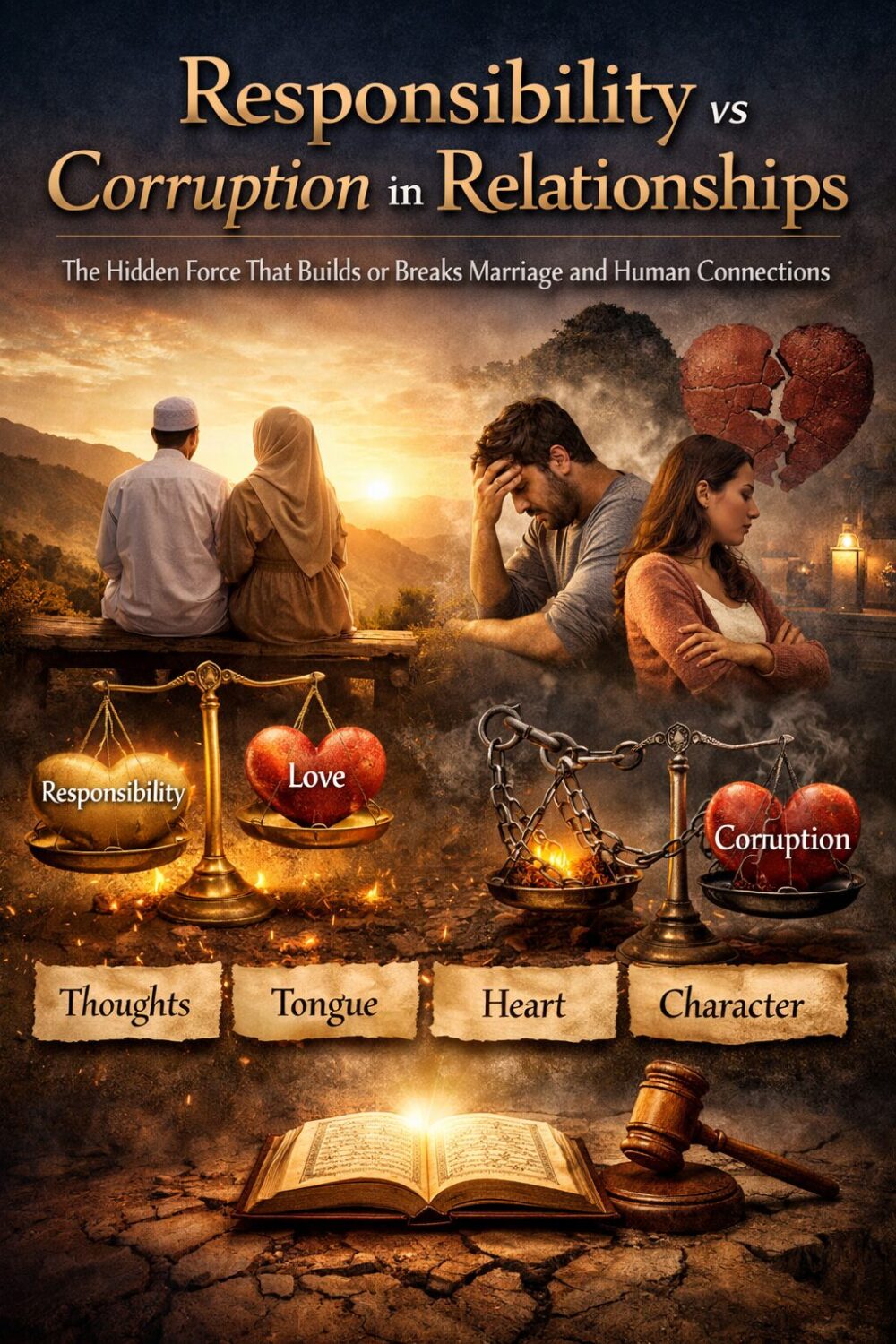
The Hidden Force That Builds or Breaks Marriage and Human Connections
Human relationships are among the most delicate and powerful elements of human life. Every relationship—whether between spouses, parents and children, friends, colleagues, or members of society—stands on an invisible foundation that determines its strength or weakness. That foundation is responsibility. When responsibility is present, relationships grow in trust, emotional security, and stability. When corruption enters, relationships slowly weaken and eventually collapse. This silent battle between responsibility and corruption shapes the quality of human connections and ultimately determines the strength of families and societies.
In today’s world, many relationships suffer not because love is absent, but because responsibility is neglected. People often expect understanding, care, loyalty, and respect from others while overlooking their own duties and behavior. Over time, small acts of irresponsibility—careless words, emotional neglect, selfish decisions, broken promises, and lack of accountability—create emotional distance. Gradually, corruption enters the relationship through negative thinking, harsh communication, ego, and weak character, damaging trust and emotional safety.
From a psychological perspective, relationships require empathy, communication, and emotional responsibility to survive. From a social perspective, strong relationships create stable families and peaceful communities. From a spiritual perspective, relationships are trusts given by Allah, and every human being is accountable for how they treat others. The Qur’an and the teachings of the Prophet Muhammad (peace be upon him) consistently emphasize kindness, justice, patience, and compassion in human interactions, especially in marriage and family life.
The battle between responsibility and corruption is most visible in relationships because relationships expose the true character of a person. A person’s real moral strength is reflected not in public success but in how they treat those closest to them. Responsible individuals build love and stability, while corrupt behavior destroys trust and emotional connection. Understanding this battle is essential for building strong marriages and healthy human relationships.
Why Spousal Relationship is Most Sensitive to Responsibility or Corruption
Marriage is not just a social contract. It is an emotional, psychological, and spiritual partnership where two individuals trust each other with:
- emotions
- dignity
- loyalty
- support
- security
- future
- family
- and life itself
This level of trust requires deep responsibility. Even small corruption in behavior can damage this trust.
For example:
- irresponsible words hurt emotions
- irresponsible actions damage trust
- irresponsible decisions create insecurity
- irresponsible behavior creates distance
Because marriage is built on daily interactions, responsibility must be present in every small action.
- Without responsibility, love cannot survive.
- Without responsibility, trust cannot grow.
- Without responsibility, peace cannot exist.
Responsibility in a Spousal Relationship
Responsibility in marriage means understanding that the spouse is not an object or a convenience but a human being with emotions, expectations, and rights.
It includes:
Responsibility in Words
Speaking respectfully, kindly, and thoughtfully.
Avoiding:
- insults
- harsh tone
- sarcasm
- humiliation
- emotional hurt
Words shape emotional safety in marriage.
Responsible speech builds love and trust.
Responsibility in Actions
Actions reflect commitment.
- Helping each other, supporting each other, fulfilling responsibilities, and caring for each other’s needs create emotional security.
- Responsible actions show love without always needing words.
- Small daily actions matter more than big occasional gestures.
Responsibility in Emotions
Understanding the emotional needs of the spouse is essential.
Providing:
- emotional support
- patience
- understanding
- empathy
- care
creates stability.
Emotional responsibility prevents loneliness inside marriage.
Responsibility in Loyalty
- Loyalty protects trust.
- Being honest, transparent, and committed builds long-term stability.
- When loyalty exists, the relationship becomes safe and peaceful.
Corruption in Spousal Relationship
Corruption in marriage does not always begin with betrayal. It begins with small moral and emotional negligence.
Corruption of Thoughts
Thinking negatively about the spouse, comparing them with others, or assuming bad intentions creates emotional distance. Negative thoughts slowly destroy love. When thoughts are corrupted, behavior follows.
Corruption of the Tongue
Harsh speech is one of the fastest destroyers of relationships.
Repeated:
- criticism
- insults
- blame
- disrespect
- shouting
Creates emotional wounds. These wounds accumulate and weaken the relationship. Sometimes relationships collapse not because of major issues, but because of daily harmful speech.
Corruption of the Heart
When ego, pride, and selfishness enter the heart, compassion disappears.
A corrupt heart becomes:
- insensitive
- self-centered
- emotionally cold
- controlling
- unkind
This destroys emotional connection.
Love cannot survive in a hardened heart.
Corruption of Character
When dishonesty, irresponsibility, and selfish behavior become part of character, marriage becomes unstable.
Examples include:
- lying
- hiding things
- ignoring responsibilities
- emotional neglect
- lack of commitment
Such behavior slowly destroys trust. Once trust breaks, rebuilding becomes very difficult.
Impact on All Relationships
The same principle applies to every relationship.
Parent-Child Relationship
- Responsible parents create confident and emotionally secure children.
- Corrupt or irresponsible behavior creates fear, confusion, and emotional damage.
- Children learn responsibility or corruption from parents.
Friendships
- Responsible friends support, guide, and protect each other.
- Corrupt friendships lead to betrayal, manipulation, and negative influence.
- Friendship survives only on responsibility and trust.
Workplace Relationships
- Responsible individuals build teamwork and respect.
- Corruption creates conflict, politics, and mistrust.
- Professional environments collapse when responsibility disappears.
Society and Community
- Responsible relationships create harmony.
- Corrupt relationships create conflict and division.
- Society is nothing more than a network of relationships.
- When relationships are responsible, society becomes peaceful.
- When relationships are corrupt, society becomes unstable.
Psychological Impact of Responsibility vs Corruption in Relationships
Responsibility Creates
- emotional safety
- trust
- stability
- mental peace
- long-term bonding
- mutual respect
- secure attachment
People feel safe and valued in responsible relationships. This leads to happiness and psychological well-being.
Corruption Creates
- anxiety
- insecurity
- emotional stress
- loneliness
- anger
- distrust
- mental exhaustion
Corrupt relationships damage mental health and emotional stability. People may stay in relationships physically but feel emotionally disconnected. This leads to silent suffering.
Spiritual Perspective
In Islam, relationships are considered trusts.
The Qur’an says: “And live with them in kindness.” (Qur’an 4:19). This emphasizes responsibility in marital relationships.
The Prophet (peace be upon him) said: “The best of you are those who are best to their families.” This shows that responsibility in relationships is a measure of character. Kindness, patience, and respect are spiritual responsibilities. Corruption in relationships is not just social harm; it is moral and spiritual failure.
Root Cause of Corruption in Relationships
The main causes include:
- ego
- selfishness
- lack of emotional maturity
- weak moral consciousness
- lack of accountability
- poor communication
- absence of empathy
When individuals focus only on their own needs and ignore the emotional needs of others, corruption enters relationships. Responsibility requires selflessness and awareness. Corruption grows through selfishness and negligence.
The Solution
To build responsible relationships, individuals must:
- control their tongue
- purify their thoughts
- develop empathy
- practice patience
- communicate respectfully
- fulfil emotional responsibilities
- maintain honesty and transparency
- prioritize mutual respect
- remember accountability before Allah
- Small daily responsibility builds strong relationships.
- Consistent kindness builds love.
- Emotional awareness builds trust.
- Spiritual consciousness builds commitment.
Final Reflection
- Responsibility builds relationships. Corruption destroys relationships.
- Responsibility creates love. Corruption creates distance.
- Responsibility builds trust. Corruption breaks trust.
- Responsibility brings peace. Corruption brings pain.
The success of marriage and all relationships depends on responsibility in thoughts, mind, tongue, heart, and character. When responsibility grows, relationships flourish. When corruption grows, relationships collapse.
Strong relationships are not built by love alone — they are built by responsibility.