
The Critical Negotiation
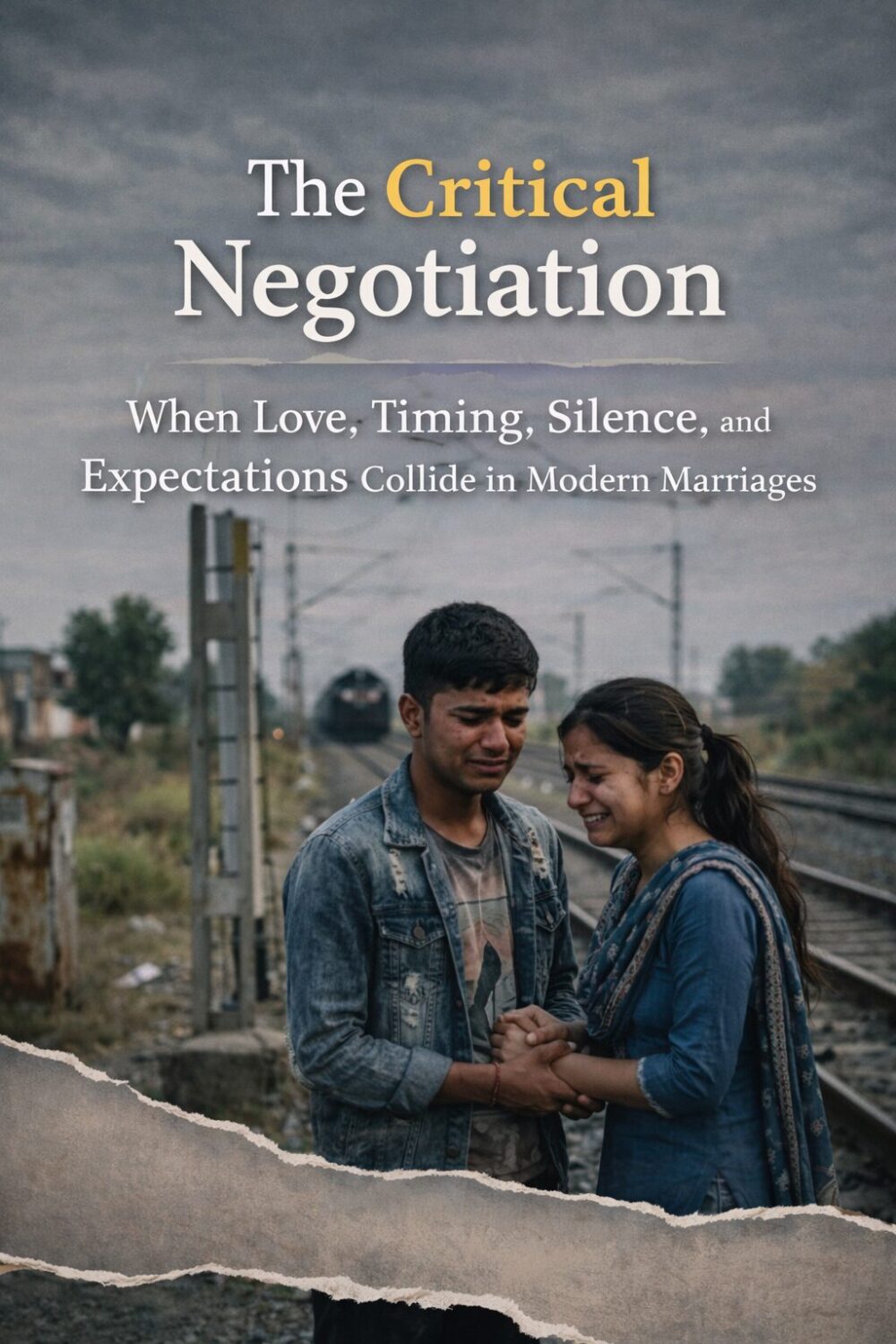
When Love, Timing, Silence, and Expectations Collide in Modern Marriages
Introduction: A Crisis That Doesn’t Begin Overnight
Marriage, in many families, is not just a personal milestone—it is a deeply emotional, social, and spiritual responsibility. Parents invest years raising their children, nurturing them with values, protecting them from harm, and dreaming of a future where they are settled, stable, and happily married.
They plan carefully:
- Searching for the “right” partner
- Evaluating families and backgrounds
- Ensuring financial and social compatibility
Yet, despite sincere intentions, many families today find themselves trapped in a painful and unexpected situation—what we can call “The Critical Negotiation.”
This is the stage where:
- Parents have chosen a partner
- Children have already formed emotional attachments elsewhere
- And both sides feel they are right
What follows is often not a discussion—but a collision.
And sometimes, tragically, it escalates beyond control.
The Silent Phase: Where the Real Story Begins
The crisis does not begin when parents propose a match.
It begins much earlier—during the silent years.
As children enter adolescence, they undergo:
- Biological changes
- Emotional awakening
- Curiosity toward relationships
Attraction toward the opposite gender is not a flaw—it is part of human design.
Allah says: “Beautified for people is the love of that which they desire…” (Surah Aal-e-Imran 3:14)
This natural inclination, however, requires guidance, boundaries, and understanding.
Without that:
- Infatuation begins
- Conversations increase
- Emotional dependency develops
- Attachment deepens
All of this often happens quietly—without parental awareness.
Time Is Passing—But Not Equally
While parents are taking their time:
- Searching
- Comparing
- Waiting for the “perfect” proposal
Years pass—often 3 to 4 years or more.
But during these same years:
- The child’s emotional world is evolving rapidly
- Bonds may be forming
- Attachments may already be strong
This creates a dangerous imbalance: Parents believe they are still “planning.” Children are already “emotionally committed.”
The Collision Point: The Beginning of the Critical Negotiation
Eventually, parents arrive with a carefully selected proposal.
They expect appreciation, trust, and agreement.
But the child responds with hesitation—or outright refusal.
Because now:
- The heart is already attached
- Promises may have been made
- Emotional investment is real
This is where the Critical Negotiation begins:
- Parents: “We know what is best for you.”
- Children: “This is my life and my choice.”
What follows is a clash between:
- Experience vs emotion
- Authority vs autonomy
- Long-term thinking vs immediate attachment
When Negotiation Turns Into Conflict
If handled without wisdom, this stage escalates quickly:
- Arguments replace conversations
- Pressure replaces understanding
- Silence replaces trust
The child may feel:
- Cornered
- Misunderstood
- Emotionally invalidated
Parents may feel:
- Disrespected
- Worried about consequences
- Responsible for protecting their child
Both sides are acting out of concern—but the lack of alignment creates conflict.
The Deeper Layer: When Delay and Secrecy Lead to Consequences
In some cases, the situation goes further.
What begins as emotional attachment may evolve into:
- Private meetings
- Secrecy
- Physical involvement
Without guidance and boundaries, this may result in serious consequences, including:
- Emotional dependency beyond control
- Compromised decision-making
- Unplanned pregnancy
At this point, the family is no longer dealing with a disagreement.
They are facing a crisis.
A More Painful Stage of the Critical Negotiation
Now the questions become heavier:
- Should the relationship be accepted under pressure?
- Should the situation be hidden or disclosed?
- Should immediate marriage be arranged?
- Should irreversible decisions be made in panic?
This stage brings:
- Emotional trauma
- Social pressure
- Moral dilemmas
- Long-term consequences
Allah reminds us of the sanctity of life: “And do not kill your children for fear of poverty. We provide for them and for you…” (Surah Al-Isra 17:31)
And more broadly, He warns us against the path that leads to such crises: “And do not go near zina…” (Surah Al-Isra 17:32)
This is not just prohibition—it is prevention.
When Emotional Collapse Becomes Tragedy
There are also extreme cases where young individuals, overwhelmed by:
- Emotional attachment
- Fear of rejection
- Lack of support
…feel that there is no way forward.
In such moments of emotional collapse, impulsive decisions may be taken—leading to tragic outcomes that devastate families forever.
It is crucial to understand: These tragedies are rarely caused by one factor alone.
They are the result of a chain: Delay + Silence + Emotional Attachment + Sudden Rejection + No Coping Support = Crisis
Is Delay the Cause? Or Just a Risk Factor?
It is tempting to say: “This happened because marriage was delayed.”
But that would be an oversimplification.
A more accurate understanding is:
- Delay increases the window of emotional vulnerability
- But lack of guidance and communication creates the real risk
Even with early marriage:
- Lack of maturity can cause problems
- Poor compatibility can lead to breakdowns
So the issue is not just timing—it is preparation.
The Prophetic Guidance on Timeliness and Responsibility
The Prophet ﷺ said: “O young people, whoever among you is able to marry, let him marry…” (Sahih al-Bukhari & Sahih Muslim)
This highlights the importance of timely marriage as a protective measure.
He also said: “Each of you is a shepherd and each of you is responsible for his flock…”
(Sahih al-Bukhari & Sahih Muslim)
This reminds parents that their role is not only to arrange—but to prepare, guide, and support.
Where Families Often Go Wrong
The real gaps are not always visible:
- Delayed emotional engagement
- Silence around relationships
- Fear-based parenting instead of trust-based communication
- Treating marriage as a one-time event rather than a long-term preparation
By the time parents step in, the situation may already be emotionally irreversible.
A Better Model: Prevention Through Preparation
Instead of reacting late, families must adopt a proactive approach.
- Early Awareness (Before Adolescence)
Children should be gradually taught:
- The purpose and sanctity of marriage
- Emotional discipline
- The difference between attraction and commitment
- Open Communication (During Adolescence)
Create a safe environment where:
- Feelings can be discussed
- Questions can be asked
- Guidance is given without judgment
When children feel heard, they are less likely to:
- Hide relationships
- Make impulsive decisions
- Timely Marriage Planning
Avoid unnecessary delays due to:
- Unrealistic expectations
- Social comparison
- Financial perfectionism
The Prophet ﷺ said: “If there comes to you one whose religion and character you are pleased with, then marry (your daughter) to him…” (Tirmidhi)
This encourages simplicity and timely decisions.
- Emotional Coaching and Coping Skills
Teach children:
- How to handle rejection
- How to process emotions
- That disappointment is not the end of life
This is often the missing link.
- Collaborative Decision-Making
Instead of:
- Imposing decisions
Shift toward:
- Discussing options
- Understanding emotions
- Guiding, not forcing
Reframing the Core Insight
The strongest and most accurate understanding is: “Timely marriage reduces risk—but early guidance prevents crisis.”
And even more powerfully: “It’s not just late marriage that creates problems—it’s late conversation.”
From Critical Negotiation to Guided Transition
The goal is not to eliminate disagreement—it is to transform it.
When:
- Communication starts early
- Emotions are guided
- Decisions are collaborative
Then the “critical negotiation” becomes:
- A respectful discussion
- A thoughtful transition
- A shared decision
Conclusion: The Real Question
The tragedy is not that conflict happens. The tragedy is that preparation didn’t happen early enough. So the real question is not: “Why did this situation arise?”
But: “When should we have started preparing for it?”
A Final Reflection
When guidance is delayed, emotions find their own path.
And when that path is suddenly blocked, some don’t see a way back.
A Final Dua
May Allah grant our families:
- Wisdom in guidance
- Patience in decisions
- Protection from avoidable trials
- And barakah in marriages
“Our Lord, grant us from among our spouses and offspring comfort to our eyes and make us leaders for the righteous.” (Surah Al-Furqan 25:74)
Ameen.