
The Paradox of Spouse Selection
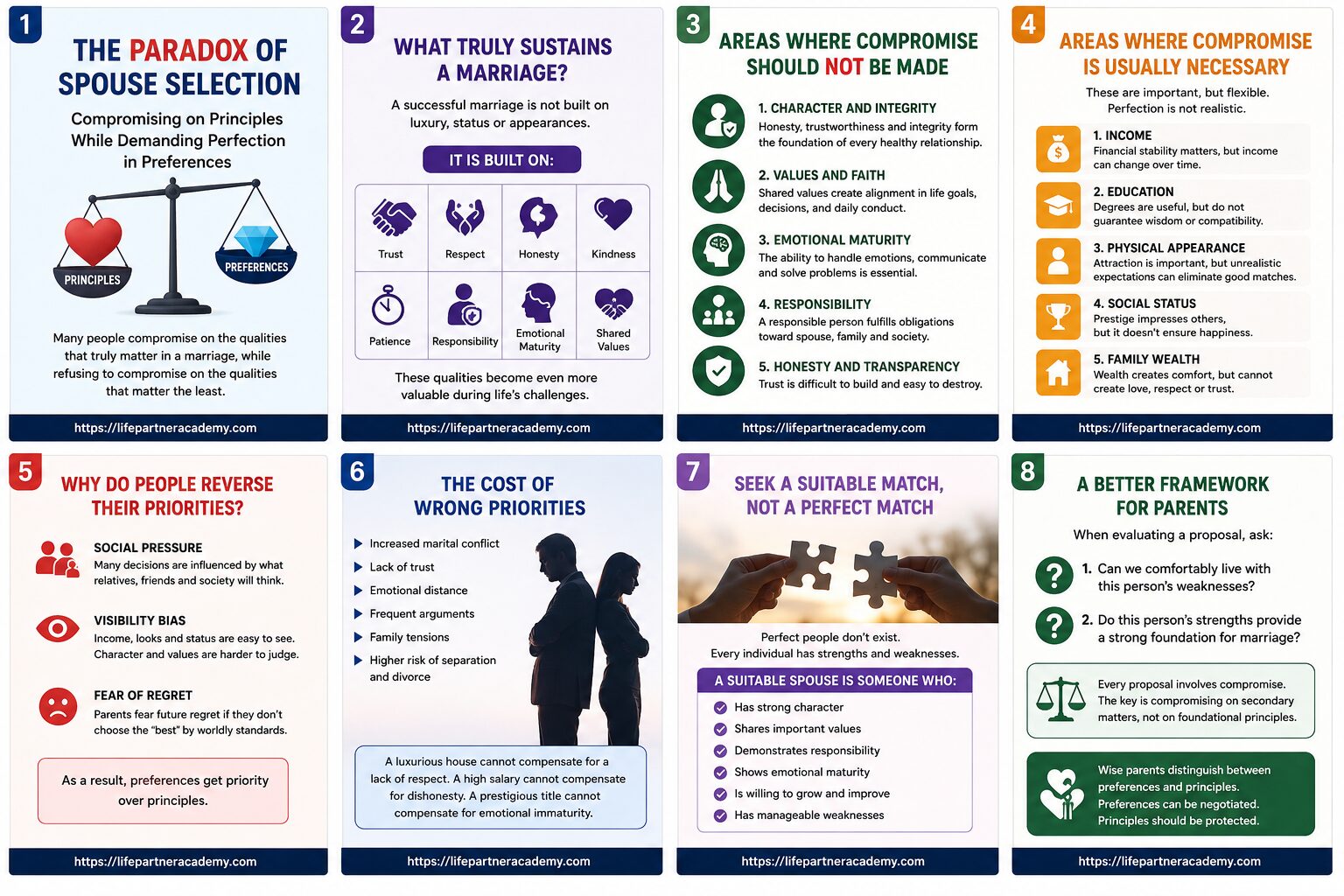
Compromising on Principles While Demanding Perfection in Preferences
Introduction
Choosing a life partner is one of the most important decisions a person will ever make. Parents and individuals often invest considerable time, energy, and resources in searching for the “best” match. They carefully evaluate educational qualifications, income, family background, physical appearance, profession, social status, and many other factors.
While this desire to secure the best future for one’s child is understandable, a paradox often emerges during the spouse selection process. Many families insist on perfection in areas where compromise is possible, yet willingly compromise in areas where compromise can have serious long-term consequences.
The result is that proposals with strong character, good values, emotional maturity, and religious commitment are sometimes rejected for lacking prestige, wealth, or beauty. At the same time, proposals with serious character concerns may be accepted because they satisfy worldly expectations. This paradox has become one of the most overlooked causes of marital dissatisfaction, conflict, and even divorce in modern society.
Understanding the Spouse Selection Paradox
The paradox can be summarized in a simple statement: People often compromise on principles while refusing to compromise on preferences.
Most parents and prospective spouses publicly acknowledge that character, values, honesty, responsibility, and emotional maturity are important. However, when actual decisions are made, factors such as salary, appearance, social status, and educational qualifications frequently receive greater weight. As a result, individuals may overlook significant concerns simply because a proposal appears attractive on paper.
The paradox is not that people value wealth, education, or beauty. These factors certainly have relevance. The paradox is that many families prioritize these secondary factors above the qualities that actually determine the success of a marriage.
What Truly Sustains a Marriage?
Before discussing compromise, it is important to understand what makes marriages successful.
- A marriage is not sustained by a degree certificate hanging on a wall.
- A marriage is not sustained by a prestigious job title.
- A marriage is not sustained by social media appearances.
Rather, successful marriages are sustained by:
- Trust
- Respect
- Honesty
- Kindness
- Patience
- Responsibility
- Emotional maturity
- Shared values
- Commitment
These qualities become especially important during life’s inevitable challenges. Every marriage will experience disagreements, financial pressures, health concerns, family obligations, and unexpected difficulties. During such moments, character becomes more valuable than credentials.
Areas Where Compromise Should Not Be Made
- Character and Integrity
Character forms the foundation of every healthy relationship. A person may possess wealth, beauty, and status, but if they lack honesty, trustworthiness, and integrity, marital stability becomes difficult. Character influences every interaction within a marriage.
- Values and Faith
Shared values create alignment in life goals, family decisions, parenting approaches, financial priorities, and daily conduct. Significant differences in values often lead to recurring conflict and dissatisfaction.
- Emotional Maturity
Marriage requires the ability to handle disagreements, communicate respectfully, manage emotions, and solve problems collaboratively. Emotional immaturity often turns minor issues into major conflicts.
- Responsibility
Marriage is built upon responsibilities rather than rights alone. A responsible individual fulfills obligations toward spouse, family, children, and society.
- Honesty and Transparency
Trust is difficult to build and easy to destroy. Without honesty, even the strongest marriage faces serious challenges. These are foundational qualities that should never be sacrificed for superficial advantages.
Areas Where Compromise Is Usually Necessary
Ironically, these are often the areas where people refuse to compromise.
- Income
Financial stability matters, but many families seek ever-higher income levels while overlooking character. A person’s earnings can change significantly over time. Character rarely changes as quickly.
- Educational Qualifications
Degrees indicate academic achievement, but they do not automatically indicate wisdom, maturity, kindness, or compatibility. Many highly educated individuals struggle in relationships, while many less-educated individuals excel as spouses.
- Physical Appearance
Attraction is important, but unrealistic expectations regarding appearance eliminate many suitable candidates. Physical beauty naturally changes over time, while character often becomes more important with age.
- Social Status
Prestige may impress others, but it does not guarantee happiness at home. Marital success depends more on how spouses treat each other than on how society perceives them.
- Family Wealth
Financial resources can create opportunities and comfort, but they cannot create trust, respect, or emotional connection. Families sometimes overestimate the value of wealth while underestimating the importance of character.
Why Do People Reverse Their Priorities?
Several factors contribute to this problem.
Social Pressure
Many parents worry about how relatives, friends, and society will evaluate their choice. Questions about income, profession, and status are often easier to answer than questions about character.
Visibility Bias
Income, degrees, beauty, and status are immediately visible. Character, patience, honesty, and emotional maturity require deeper investigation and observation. As a result, people often focus on what is easy to measure rather than what truly matters.
Fear of Regret
Some families fear that accepting a proposal without ideal worldly qualifications may result in future regret. Ironically, many later discover that the qualities they ignored become the very reasons for marital problems.
The Cost of Wrong Priorities
When priorities become inverted, several consequences can emerge:
- Increased marital conflict
- Lack of trust
- Emotional distance
- Frequent arguments
- Family tensions
- Higher risk of separation and divorce
Many marriages struggle not because spouses lacked wealth or prestige, but because they lacked the personal qualities necessary to build a healthy relationship.
- A luxurious house cannot compensate for a lack of respect.
- A high salary cannot compensate for dishonesty.
- A prestigious designation cannot compensate for emotional immaturity.
Seeking a Suitable Match Instead of a Perfect Match
One of the greatest mistakes in spouse selection is the pursuit of perfection. Perfect human beings do not exist. Every individual possesses strengths and weaknesses. The objective should not be to find someone who meets every preference but to find someone who possesses the qualities most essential for a successful marriage. A suitable spouse is someone who:
- Has strong character
- Shares important values
- Demonstrates responsibility
- Shows emotional maturity
- Is willing to grow and improve
- Has manageable weaknesses
This approach is far more realistic and beneficial than seeking perfection.
A Better Framework for Parents
When evaluating a proposal, parents can ask two questions:
Question 1: Can we comfortably live with this person’s weaknesses?
Question 2: Do this person’s strengths provide a strong foundation for marriage?
Every proposal will involve compromise somewhere. The key is ensuring that compromise occurs in secondary matters rather than foundational principles. Wise parents distinguish between preferences and principles. Preferences can be negotiated. Principles should be protected.
Conclusion
The paradox of spouse selection affects countless families around the world. Many individuals demand perfection in appearance, income, education, and status while overlooking deficiencies in character, values, honesty, and emotional maturity. Yet the qualities that attract attention before marriage are often not the qualities that sustain marriage after marriage.
The strongest marriages are rarely built upon wealth, beauty, or prestige alone. They are built upon trust, respect, responsibility, commitment, and shared values. Parents who understand this distinction place principles above preferences. They seek a suitable spouse rather than a perfect spouse.
In the end, a wise spouse selection process is not about finding someone without flaws. It is about finding someone whose character, values, and commitment provide a solid foundation upon which a successful and lasting marriage can be built.