
The Silent Theft: Wealth is Guarded, Time is Lost
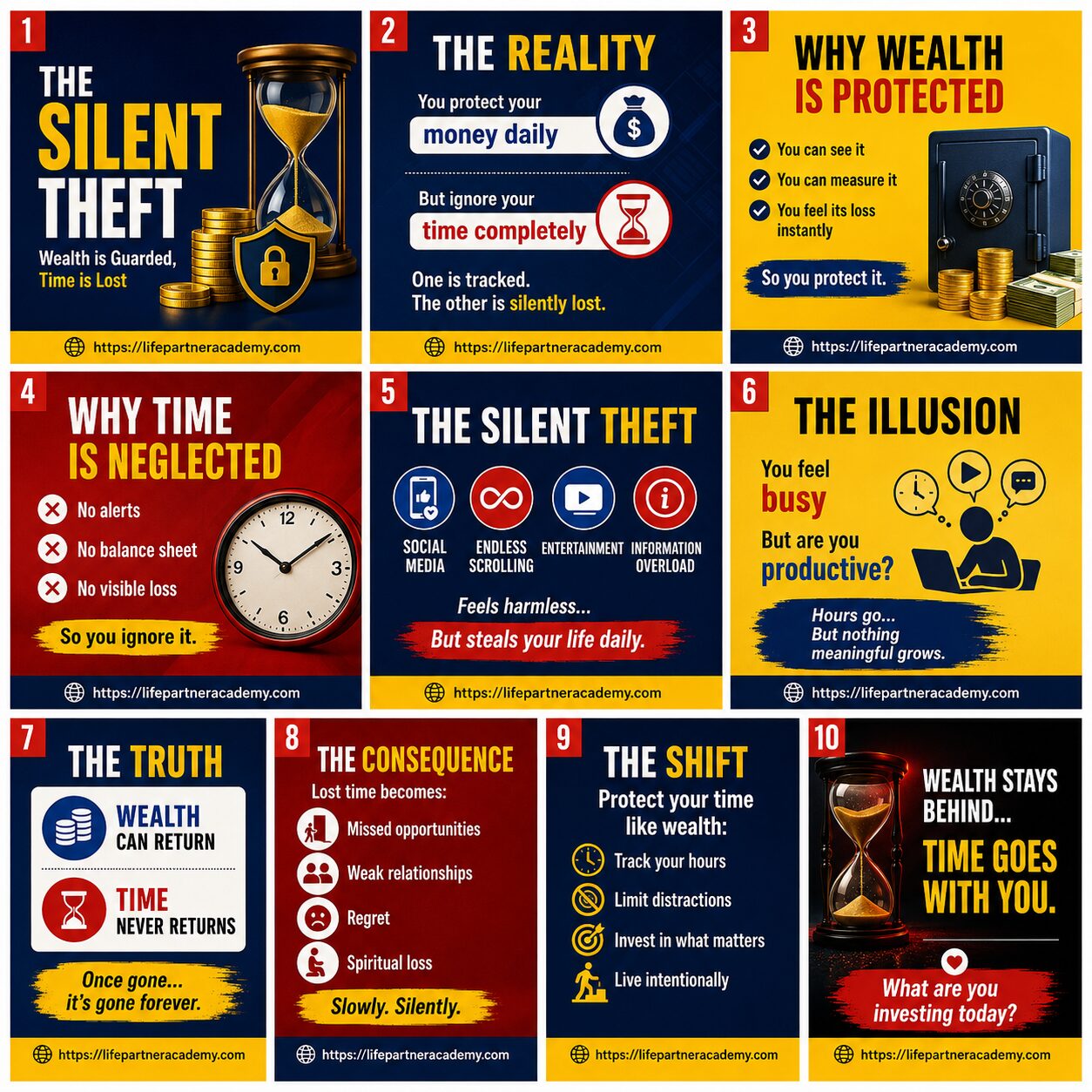
Introduction: Wealth vs Time – Two Assets, One Neglected
In every era, human beings have understood the importance of wealth. From daily earnings to long-term investments, individuals strive to grow, protect, and sustain their financial resources. Wealth is tracked, measured, and carefully managed. People monitor their bank balances, review their expenses, and plan for financial security with precision. The reason is simple: wealth is visible. Its growth brings satisfaction, and its loss creates immediate concern.
Time, however, is treated very differently.
Unlike wealth, time cannot be seen, stored, or calculated in the same tangible way. There is no account balance for time, no alerts for its depletion, and no recovery once it is lost. Yet, time is far more valuable than wealth. Every achievement, every relationship, every act of Ibadah and every success in this world and the Hereafter depends entirely on how time is used. Despite this, while wealth is guarded with discipline, time is often neglected, misused, and quietly lost—without awareness. This silent imbalance is one of the greatest crises of modern life.
Why Wealth is Protected So Carefully
People naturally prioritize protecting their wealth because it is:
- Visible and measurable
- Limited and valuable
- Linked to comfort and survival
- Easily lost through negligence
From budgeting and saving to investing and diversifying, individuals deploy multiple strategies to ensure their wealth is secure. Financial discipline is taught, practiced, and even admired in society. A person who manages money wisely is considered responsible and successful. More importantly, wealth gives immediate feedback. If spending increases, savings decrease. If investments perform well, wealth grows. This constant visibility creates awareness, and awareness leads to action. As a result, people become highly alert when it comes to financial protection.
Why Time is Neglected and Unprotected
Time, on the other hand, suffers from a dangerous disadvantage: it is invisible in its loss.
There is no daily statement that shows how many hours were wasted. There is no warning that signals a decline in life’s remaining time. A person may lose several hours every day without ever realizing the magnitude of that loss.
Even more concerning is that time loss is often disguised as enjoyment.
- Scrolling through social media feels relaxing
- Watching videos feels like a break
- Endless information consumption feels productive
But in reality, these activities often consume large portions of life without adding meaningful value. Because there is no immediate consequence, individuals do not feel the urgency to protect their time. The loss remains unnoticed, and therefore, unaddressed.
The Rise of the Attention Economy
In today’s digital world, time is not just being wasted—it is being targeted and captured.
Entire industries are built around gaining and retaining human attention. Social media platforms, streaming services, and digital entertainment systems are designed to keep individuals engaged for as long as possible.
Their goals are clear:
- Increase screen time
- Maximize user engagement
- Encourage repeated usage
- Create dependency
These platforms use psychological triggers, algorithms, and personalized content to ensure that users stay connected. The longer a person stays, the more valuable they become to these systems. In this environment, time is not merely lost—it is systematically extracted, often without the user’s awareness.
The Illusion of Being Busy
One of the most deceptive aspects of time loss is the illusion of productivity. Many people feel busy throughout the day. They move from one activity to another, constantly engaged with screens, messages, and tasks. However, being busy does not always mean being productive.
A person can spend hours:
- Consuming content
- Engaging in low-value conversations
- Switching between tasks without focus
At the end of the day, they feel exhausted—but not fulfilled. True productivity is not about activity; it is about meaningful progress. Without intentional use of time, busyness becomes a trap that hides the reality of wasted life.
A Fundamental Difference: Wealth vs Time
Understanding the difference between wealth and time is crucial:
Wealth
- Can be earned again
- Can be increased and multiplied
- Can be recovered after loss
- Can be transferred to others
Time
- Cannot be regained once lost
- Cannot be stored or saved
- Cannot be increased beyond its limit
- Ends completely with life
This distinction makes time the most valuable resource a person possesses. Yet paradoxically, it is the least protected.
The Long-Term Consequences of Wasted Time
The impact of misused time is not always immediate—but it is always significant.
Over time, wasted hours accumulate into:
- Missed opportunities
- Lack of personal growth
- Weak relationships
- Spiritual neglect
- Regret and dissatisfaction
A person may realize, years later, that they were constantly occupied—but not truly advancing in life. This realization often comes too late.
The Islamic Perspective on Time
In Islam, time is considered a trust (Amanah) and a test. Life itself is defined by time, and every individual will be accountable for how it was spent. The Qur’an and Hadith repeatedly emphasize the importance of utilizing time wisely, especially in matters that benefit both this world and the Hereafter.
Time invested in:
- Ibadah
- Seeking knowledge
- Serving others
- Building strong families
- Earning halal sustenance
Becomes a source of lasting reward. Neglected time, however, becomes a source of regret.
Reframing Time as an Investment
To truly protect time, one must change how it is perceived. Time should not be seen as something to “pass” or “kill,” but as something to invest.
Just as money is allocated carefully, time must be assigned to high-value activities:
- Personal development
- Spiritual growth
- Meaningful work
- Family and community
Every hour should serve a purpose that contributes to long-term benefit.
Two examples below how TIME is invested with Discipline:
Vedaant chasing Olympic Golds
Labourer’s son scores 498/500 in board exams
Practical Steps to Protect Time
Protecting time requires conscious effort and discipline. Here are some key strategies:
Track Your Time
Just as you track expenses, monitor how you spend your hours daily.
Limit Digital Consumption
Set boundaries for social media and entertainment usage.
Prioritize What Matters
Focus on activities that bring real value to your life and Aakhirah
Create a Structured Routine
Plan your day to reduce randomness and wasted time.
Eliminate Low-Value Activities
Identify and remove habits that consume time without benefit.
Practice Intentional Living
Do not act out of habit—act with purpose.
Wealth Remains, Time Departs
One of the most profound realities of life is this:
When a person dies, their wealth remains—but their time is finished.
- Their assets may continue to grow
- Their money may benefit others
- Their possessions may be distributed
But their time is completely exhausted. Every moment they had is gone—permanently. This reality alone should reshape how we prioritize our daily lives.
Conclusion: The Real Loss
Wealth is guarded because its loss is visible. Time is neglected because its loss is silent.
But in reality:
The loss of wealth is temporary. The loss of time is permanent. The modern world will continue to offer distractions. Entertainment will continue to evolve. Opportunities to waste time will always exist. But the responsibility lies with the individual.
- To recognize the value of time.
- To protect it with discipline.
- To invest it with purpose.