
Change or Grow
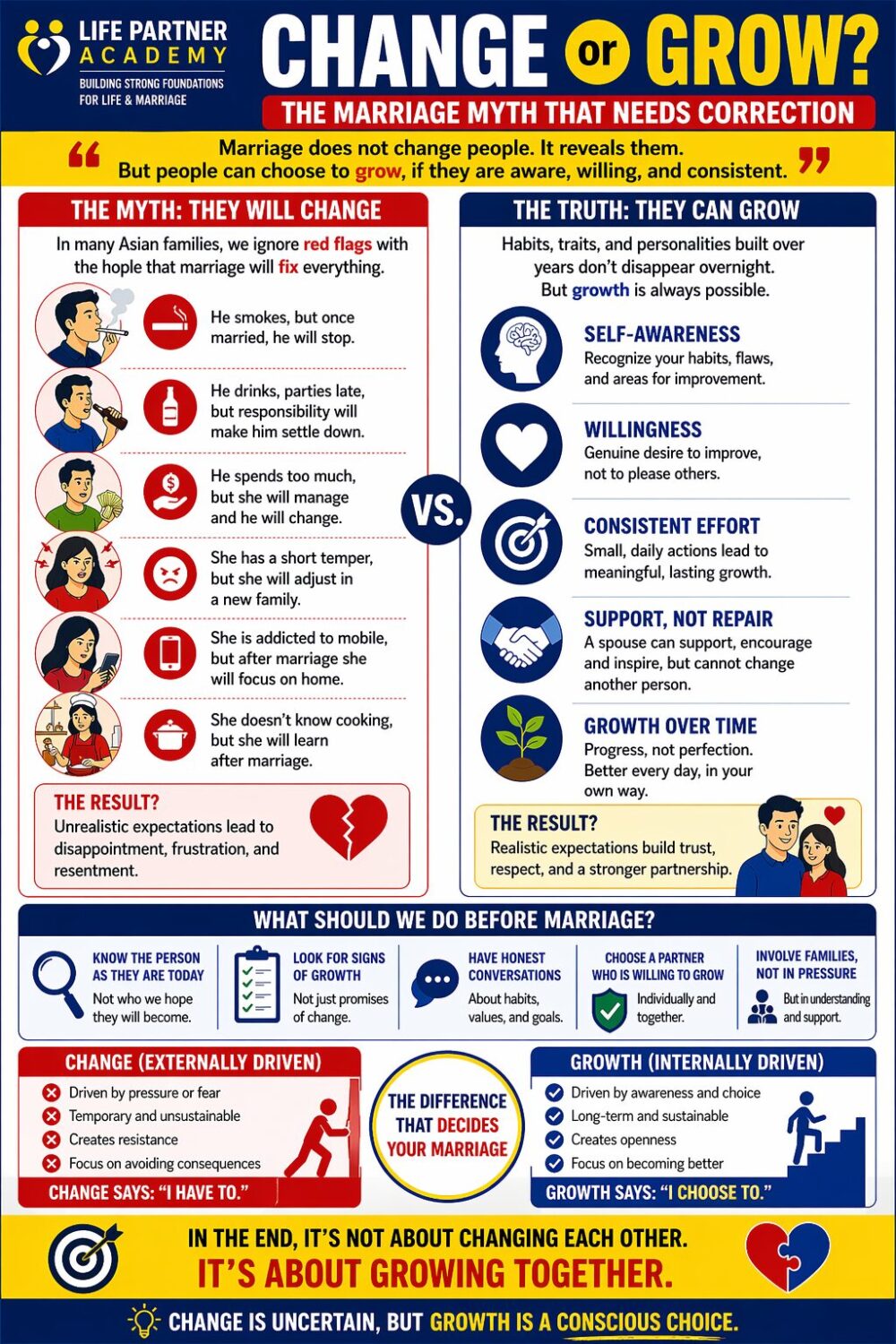
The Marriage Myth That Needs Correction
In many societies—especially across the Asian subcontinent—marriage is often viewed not just as a sacred bond, but as a corrective mechanism. It is silently believed that marriage has the power to transform individuals, to polish their flaws, and to replace undesirable habits with responsibility and maturity. This belief, though deeply rooted in culture, has led to unrealistic expectations and avoidable disappointments in countless marriages.
A common narrative plays out repeatedly: a groom with habits like smoking, alcohol consumption, late-night socializing, or financial irresponsibility is excused with the assumption that “once he gets married, he will change.” Similarly, a bride who may struggle with emotional regulation, lacks household skills, or is overly dependent on digital distractions is expected to “adjust and learn” once she enters her marital home.
But this assumption raises a critical question—does marriage truly change people? Or does it simply expose who they already are?
The truth is far less comforting than the assumption. Marriage does not possess the power to transform deeply ingrained habits overnight. Instead, it amplifies existing traits, bringing both strengths and weaknesses into sharper focus.
What is possible, however, is not forced change—but intentional growth. And understanding this distinction can mean the difference between a thriving marriage and a struggling one.
The Illusion of Post-Marriage Transformation
The idea that marriage will “fix” a person is one of the most dangerous myths in relationship building. It allows individuals and families to overlook clear red flags during the premarital phase, relying instead on hope rather than evidence.
Statements like these are all too common:
- “He will become responsible after marriage.”
- “She will learn everything once she comes into the family.”
- “Marriage will make him settle down.”
- “Time will change her nature.”
These are not plans—they are assumptions. And assumptions, when unmet, turn into disappointment, conflict, and emotional strain.
Marriage is not a reform school. It does not automatically instill discipline, erase addictions, or teach life skills. In fact, the added responsibilities and pressures of marriage often intensify existing behaviors rather than eliminate them.
A person who lacks discipline before marriage is unlikely to suddenly become disciplined afterward without conscious effort. Similarly, unresolved emotional patterns do not disappear—they resurface more frequently in close relationships.
Change vs Growth: A Critical Distinction
To build realistic expectations, it is essential to distinguish between change and growth.
Change is often external. It is driven by pressure, expectations, or fear of consequences. It may occur temporarily but lacks depth and sustainability.
Growth, on the other hand, is internal. It is a conscious, voluntary process of improvement. It is rooted in self-awareness, intention, and consistency.
Consider the difference:
- Change is: “I have to stop this because my spouse doesn’t like it.”
- Growth is: “I want to improve this because I recognize its impact on my life and relationship.”
Change imposed from outside creates resistance. Growth chosen from within creates transformation.
This is why many post-marriage “changes” fail—they are not driven by personal conviction, but by external pressure.
Why Long-Standing Habits Resist Change
Human behavior is not formed overnight. Habits are built over years—sometimes decades—through repetition, environment, and reinforcement.
A person who has spent 20+ years living a certain lifestyle—whether it involves smoking, poor financial management, emotional reactivity, or lack of responsibility—cannot simply switch off these patterns because of a new relationship status.
These habits are often tied to:
- Emotional coping mechanisms
- Social circles and influences
- Personal identity and comfort zones
- Lack of awareness or accountability
Expecting immediate transformation ignores the complexity of human behavior.
This does not mean change is impossible—but it does mean that change without effort is impossible.
The Real Opportunity: Growth Through Awareness and Effort
While forced change is unreliable, growth remains a powerful and realistic possibility.
Growth begins with self-awareness—the ability to recognize one’s own shortcomings without denial or defensiveness. This is followed by willingness, a genuine desire to improve. Finally, it requires consistent effort, where small steps are taken regularly over time.
Growth is not dramatic—it is gradual.
- A smoker does not quit overnight but starts reducing and seeking support.
- A person with anger issues begins learning emotional control techniques.
- Someone inexperienced in household responsibilities starts contributing step by step.
- A digitally distracted individual begins setting boundaries with screen time.
These are not instant transformations—but they are meaningful progress.
Growth is sustainable because it is chosen, not imposed.
The Misplaced Responsibility in Marriage
One of the most damaging expectations in marriage is assigning the role of “changer” to the spouse.
A wife is often expected to “fix” her husband’s habits.
A husband is often expected to “train” or “shape” his wife’s behavior.
This mindset is flawed and unfair.
No individual has the power to fundamentally change another adult. Attempting to do so leads to:
- Frustration and resentment
- Emotional burnout
- Power struggles
- Loss of respect
A healthy spouse can support, encourage, and guide—but not control or reform.
Marriage is a partnership, not a rehabilitation project.
Premarital Clarity: The Foundation of a Strong Marriage
Many marital challenges can be avoided with honest and practical premarital evaluation.
Instead of asking:
- “Will they change?”
The more important questions are:
- “Are they aware of their current habits?”
- “Have they shown any effort to improve?”
- “Do their actions reflect readiness for responsibility?”
- “Are these habits something I can realistically live with if they don’t change?”
Marriage should be based on present reality, not future assumptions.
Ignoring red flags before marriage often leads to magnified issues after marriage.
Reframing Expectations: From Fantasy to Reality
The phrase “they will change after marriage” needs to be replaced with a more grounded perspective:
“They may grow—if they choose to.”
This shift in thinking transforms expectations:
- From blind hope → to informed decision-making
- From pressure → to personal responsibility
- From disappointment → to realistic acceptance
Growth is visible through actions. It is not a promise—it is a pattern.
Building a Growth-Oriented Marriage
A successful marriage is not built on perfection—it is built on progress.
When both partners commit to growth, the relationship evolves naturally. This includes:
- Open communication about strengths and weaknesses
- Mutual encouragement without criticism or control
- Patience with each other’s pace of improvement
- Shared values and long-term vision
Growth in marriage is not about becoming someone else—it is about becoming a better version of oneself.
Conclusion
Marriage does not transform individuals overnight—it reveals them. It magnifies habits, attitudes, and character traits that already exist. Entering marriage with the expectation that a partner will change is not just unrealistic—it is risky.
However, this does not mean people are fixed and incapable of improvement. The real potential lies in growth—intentional, consistent, and self-driven.
The question, therefore, is not: “Will they change after marriage?”
But rather: “Are they willing to grow—and am I willing to grow alongside them?”
Because in the end, change is uncertain, but growth is a conscious choice.