
Unknown Destination, Unplanned Roadmap
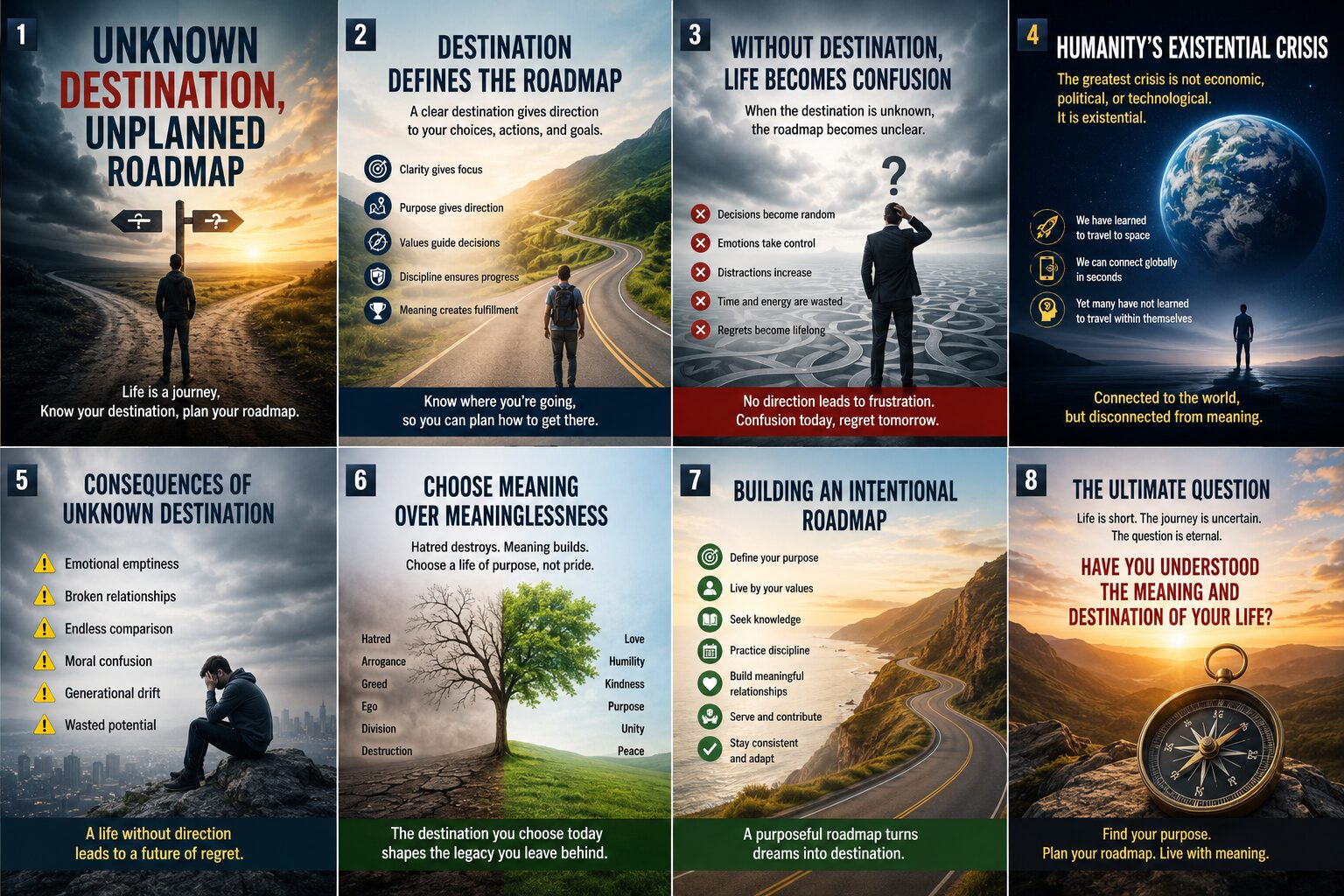
Every meaningful journey begins with clarity of destination. A traveler heading toward a specific city prepares differently from one wandering without direction. The destination determines the route, the preparation, the discipline, and the decisions made along the way. Human life is no different. Before planning careers, relationships, ambitions, or lifestyles, every individual must first ask one fundamental question: What is the destination of my life?
Modern society has become deeply focused on movement but not necessarily direction. People are constantly busy, connected, entertained, employed, educated, and occupied, yet many quietly struggle with confusion, emptiness, anxiety, and a lack of meaning. Humanity has achieved remarkable technological advancements, but many individuals still do not understand why they exist or where their lives are ultimately heading. Without understanding the purpose and destination of life, people often build roadmaps based on temporary emotions, social pressure, material desires, or trends rather than lasting meaning and wisdom.
An unknown destination always creates an unplanned roadmap. When individuals fail to define the purpose of life, they drift through existence reacting to circumstances rather than living intentionally. This confusion affects not only individuals but also families, communities, and entire civilizations. History repeatedly shows that societies that lose their moral and spiritual direction eventually lose their peace and stability as well.
The greatest question humanity must answer today is not merely how to live, but why to live.
The Importance of Knowing the Destination
No intelligent traveler starts a journey without knowing where he or she intends to go. Imagine boarding a train, airplane, or bus without any idea of the destination. Such behavior would appear irrational and dangerous. Yet millions of people live exactly this way every day. They wake up, work, consume, compete, entertain themselves, and age without ever reflecting deeply upon the purpose of their existence.
The destination shapes the roadmap. If a person believes life is only about material success, then the roadmap will revolve around wealth, status, competition, and temporary pleasures. If another person believes life is about peace, righteousness, family, contribution, and spiritual fulfillment, then the roadmap will reflect entirely different values and decisions.
A person who understands the destination of life develops clarity. Decisions become easier because they are guided by purpose rather than impulse. Sacrifices gain meaning because they serve a greater objective. Difficulties become manageable because the individual understands that every journey contains obstacles before reaching the final destination.
Without destination, however, people become vulnerable to confusion, manipulation, trends, addictions, and emotional instability. They chase temporary pleasures believing they will eventually create permanent happiness, only to discover that emptiness continues to grow within them.
Humanity’s Existential Crisis
The greatest crisis of humanity today is not merely economic, political, or technological. It is existential. Human beings have learned how to travel to space, but many have not learned how to travel within themselves. People can connect globally within seconds, yet remain disconnected from the meaning of their own existence.
Modern civilization has mastered external development while neglecting internal development. Society measures success through income, followers, degrees, possessions, and visibility, but rarely through wisdom, self-awareness, integrity, emotional peace, or spiritual understanding. As a result, many people live outwardly successful lives while internally struggling with anxiety, loneliness, dissatisfaction, anger, and purposelessness. Mental exhaustion has increased even in societies with greater comfort and convenience. People have more entertainment than ever before, yet many experience less fulfillment than previous generations.
This contradiction reveals an important truth: technological advancement alone cannot answer existential questions. Material success may improve comfort, but it cannot fully satisfy the human soul’s search for meaning.
The Consequences of an Unknown Destination
When individuals fail to understand life’s purpose, their roadmaps become unstable and reactive. Decisions are often based on trends, peer pressure, desires, or emotional impulses rather than wisdom and long-term vision.
This confusion creates several consequences:
- Emotional Emptiness
People spend years chasing achievements only to discover that accomplishments alone cannot provide inner peace. Many individuals reach milestones they once dreamed about yet still feel incomplete.
- Broken Relationships
When life lacks higher meaning, relationships often become transactional rather than meaningful. People begin valuing others based on utility, attraction, status, or temporary emotions instead of loyalty, compassion, and shared values.
- Endless Comparison
A purposeless life constantly compares itself with others. Social media has intensified this problem by creating environments where people measure their worth against curated images of other people’s lives.
- Moral Confusion
Without clear direction, societies gradually lose moral stability. Right and wrong become subjective. Personal desires begin replacing principles. Short-term satisfaction becomes more important than long-term consequences.
- Generational Drift
Entire generations can drift without meaning when societies fail to teach purpose, values, and responsibility. People inherit lifestyles, ambitions, and habits without questioning whether they truly lead to peace and fulfillment.
Living With Meaning Instead of Hatred
History demonstrates that hatred, arrogance, greed, and ego eventually destroy both individuals and nations. Many civilizations achieved power and dominance but collapsed internally because they lost their ethical and spiritual foundations.
Human beings were not created merely to compete endlessly for superiority. Life gains beauty when it is connected to meaning, contribution, compassion, and purpose. An individual who understands life’s destination begins focusing less on destructive competition and more on meaningful living. Such a person values:
- inner peace over constant comparison,
- wisdom over popularity,
- contribution over selfishness,
- discipline over impulse,
- relationships over ego,
- purpose over temporary pleasure.
A meaningful life does not eliminate hardship, but it transforms hardship into growth rather than despair. People with purpose can endure difficulties because they understand that life’s journey is larger than temporary pain.
Rediscovering the Meaning of Life
The search for meaning is one of humanity’s oldest and most important pursuits. Throughout history, philosophers, prophets, scholars, and thinkers have asked the same essential questions:
- Why are we here?
- What is the purpose of existence?
- What truly brings peace?
- What happens after this life?
- What kind of legacy should we leave behind?
These questions remain relevant because every human being eventually confronts them, whether consciously or subconsciously.
Rediscovering meaning requires reflection. It requires stepping away from constant distraction and asking difficult but necessary questions about existence, priorities, relationships, and values.
A meaningful life usually includes:
- spiritual awareness,
- moral responsibility,
- self-discipline,
- meaningful relationships,
- contribution to others,
- personal growth,
- gratitude,
- and alignment between beliefs and actions.
Meaning cannot simply be purchased, downloaded, or inherited. It must be consciously discovered and lived.
The Need for an Intentional Roadmap
Once the destination becomes clear, the roadmap of life also becomes clearer.
A purposeful roadmap includes:
- defining personal values,
- choosing healthy relationships,
- developing discipline,
- protecting mental and emotional well-being,
- seeking beneficial knowledge,
- contributing positively to society,
- And living with accountability and integrity.
People who live intentionally are less likely to be controlled by temporary emotions or social pressure because their actions are guided by deeper convictions. An intentional roadmap also creates stability during uncertainty. Economic struggles, disappointments, failures, and hardships become easier to navigate when life has a meaningful foundation.
Without intentionality, however, life often becomes reactive rather than purposeful. Individuals drift from one distraction to another without lasting fulfilment.
Conclusion
An unknown destination always produces an unplanned roadmap. Humanity’s greatest struggle today is not merely lack of resources or intelligence, but lack of clarity about the meaning and purpose of life itself. Human beings have advanced technologically beyond imagination, yet many remain uncertain about the direction of their own existence. People have learned how to connect with the world, but many still struggle to connect with themselves, their purpose, and their Creator.
A life without purpose eventually becomes a journey without direction. But when the destination becomes clear, every step gains meaning, every sacrifice gains value, and every challenge becomes part of a greater journey.