
Why Marriage Has Fallen Off the List of Priorities of Many Indian Women
An Islamic Perspective on the Causes Behind the Shift
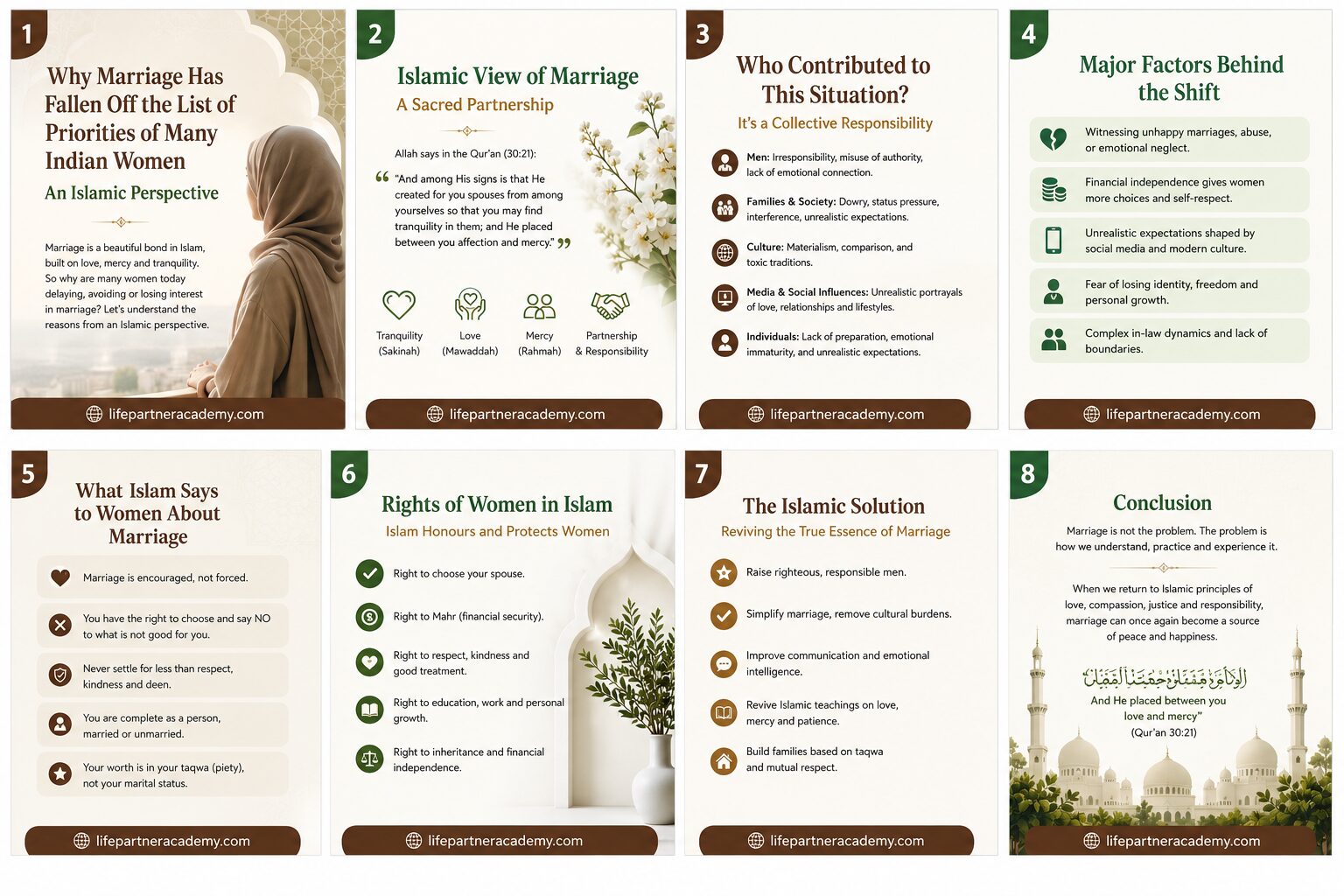
Introduction
Across urban and semi-urban India, a noticeable social shift is taking place: many women are delaying marriage, questioning its value, or choosing to remain single altogether. What was once considered a compulsory milestone of adulthood is increasingly being viewed as optional. While economic independence, education, and changing lifestyles are often cited as reasons, the deeper issue goes beyond career ambitions or modern trends. Many women today have lost trust in marriage itself. From an Islamic perspective, this situation did not emerge overnight, nor can it be blamed entirely on women or men alone. It is the result of cultural distortions, weakening moral responsibility, unrealistic expectations, family interference, media influence, and the gradual departure from the balanced principles taught in Qur’an and the teachings of Muhammad (saw).
Marriage in Islam: A Sacred Partnership, Not a Social Burden
Islam views marriage as one of the most important institutions of human society. It is not merely a contract for physical companionship or financial arrangement. Marriage is intended to create emotional tranquility, mercy, cooperation, and spiritual growth.
The Qur’an beautifully states: “And among His signs is that He created for you spouses from among yourselves so that you may find tranquility in them; and He placed between you affection and mercy.”
Marriage in Islam is built upon:
- love,
- compassion,
- trust,
- sacrifice,
- mutual rights,
- and responsibility before Allah.
When these foundations weaken, marriage slowly transforms from a source of peace into a source of fear and emotional exhaustion.
1. Misuse of Male Authority and Responsibility
One of the major reasons many women hesitate toward marriage is the negative example they have witnessed around them.
Many girls grow up seeing:
- mothers emotionally neglected,
- wives treated like unpaid servants,
- women carrying the burden of both career and household,
- husbands displaying anger, irresponsibility, addiction, or emotional absence.
Islam gave men leadership in the family, but leadership in Islam is responsibility — not dictatorship. The Prophet Muhammad said: “The best of you are those who are best to their wives.” Unfortunately, culture often turned leadership into control and dominance. Some men demand obedience while neglecting kindness, financial stability, emotional support, and character. When women repeatedly witness unhappy marriages, fear naturally replaces enthusiasm.
Cultural Practices Replacing Islamic Simplicity
Another major factor is the burden society itself has placed upon marriage.
In many Indian communities:
- extravagant weddings,
- dowry expectations,
- status competition,
- family politics,
- interference from relatives,
- and social comparisons
Have made marriage stressful and transactional. Islam made marriage simple:
- modest nikah,
- reasonable mahr,
- minimal burden,
- and ease for both families.
But society transformed marriage into a display of prestige. Many women fear entering homes where:
- in-laws dominate every decision,
- personal freedom disappears,
- comparisons with other daughters-in-law continue endlessly,
- And emotional boundaries are not respected.
These problems often originate from culture, not religion.
Economic Independence Changed Social Dependency
Historically, marriage was often necessary for a woman’s financial survival. Today many women are educated, employed, and financially independent.
From an Islamic perspective, there is nothing wrong with women being educated or financially capable. Islam granted women:
- inheritance rights,
- ownership rights,
- business rights,
- and financial independence long before modern systems did.
However, financial independence changed one major reality: Women no longer feel forced to remain in unhealthy situations merely for survival. This has created two outcomes:
- Women now seek emotional compatibility and respect rather than economic security alone.
- Many women prefer remaining single over entering emotionally draining marriages.
The phrase “better single than sorry” reflects this mindset.
Unrealistic Expectations Created by Modern Media
Modern digital culture has deeply influenced attitudes toward marriage.
Social media constantly displays:
- luxury lifestyles,
- unrealistic romance,
- curated perfection,
- And endless comparison.
At the same time, online platforms amplify:
- divorce stories,
- toxic relationship experiences,
- cheating scandals,
- and anti-marriage narratives.
As a result:
- men develop unrealistic expectations from women,
- women develop unrealistic expectations from men,
- and both lose the ability to appreciate ordinary human imperfection.
Islam teaches realism. No spouse is perfect. Marriage requires:
- patience,
- forgiveness,
- compromise,
- emotional maturity,
- and sincere effort.
But modern culture often promotes self-centered individualism over commitment and sacrifice.
Weak Preparation for Marriage
Many people prepare extensively for:
- careers,
- degrees,
- business,
- and financial success,
But almost nobody prepares for marriage itself. People enter marriage with:
- poor communication skills,
- emotional immaturity,
- unrealistic fantasies,
- unresolved trauma,
- and little understanding of Islamic marital responsibilities.
The Prophet Muhammad emphasized character and Deen when selecting a spouse. Today many marriages are built primarily on:
- appearance,
- income,
- family status,
- or social pressure.
Without strong foundations, marriages become fragile. Many women now fear marriage because they have seen emotionally unprepared men fail as husbands.
Feminism, Hyper-Individualism, and Confusion about Freedom
Modern ideologies have also influenced perceptions of marriage. Some forms of feminism rightfully challenged:
- abuse,
- inequality,
- forced dependence,
- and denial of women’s rights.
However, extreme forms of individualism sometimes portray:
- marriage as oppression,
- family responsibility as weakness,
- sacrifice as exploitation,
- and commitment as loss of freedom.
Islam does not support oppression of women. But Islam also does not glorify selfish independence disconnected from family and responsibility. Islam promotes balance:
- dignity with responsibility,
- freedom with morality,
- rights with duties,
- and individuality with family stability.
Fear Created by Rising Divorce and Marital Conflict
Another factor is the increasing visibility of divorce, abuse, and toxic relationships.
Women today observe:
- emotional manipulation,
- domestic violence,
- infidelity,
- financial irresponsibility,
- and broken homes
More openly than previous generations. Many conclude: “If marriage risks my peace, perhaps remaining single is safer.” Islam recognizes the seriousness of these fears. Islam does not tell women to blindly marry anyone. Women have the right to:
- evaluate character,
- reject unsuitable proposals,
- seek emotional safety,
- and prioritize righteousness.
At the same time, Islam discourages hatred toward the institution of marriage itself because healthy marriages still exist.
What Islam Advises Women about Marriage
Islam does not force women into marriage against their will. Nor does it treat unmarried women as failures. A woman’s honor in Islam is not dependent solely upon marital status. Her true value lies in:
- Taqwa,
- character,
- sincerity,
- modesty,
- and righteousness.
However, Islam still highly encourages marriage because it provides:
- companionship,
- protection,
- emotional support,
- family structure,
- and spiritual growth.
Islam advises women to seek men who possess:
- deen,
- honesty,
- emotional maturity,
- responsibility,
- kindness,
- and self-control.
Marriage should not be pursued out of desperation, nor rejected out of fear alone.
The Islamic Solution to the Marriage Crisis
The solution is not gender war between men and women. Islamic solutions include:
- raising responsible men,
- teaching women realistic expectations,
- simplifying marriage,
- reducing cultural toxicity,
- strengthening Islamic education,
- improving emotional maturity,
- and reviving mercy within families.
Society must stop glorifying:
- arrogance,
- materialism,
- selfishness,
- and domination.
Instead, families must revive:
- compassion,
- accountability,
- trustworthiness,
- modesty,
- and God-consciousness.
Conclusion
The decline of marriage as a priority among many Indian women is not simply a rebellion against tradition. It is often a reaction to witnessing painful marriages, emotional injustice, cultural burdens, and broken trust. From an Islamic perspective, both men and women — along with families and society — contributed to this situation by drifting away from the balanced principles of Islam.
True Islamic marriage was never meant to imprison women or burden men. It was designed to create tranquility, mercy, protection, and mutual growth. If Muslim societies sincerely revive the Qur’anic values of justice, compassion, responsibility, and simplicity, trust in marriage can gradually be restored. Marriage succeeds not merely because two people live together, but because both fear Allah, honor each other, and fulfill their responsibilities with sincerity.