
I DARE YOU CHALLENGE
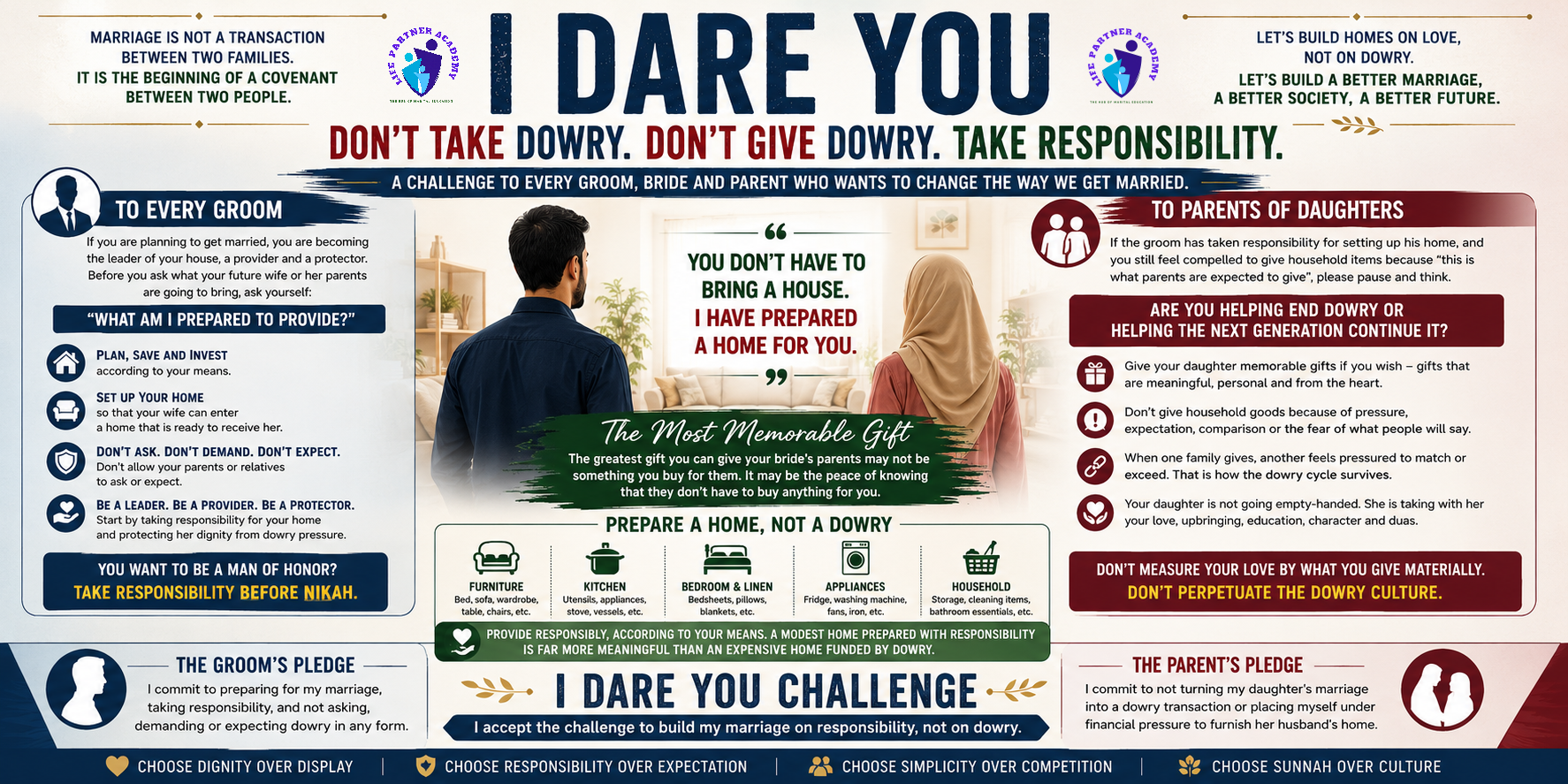
Don’t Take Dowry.
Don’t Give Dowry.
Take Responsibility.
A Challenge to Every Groom, Bride and Parent Who Wants to Change the Way We Get Married
What if we changed the way we think about marriage?
What if, instead of the first question being “What is the bride bringing?”, the groom asked himself: “What am I prepared to provide for the home I am about to build?”
- What if the bride’s parents were not expected to furnish their daughter’s new home?
- What if the groom and his parents never asked, hinted, negotiated or expected anything from the bride’s family?
- And what if the bride’s parents, instead of feeling compelled to provide household goods, also had the courage to say: “We will not participate in the dowry culture either.”
Imagine what would happen if both families took responsibility for changing the culture.
That is the challenge.
I DARE YOU
To Every Man Planning to Get Married
If you are planning to get married, you are not merely preparing for a wedding. You are preparing to become a husband, a leader of your household, a provider and a protector. So before asking what your future wife or her parents are going to bring into the marriage, ask yourself:
“What am I prepared to provide?”
- Plan.
- Save.
- Invest.
- Prepare.
Set up your home according to your means so that your wife can enter a home that is ready to receive her.
- Furniture.
- Kitchen utensils and appliances.
- Bedroom essentials.
- Household appliances.
- Basic household necessities.
Whatever is genuinely required to establish a comfortable home—take responsibility for providing it yourself, within your means.
- Don’t ask.
- Don’t demand.
- Don’t expect.
- Don’t allow your parents to ask.
- Don’t allow relatives or social customs to create expectations.
And don’t allow the absence of a formal demand to become a clever way of communicating an expectation.
If you want to become the leader of the house, start by taking responsibility for the house.
If you want to be a provider: Start providing. If you want to be a protector: Start by protecting her dignity from the pressure of dowry.
Imagine the Moment
Imagine the most memorable day of a girl’s life. Her parents have spent years raising her, educating her, protecting her and preparing her for adulthood. Now the day has arrived for her to begin a new chapter. But instead of worrying about: “What do we have to give?” they hear something completely different from the groom:
- “Please don’t worry about furnishing the house. I have already prepared it.”
- “Don’t worry about the kitchen. I have taken care of it.”
- “Don’t worry about household necessities. I have planned for them.”
- “Your daughter is coming to a home that is ready for her.”
What a moment that would be.
The parents would not feel that they were buying their daughter’s place in another family. They would simply be able to celebrate. And perhaps the greatest gift the groom could give his bride’s parents is not something he buys for them. It is the peace of knowing that they don’t have to buy anything for him.
“You Don’t Have to Bring a House. I Have Prepared a Home.”
Imagine a groom saying this to his future bride: “You don’t have to bring a house with you. I have prepared a home for you.”
Those words could mean more than an entire truckload of expensive gifts. Because marriage should not be a transaction between two families. It should be the beginning of a covenant between two people. The bride should not arrive carrying the financial expectations of an entire household. She should arrive as a wife, a companion and a person with dignity—not as a package of goods. And the groom should not measure the value of his marriage by what arrives with his bride. He should measure himself by what he is prepared to give, protect, provide, sacrifice and take responsibility for.
To Every Girl and Her Parents
There is another side to this challenge. Ending dowry is not only the responsibility of the groom and his family.
The bride’s family also has a role to play.
If the groom has already taken responsibility for establishing his home, and the bride’s parents still feel compelled to send furniture, kitchen appliances, household equipment, electronics and other expensive items simply because: “This is what parents are supposed to give their daughter,” then we need to pause and ask a difficult question:
Are we really helping to end dowry—or are we helping the next generation continue it?
This is not about stopping parents from giving their daughter a meaningful gift. Parents may wish to give their daughter something special, personal and memorable. That is different from feeling obligated to furnish her husband’s home. The danger begins when gifts become expected, measured, compared or socially compulsory. Because when one family gives generously under social pressure, the next family is expected to match or exceed it. And then another family says: “They gave so much. What are we going to give?” That is how the cycle survives.
The groom may stop demanding dowry, but if society continues expecting it, the dowry culture remains alive.
Your Daughter Is Not Going Empty-Handed
Dear Parents,
If your daughter enters her husband’s home without furniture, appliances, electronics and household goods from your side, she is not going empty-handed. She is carrying something far more valuable. She is taking with her:
- Your upbringing.
- Your Duas.
- Your love.
- Your wisdom.
- Her education.
- Her character.
- Her skills.
- Her personality.
- The memories of the home in which you raised her.
And most importantly, she is entering her marriage as a human being with dignity—not as a financial contribution from her parents.
- You don’t have to prove your love by furnishing somebody else’s home.
- You don’t have to compete with another family.
- You don’t have to prove your status.
- You don’t have to fill a truck.
- You don’t have to go into debt.
- And you don’t have to satisfy people who will forget your expenses long before you recover from them.
If you genuinely want to help end dowry, have the courage to say: “Our daughter is our gift. We will not turn her marriage into a transaction.”
Let Her Prepare Herself—Not a Dowry
There is another beautiful consequence of removing this pressure. The bride gains something far more valuable than household goods: Time.
- Time to prepare herself for marriage.
- Time to understand her new responsibilities.
- Time to learn about communication, emotional maturity, conflict resolution, financial management, health, relationships and family life.
- Time to prepare herself across the eight dimensions of wellness:
- Physical.
- Emotional.
- Intellectual.
- Social.
- Spiritual.
- Occupational.
- Financial.
- Environmental.
Instead of spending months thinking: “What should we buy?” she can spend those months thinking: “How can I prepare myself for this new chapter of my life?”
And instead of her parents worrying: “How will we afford everything?” they can ask: “How can we make this wedding meaningful, dignified and joyful for our daughter?”
What a transformation that would be.
The Groom’s Responsibility Begins Before the Wedding
A man who wants to become a husband must understand something very important: Responsibility does not begin after the wedding. The mindset of responsibility begins before the Nikah.
- If you intend to become a leader of a household, begin preparing for leadership.
- If you intend to become a provider, begin preparing to provide.
- If you intend to become a protector, begin by protecting the dignity of the woman you are going to marry.
- You do not have to be wealthy.
- You do not have to create a luxurious home.
- You do not have to buy everything at once.
- You do not have to compete with anyone.
- You simply need to take responsibility according to your means.
Start small. Save consistently. Prioritise necessities over luxuries. Build your home gradually. A modest home prepared with responsibility is far more meaningful than an expensive home funded through financial pressure placed on the bride’s family.
What Should You Prepare For?
Before marriage, ask yourself whether you are financially prepared to provide the genuine necessities of establishing your household. Depending on your circumstances and means, these may include:
Furniture
Bed, mattress, wardrobe, dressing table, sofa, dining table and other basic furniture.
Kitchen
Cooking vessels, utensils, plates, glasses, cutlery, stove, pressure cooker, mixer/grinder and necessary appliances.
Bedroom & Household Linen
Bedsheets, blankets, pillows, towels and other essentials.
Electrical Appliances
Refrigerator, washing machine, fans, iron and other appliances according to genuine need and affordability.
Household Necessities
Storage, cleaning equipment, basic bathroom requirements and other domestic essentials. The objective is not to create another groom’s shopping list. The objective is to create a responsibility mindset.
- Don’t buy things merely to impress people.
- Don’t go into debt to prove that you are a provider.
- Provide responsibly, according to your means.
Don’t Take Dowry. Don’t Give Dowry. Take Responsibility.
The real challenge is not simply to say: “I will not take dowry.” The deeper challenge is: “I will take responsibility.” And the bride’s family can make the same commitment: “We will not give dowry merely because society expects us to.” There is a huge difference between a voluntary gift given out of love and a household contribution given because everyone expects it.
- The goal is not to prevent parents from loving their daughter.
- The goal is to prevent love from being converted into an obligation.
- The goal is not to prevent generosity.
- The goal is to prevent generosity from becoming a social requirement.
- The goal is not to create two opposing families.
- The goal is to create two responsible families.
Let the Wedding Become a Celebration—Not a Transfer of Wealth
- What if weddings became simpler?
- What if parents could spend less on household goods and more on their daughter’s education, wellbeing and future?
- What if the groom invested in establishing his home rather than waiting for the bride’s parents to do it?
- What if the bride invested her time in preparing herself for the responsibilities of marriage?
- What if both families stopped competing with society and started preparing for the actual purpose of marriage?
The wedding could then become what it was always meant to be: A celebration.
- Not a negotiation.
- Not a financial transaction.
- Not a demonstration of wealth.
- Not a competition between families.
- Not a test of how much the bride’s parents can provide.
A celebration of the beginning of a new family.
The Challenge Is for Everyone
- To the Groom: Don’t take dowry. Take responsibility.
- To the Groom’s Parents: Don’t expect your son’s wife to furnish your son’s home.
- To the Bride’s Parents: Don’t feel obligated to furnish your daughter’s husband’s home.
- To the Bride: Prepare yourself for marriage, not a dowry package.
- To Both Families: Choose dignity over display. Responsibility over expectation. Simplicity over competition.
I DARE YOU
If you are planning to get married:
- Don’t wait for your bride’s family to set up your home.
- Don’t make your parents negotiate for household goods.
- Don’t create expectations around what she should bring.
- Don’t allow culture to override responsibility.
And if you are the bride’s parent: Don’t feel compelled to furnish someone else’s home. Don’t turn your love for your daughter into a financial burden. Don’t perpetuate a culture that you hope your own children will escape.
Instead:
- Plan.
- Save.
- Invest.
- Prepare.
- Provide.
- Simplify.
- Celebrate.
Then, when the day finally arrives, let the bride and her parents experience something they may remember for the rest of their lives: “The groom has already taken responsibility.” The bride can come to the marriage with herself. Her parents can come with their duas and their blessings. The groom can come with his commitment and his preparation. And both families can come together with dignity, joy and peace. That is how we begin changing the culture. Not merely by telling people: “Don’t take dowry.” But by creating a new standard:
DON’T TAKE DOWRY.
DON’T GIVE DOWRY.
TAKE RESPONSIBILITY.
Future Husband — I Dare You.
Set up your own home. Carry your own responsibility. Protect her dignity. Give her parents peace. Let her come to you with herself—not with a price tag.
Parents — I Dare You.
- Don’t measure your love by what you give materially.
- Don’t let society decide what your daughter is worth.
- Don’t perpetuate the cycle you want the next generation to escape.
Together, I Dare You.
- Let’s make the next generation proud of us.
- Let’s make marriage about responsibility, not dowry.
- Let’s make weddings about celebration, not financial pressure.
Excellent inspiring article. A unique way of motivation.
I do hope this inspires and motivates many to follow the Sunnah in marriages.
Jazakallah khairan Aleem Saheb for your kind feedback.