
Clarity Before Commitment: The Snellen Chart Vs the Spouse Selection Chart
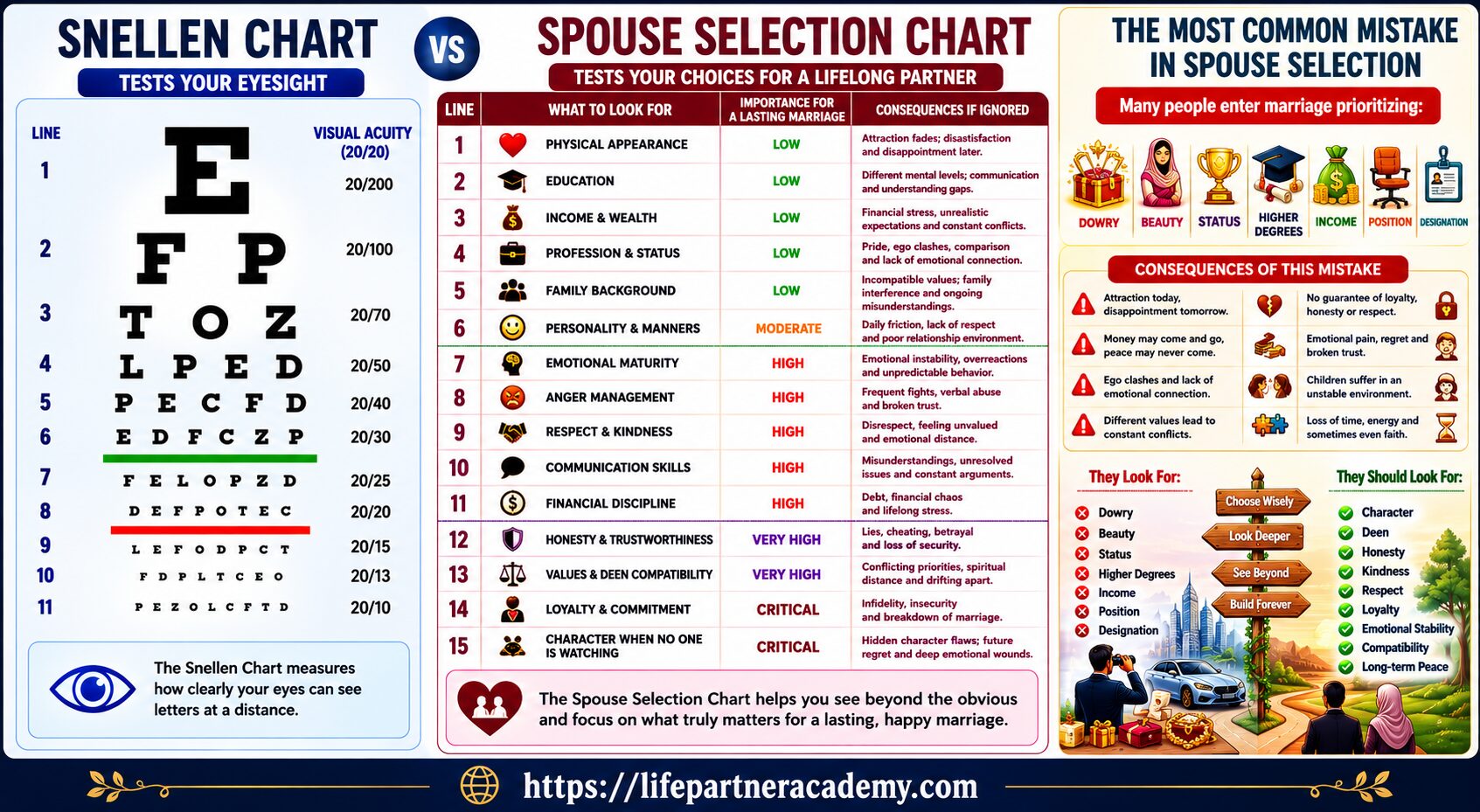
Why Many Marriages Fail Because People Never Learned to “See Clearly”
Introduction
One of the most recognized tools in medical history is the Snellen Chart — the chart optometrists use to test eyesight from a distance. Large letters appear at the top while progressively smaller letters appear below. The chart measures visual acuity and helps determine how clearly a person can see. Humanity takes eyesight seriously because poor vision affects reading, driving, work, education, safety, and daily life. People regularly undergo eye examinations, wear glasses, use corrective lenses, and even undergo laser surgeries because they understand the importance of clear vision.
Yet while society invests heavily in protecting physical eyesight, very little attention is given to another form of vision that is equally important: the ability to clearly evaluate a future spouse. Many individuals enter marriage seeing only the “large letters” — beauty, wealth, degrees, profession, status, and income — while failing to recognize the smaller but far more critical qualities that determine lifelong marital stability. This is where the symbolic “Spouse Selection Chart” becomes meaningful. Like the Snellen Chart, it teaches people the difference between merely looking and truly seeing. Because successful marriages are rarely built only on attraction and status. They are built on character, emotional maturity, trust, loyalty, communication, values, and deen.
The Difference between Seeing and Understanding
Many people believe spouse selection simply requires attraction, family approval, and financial compatibility. But marriage is not a one-day event. It is a lifelong partnership that affects:
- emotional health,
- peace of mind,
- future children,
- family stability,
- financial well-being,
- and even one’s akhirah.
The tragedy is that many individuals evaluate marriage using superficial vision instead of deep insight.
They clearly see:
- beauty,
- salary,
- status,
- educational qualifications,
- profession,
- social reputation,
- and family prestige.
But fail to see:
- anger issues,
- emotional instability,
- dishonesty,
- arrogance,
- selfishness,
- lack of responsibility,
- poor communication,
- or weak character.
This is similar to inspecting only the exterior design of a building while ignoring its structural foundation.
The Most Common Mistake in Spouse Selection
Many people enter marriage prioritizing:
- dowry,
- beauty,
- higher degrees,
- income,
- position,
- designation,
- and social status.
These qualities may create attraction, excitement, and public admiration, but they do not automatically create:
- peace,
- loyalty,
- emotional safety,
- patience,
- trust,
- respect,
- compatibility,
- or barakah.
A person may marry:
- a beautiful spouse but experience emotional neglect,
- a wealthy spouse but live without peace,
- a highly educated spouse but face arrogance and disrespect,
- a socially respected spouse but privately endure manipulation or dishonesty.
External qualities can attract people into marriage.
Internal qualities determine whether the marriage survives.
The Spouse Selection Chart: Reading beyond the Top Lines
Just as the Snellen Chart begins with large, obvious letters, spouse selection often begins with visible qualities. However, the deeper lines — the ones most people fail to examine carefully often determine the future success or failure of the marriage.
The Top Lines: What Most People Notice First
Physical Appearance
Physical attraction creates initial interest and comfort between spouses. However, beauty alone cannot sustain emotional security, trust, sacrifice, or loyalty.
Consequences if Overvalued or Misunderstood
- Attraction may fade with time
- Unrealistic expectations may develop
- Emotional dissatisfaction may increase
- Deeper incompatibilities become more visible later
Beauty may attract attention, but character sustains relationships.
Education
Education can improve communication and intellectual compatibility. However, degrees do not automatically produce wisdom, patience, humility, or emotional intelligence.
Consequences if Ignored
- Communication gaps
- Different perspectives and expectations
- Difficulty understanding one another
- Poor problem-solving as a couple
A highly qualified person can still lack emotional maturity.
Income and Wealth
Financial stability is important because financial stress often damages marriages. However, wealth without discipline or gratitude can become destructive.
Consequences if Ignored
- Debt-related conflicts
- Financial insecurity
- Constant pressure and arguments
- Unrealistic lifestyle expectations
Money can support comfort, but it cannot create love, trust, or peace.
Profession and Social Status
Many people equate profession and status with success and security.
Consequences if Ignored
- Ego clashes
- Pride and superiority complexes
- Emotional disconnection
- Marrying for image rather than compatibility
Public reputation does not guarantee private character.
Family Background
Family culture influences communication styles, expectations, traditions, and conflict management.
Consequences if Ignored
- Family interference
- Conflicting values
- Misunderstandings
- Ongoing pressure from relatives
Marriage often joins two family systems, not just two individuals.
The Middle Lines: The Qualities That Sustain Marriage
Personality and Manners
Daily behavior determines the emotional atmosphere of the home.
Consequences if Ignored
- Constant friction
- Irritation and emotional exhaustion
- Lack of appreciation
- Unhealthy relationship environment
Small habits repeated daily eventually shape the entire marriage.
Emotional Maturity
Emotionally mature individuals can handle disagreements calmly and think long-term.
Consequences if Ignored
- Emotional instability
- Overreactions
- Manipulative behavior
- Frequent unnecessary conflicts
Immaturity turns minor issues into major emotional crises.
Anger Management
One uncontrolled reaction can permanently damage trust and emotional safety.
Consequences if Ignored
- Verbal abuse
- Emotional trauma
- Fear within the household
- Broken relationships with children and relatives
Many marriages fail not because of disagreement, but because of destructive reactions during disagreement.
Respect and Kindness
Respect is one of the strongest foundations of emotional security.
Consequences if Ignored
- Feeling emotionally unsafe
- Constant criticism
- Loss of affection
- Emotional withdrawal
A home without kindness eventually becomes emotionally exhausting.
Communication Skills
Healthy communication prevents misunderstandings from becoming destructive.
Consequences if Ignored
- Misunderstandings
- Silent resentment
- Unresolved conflicts
- Emotional distance
Poor communication slowly weakens emotional connection.
Financial Discipline
Financial discipline is often more important than income itself.
Consequences if Ignored
- Financial chaos
- Debt accumulation
- Stress and insecurity
- Constant arguments about money
Some people earn well but destroy peace through irresponsible spending.
The Lower Lines: The Most Critical Qualities
These are the “smallest lines” in the Spouse Selection Chart — often difficult to identify before marriage but extremely important afterward.
Honesty and Trustworthiness
Trust is the backbone of marriage.
Consequences if Ignored
- Lies and betrayal
- Suspicion and insecurity
- Emotional instability
- Loss of emotional safety
Once trust breaks, rebuilding it becomes extremely difficult.
Values and Deen Compatibility
Shared values shape:
- parenting,
- priorities,
- finances,
- modesty,
- social boundaries,
- and long-term goals.
Consequences if Ignored
- Constant value conflicts
- Spiritual disconnection
- Different parenting approaches
- Gradual emotional drifting
Deen compatibility often determines whether spouses help or harm one another’s akhirah.
Loyalty and Commitment
Commitment becomes most visible during hardship, not comfort.
Consequences if Ignored
- Infidelity
- Emotional insecurity
- Fear of abandonment
- Breakdown of trust
A marriage without loyalty eventually loses emotional stability.
Character When No One Is Watching
Public behavior can be managed temporarily. Private character reveals the real person.
Consequences if Ignored
- Hidden addictions
- Secretive behavior
- Manipulation
- Emotional wounds
- Lifelong regret
The greatest danger is confusing public image with private reality.
Why Many People Ignore the Deeper Lines
Many individuals fail to evaluate deeper qualities because:
- attraction clouds judgment,
- social pressure rushes decisions,
- families prioritize status,
- difficult questions are avoided,
- And premarital discussions remain superficial.
As a result, people spend months preparing for the wedding but very little time preparing for the marriage itself.
Marriage Requires More Than Eyesight
The Snellen Chart measures how clearly the eyes can see from a distance. The Spouse Selection Chart symbolically measures how clearly a person can see the future consequences of their marital choices.
Marriage is not merely about:
- chemistry,
- attraction,
- luxury,
- social approval,
- or financial comfort.
It is about selecting someone:
- who protects your peace,
- strengthens your Deen,
- supports your growth,
- raises future generations responsibly,
- remains trustworthy during hardship,
- and helps you succeed both in Dunya and Akhirah.
Conclusion
Many people enter marriage with clear eyesight but blurred judgment. They carefully inspect beauty, salary, status, degrees, profession, and social reputation while overlooking emotional maturity, honesty, loyalty, respect, communication, Deen, and private character.
The Snellen Chart protects eyesight. The Spouse Selection Chart protects lives, families, emotional health, and future generations. One helps people avoid physical accidents.
The other helps people avoid emotional, financial, spiritual, and family disasters.
- Beauty changes.
- Wealth fluctuates.
- Positions disappear.
- Status fades.
- Degrees alone cannot guarantee peace.
But:
- character,
- Deen,
- honesty,
- emotional maturity,
- loyalty,
- kindness,
- and responsibility
Continue shaping everyday life long after appearances change. The problem is not always that the warning signs were invisible. Often, people simply never learned how to read the deeper lines.