
COMPARISON AND COMPETITION
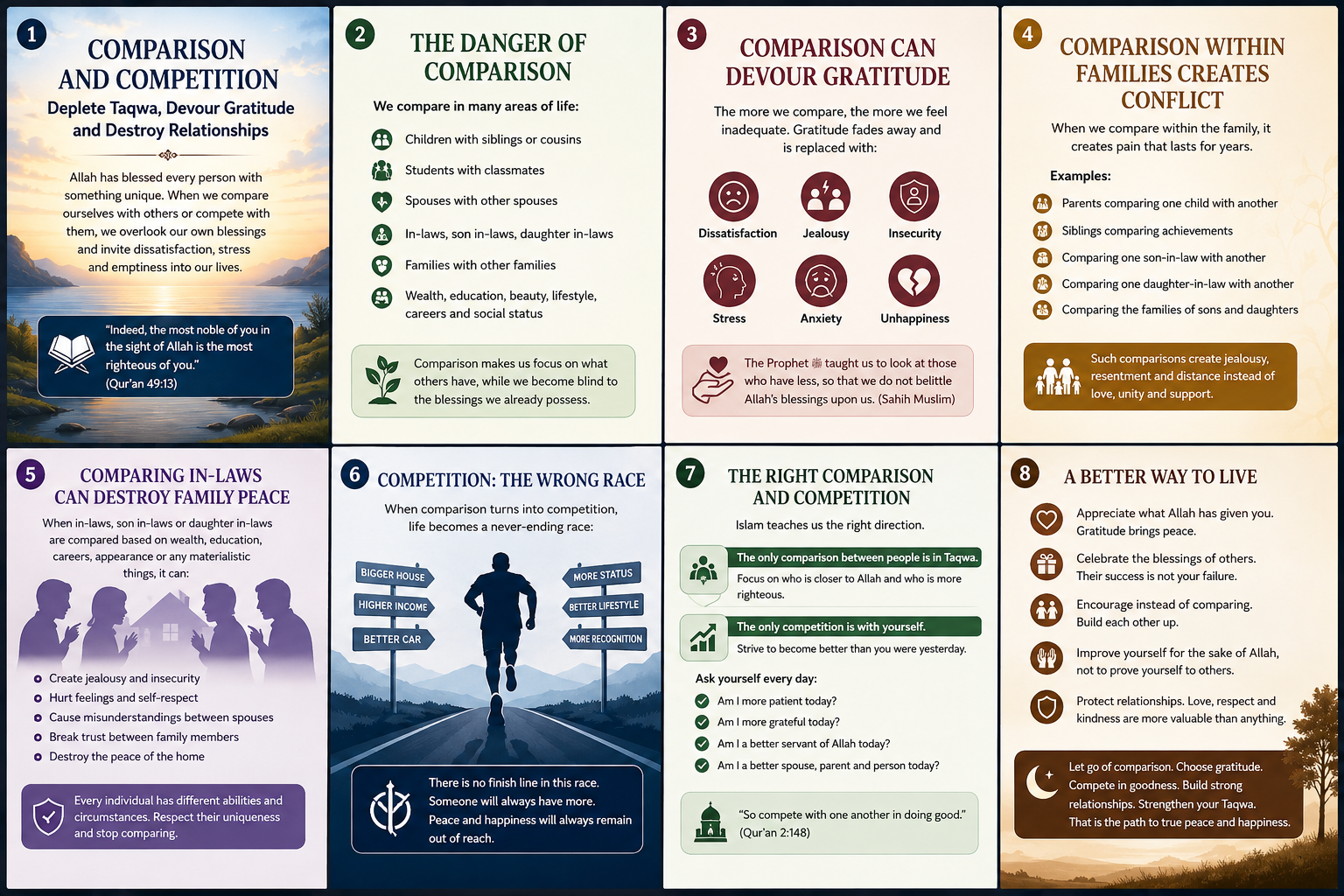
How They Can Deplete Taqwa, Devour Gratitude and Destroy Relationships
Comparison and competition are part of everyday life. Yet when we constantly compare ourselves with others or compete against them, we may slowly lose something far more valuable than worldly success: our gratitude, peace, happiness and even our Taqwa.
Human beings naturally observe one another. We notice what others have, what they achieve and how they live. There is nothing inherently wrong with observing, learning or even being inspired by another person’s qualities or accomplishments. The problem begins when observation becomes comparison, comparison becomes dissatisfaction, and dissatisfaction becomes competition.
A child is compared with a sibling. A student is compared with a classmate. An employee is compared with a colleague. A husband is compared with another husband, and a wife with another wife. One daughter-in-law is compared with another. One son-in-law is compared with another. Families compare their homes, cars, education, income, children, careers, lifestyles and social status. Sometimes the comparison is intentional. Sometimes it happens casually. Sometimes it is even presented as motivation. But comparison can have a hidden cost.
The Problem with Comparing People
Human beings were never created to be identical. Allah has given every person different abilities, opportunities, circumstances, personalities, talents, responsibilities and blessings. One person may possess wealth but face difficulties that others cannot see. Another may have excellent health but limited financial resources. One may have impressive academic qualifications while another possesses exceptional practical wisdom. Someone may have a beautiful home but experience difficulties within that home that remain invisible to outsiders.
When we compare only what is visible, we rarely see the complete picture. More importantly, we can begin to question the blessings Allah has already given us.
The Qur’an gives us the correct measure of human honour: “Indeed, the most noble of you in the sight of Allah is the most righteous of you.” Qur’an 49:13
This gives us an important Islamic principle. The ultimate comparison between two individuals is not based on wealth, beauty, education, profession, possessions, family background or social status. The measure of honour before Allah is Taqwa. This does not mean that we cannot learn from people who are more knowledgeable, more experienced or more accomplished in a particular field. We absolutely can. We should learn from good examples and seek to improve ourselves. But there is a fundamental difference between learning from someone and measuring our worth against them. Learning can produce growth. Unhealthy comparison can produce dissatisfaction.
Comparison Can Devour Gratitude
Imagine someone who owns a perfectly good car but constantly compares it with a neighbour’s more expensive car. The car that once brought happiness gradually begins to feel inadequate. Someone may have a comfortable home but become dissatisfied after seeing somebody else’s larger house. A person may have a good income but feel poor because a friend earns more.
Parents may be proud of their child until they begin comparing that child with another child who achieved more academically. A husband may deeply appreciate his wife until he begins comparing her with another man’s wife. A wife may be content with her husband until she starts comparing his income, appearance, career or behaviour with someone else’s husband. The blessing has not changed. The perception of the blessing has changed. This is one of the greatest dangers of comparison. Something that once made us say Alhamdulillah can slowly become something we take for granted because our attention has shifted toward what somebody else possesses. Instead of thinking, “Allah has blessed me with this,” we begin thinking, “Why don’t I have what they have?”
Gratitude slowly becomes dissatisfaction. Contentment becomes restlessness. Happiness becomes dependent upon comparison. The Prophet Muhammad ﷺ gave us a remarkable principle for protecting gratitude. He taught believers to look at those who have less in worldly matters rather than constantly looking at those who have more, so that we do not belittle Allah’s blessings upon us. This guidance is recorded in Sahih Muslim. The lesson is not that we should stop improving ourselves or aspiring for better things. Rather, it teaches us to recognise our blessings before pursuing improvement. We can aspire for more while remaining grateful for what we already have.
Comparison within Families Can Destroy Peace
Perhaps nowhere is comparison more dangerous than within the family.
A family should be a place of love, mercy, belonging and emotional security. Yet comparison can quietly introduce competition into relationships that should have been built upon affection and cooperation.
Parents may compare one child with another. Siblings may compare their achievements. Relatives may compare one family with another. Parents may compare one son-in-law with another or one daughter-in-law with another. The families of sons and daughters may even be compared based on wealth, education, lifestyle, hospitality, gifts, social standing or achievements.
Statements that appear harmless can become deeply hurtful:
- “Your brother is doing much better.”
- “Why can’t you be more like your sister?”
- “Look at what your brother-in-law has achieved.”
- “Your sister-in-law manages everything so well.”
- “Why doesn’t your husband earn as much as him?”
- “Her family gives so much more.”
The person making the comparison may believe that they are motivating someone. But the person receiving it may hear something completely different: “I am not good enough.” Repeated comparison can create insecurity, jealousy, resentment and emotional distance. Siblings who should naturally support one another can begin to compete. A daughter-in-law can begin feeling that she is constantly being evaluated against another woman. A son-in-law may feel that nothing he does is ever enough. Spouses may become defensive when their parents criticise or compare their partners. What began as a simple comparison can eventually become a source of conflict between siblings, spouses and in-laws.
Comparing In-Laws Can Be Particularly Destructive
Comparison between in-laws deserves special attention because it can affect several relationships simultaneously. When parents compare one daughter-in-law with another, one son-in-law with another, or compare the families of their sons and daughters, they can unintentionally create jealousy, insecurity and resentment.
Who earns more? Who gives more? Whose spouse is more caring? Whose children are more successful? Whose family is more generous? Whose house is bigger? Whose lifestyle is better?
These questions may never be asked openly, yet they can exist silently in the minds of family members. A daughter-in-law may feel that she is being judged against another daughter-in-law. A son-in-law may feel that his contribution is constantly being measured against someone else’s. Siblings may begin competing for parental approval. Spouses may feel pressured to defend their partners.
Over time, such comparisons can turn healthy family relationships into silent competition, create misunderstandings, and disturb the peace of the entire family. Every son-in-law and daughter-in-law has different qualities, circumstances, abilities and personalities. They should not be expected to be identical. Appreciating their uniqueness rather than comparing them is essential to preserving dignity, gratitude and family harmony.
When Parents Compare Their Children
Parents have a particularly important role because their words can remain in a child’s heart for years. Consider a child who repeatedly hears, “Why can’t you be like your brother?” Or a daughter who is constantly told, “Your sister is doing much better than you.” Perhaps the parents genuinely want to motivate their child. Yet repeated comparison can communicate an unintended message: “You are not good enough because somebody else is better.”
Over time, the child may become insecure, resentful or jealous. Instead of viewing a sibling’s success as something to celebrate, the child may begin seeing it as a threat to their own worth.
Even after the children become adults, these comparisons can continue to influence their relationships. A better approach is to encourage individual growth. Instead of asking, “Why can’t you be like your brother?”, ask, “How can I help you become the best version of yourself?” Instead of comparing one child with another, compare the child’s present progress with their own previous progress. That encourages improvement without creating rivalry. Children need guidance, encouragement and accountability. They do not need to feel that parental love or approval is a competition that must be won.
Competition Can Destroy What Comparison Begins
Comparison asks: “What does he have that I don’t?”
Competition then asks: “How can I have more than him?”
This is where comparison can become even more destructive.
- Who earns more?
- Who has the bigger house?
- Whose children are more successful?
- Whose wedding was better?
- Who travels more?
- Whose spouse is more successful?
- Whose family has greater status?
- Who receives more respect?
- Who can give more expensive gifts?
The problem is that there is no natural finish line. Someone will always have more. There will always be a bigger house, newer car, higher salary, better qualification, greater recognition or more impressive achievement. If happiness depends upon being ahead of someone else, happiness will always remain unstable. Even when we reach one level, someone else may appear to be one step ahead. The race never ends because the finish line was never real.
Social Media Has Made Comparison Easier
In the past, comparison may have been limited to neighbours, relatives and people we encountered personally. Today, social media can expose us to hundreds of carefully selected images of other people’s lives every day. We see successful businesses, beautiful homes, luxury holidays, happy families, graduations, weddings, new cars, awards, promotions and celebrations. But we rarely see the complete reality behind those images. We see somebody else’s highlight reel while living our own behind-the-scenes reality. This can create the illusion that everyone else is happier, wealthier, more successful or more fulfilled than we are. The danger is that we may begin comparing our entire life with a carefully selected fraction of someone else’s life. Allah has not asked us to live somebody else’s life.
Islam Does Encourage a Different Kind of Competition
It is important to understand that Islam does not condemn every form of competition. Allah says: “So compete with one another in doing good.” Qur’an 2:148
The problem is not competition itself. The question is what we are competing for and against whom. Competing in good deeds can elevate us. Competing in service can benefit society. Competing to improve our character can bring us closer to Allah. But competing for worldly superiority can consume us. We should therefore compete in goodness, not possessions; in character, not status; in service, not superiority; and in righteousness, not recognition. The Qur’anic concept of competition redirects our energy away from proving that we are better than someone else and toward becoming better servants of Allah.
The Healthiest Competition Is With Yourself
Perhaps the most constructive competition is the competition with ourselves. Instead of trying to become better than another person, try to become better than the person you were yesterday.
- Was I more patient today?
- Was I more grateful?
- Did I control my anger better?
- Did I become more generous?
- Did I improve my relationship with my parents?
- Did I become a better spouse?
- Did I become a better parent?
- Did I strengthen my relationship with Allah?
- Did I improve my character?
- Did I become more useful to others?
These questions transform competition from a destructive external struggle into a constructive internal journey. There is enormous freedom in this mind-set. You do not have to defeat your sibling. You do not have to outperform your neighbour. You do not have to prove yourself to your relatives. You do not have to possess what someone else possesses. You simply need to ask: “Am I becoming a better servant of Allah and a better human being?” That is a competition worth winning.
Your Greatest Competitor Is Yesterday’s You
Yesterday’s version of you is a far more meaningful competitor than another person.
- If yesterday you were impatient, become more patient today.
- If yesterday you were wasteful, become more disciplined today.
- If yesterday you neglected gratitude, become more grateful today.
- If yesterday you hurt someone with your words, learn to speak with greater kindness today.
- If yesterday your relationship with Allah was weak, take another step toward Him today.
This kind of competition does not require another person’s failure for you to succeed. You can both succeed. You can become better without making someone else feel smaller. That is the beauty of competing with yourself.
Celebrate the Blessings of Others
There is another beautiful transformation that takes place when we stop competing against people: Their success no longer becomes our failure.
- Someone else’s beautiful home does not make our home less valuable.
- Someone else’s successful child does not make our child a failure.
- Someone else’s wealth does not reduce our provision.
- Someone else’s successful marriage does not make our marriage unsuccessful.
- Someone else’s achievement does not diminish our own accomplishments.
Instead, their blessing can become an opportunity to say: “Alhamdulillah. May Allah bless them further” This is a powerful emotional transformation.
- Instead of envy, we develop goodwill.
- Instead of resentment, we develop appreciation.
- Instead of competition, we develop cooperation.
- Instead of dissatisfaction, we develop gratitude.
The ability to celebrate another person’s blessing without feeling that we have lost something ourselves is a sign of emotional and spiritual maturity.
Gratitude Does Not Mean Complacency
There is sometimes a misunderstanding that gratitude means accepting everything exactly as it is and never seeking improvement. That is not the message. Gratitude does not mean that we stop learning.
- It does not mean that we stop growing.
- It does not mean that we stop setting goals.
- It does not mean that we stop correcting our weaknesses.
Rather, gratitude means that we do not make dissatisfaction the fuel for our improvement. We can say: “Alhamdulillah for what Allah has given me, and I will work sincerely to make the best use of it.” That is very different from: “I will never be happy until I have what they have.”
- The first produces gratitude and purposeful growth.
- The second produces endless comparison.
One gives peace. The other steals it.
A Better Way to Live
Perhaps this entire principle can be remembered through a simple framework:
- Compare — only in Taqwa.
- Compete — only in goodness.
- Compete — with yourself.
- Appreciate — what Allah has given you.
- Celebrate — the blessings of others.
When you find yourself comparing your life with someone else’s, pause and ask: “What blessing of Allah am I failing to appreciate because I am looking at somebody else’s blessing?”
When you feel the urge to compete, ask: “Am I trying to become better, or merely trying to appear better than someone else?” And when you are tempted to compare one person with another, especially a child, spouse, sibling or in-law, ask: “Will this comparison bring them closer together, or will it create resentment between them?” These questions can change the way we see ourselves, our families and the people around us.
Stop Measuring Your Life against Someone Else’s
Allah has not asked us to live somebody else’s life. He has given each of us our own test, our own responsibilities, our own abilities and our own opportunities.
- Every person has something unique.
- Every family has different circumstances.
- Every marriage has its own journey.
- Every child develops differently.
- Every individual has strengths and weaknesses that may not be visible to others.
The goal is therefore not to have what everyone else has. The goal is to use what Allah has given us in a manner that pleases Him.
- Comparison with others can deplete Taqwa.
- Competition against others can devour gratitude.
- Constant comparison can steal peace and happiness.
- Comparison within families can create jealousy, resentment and conflict.
Repeated comparison can damage relationships that should have been built upon love, mercy and mutual respect. So let us change the direction of our gaze. Do not constantly look sideways at what others have.
- Look upward to Allah with gratitude.
- Look inward at yourself with honesty.
- Look forward with the intention to improve.
And when it comes to others, celebrate their blessings rather than competing with them. Because ultimately: Your journey is not a race against another person. It is a journey toward becoming the best version of yourself in the sight of Allah.
- Compare — only in Taqwa.
- Compete — only in goodness.
- Improve — yourself.
- Appreciate — your blessings.
- Celebrate — the blessings of others.
- Encourage — rather than compare.
- Build — rather than compete destructively.
- Protect — the peace of your relationships.
That is a healthier way to live.
- A healthier way to raise children.
- A healthier way to build marriages.
- A healthier way to relate to in-laws.
- A healthier way to build families.
And, In Sha Allah, a healthier way to protect our Taqwa, Iman, gratitude, peace and happiness.
May Allah make us people who recognise His blessings, appreciate what we have, celebrate the blessings of others, compete in goodness and continuously strive to become better versions of ourselves.
The Emotional Millionaire offers a compelling and practical way of looking at something we often fail to measure—the wealth we create through our relationships.
Through the powerful language of emotional assets, deposits, withdrawals, debt, and legacy, this book invites us to recognise that every word, action, and interaction leaves an emotional imprint.
What makes this work particularly valuable is that it does not stop at awareness; it calls us to intentional action—to build trust, repair what has been damaged, strengthen our relationships, and leave behind a legacy that cannot be measured in money.
A thought-provoking and practical read for anyone who desires stronger relationships, healthier families, and a life rich in meaning and positive impact.
— Um Omar (Nurture and Lead centre)
Jazakallah for your kind feedback. The book will be published soon In-Sha-Allah.