
Islamic Education on Social Media Platforms
For centuries, the Prophets of Allah called their people towards submission to Him, and that journey was never easy. Nuh (AS) called his people for nine hundred and fifty years, yet only a few believed. Other Prophets faced rejection, ridicule, persecution and even attempts on their lives. The message was repeatedly conveyed, generation after generation, until Allah chose Muhammad (saw) as His final Messenger and completed the religion through him.
Islam was then not merely a religion to be accepted by name. It was a complete way of life to be understood, believed and lived. Today, however, we face a different challenge. The challenge is no longer that Islam has not reached us. Islam has reached almost every corner of the world. The Qur’an is available in our homes, masajid are present in our communities, Islamic lectures are available at the touch of a button, and reminders appear constantly on our social media feeds.
Yet, despite this extraordinary accessibility, there appears to be a growing gap between having access to Islam and actually studying Islam, understanding Islam and implementing Islam in our lives. We may know Islam as a collection of reminders, quotations, reels, lectures and forwarded messages, while remaining unfamiliar with the depth and completeness of the Deen. And the consequences of this gap are visible around us.
When people do not study their religion properly, ignorance can take the place of knowledge. When knowledge is selective, personal opinions can take the place of principles. When people learn only what suits them, the Deen can gradually become fragmented into convenient portions rather than a complete way of life. And sometimes the problem is not ignorance alone. It can also be arrogance—the unwillingness to learn, to question ourselves, to accept correction or to submit our preferences to what Allah has commanded.
The Prophets spent their lives calling people towards the truth. Today, we have inherited that truth. The question before us is therefore no longer merely, “Have we accepted Islam?” The more important question is: “How much of Islam have we actually studied, understood and implemented?” Because accepting Islam is the beginning of the journey. Living Islam is the responsibility that follows.
Perhaps the greatest challenge before the Ummah today is not the absence of Islam, but the absence of a serious commitment to learn it as a complete Deen and to allow it to shape our beliefs, character, families, relationships, business, education, justice, responsibilities and everyday decisions.
We cannot expect the consequences of our lives to be different when our understanding of the guidance meant to govern those lives remains incomplete.
- The Qur’an was not revealed merely to be recited.
- Islam was not given merely to be identified with.
- And the Sunnah was not preserved merely to be quoted.
- They were given to be understood, believed and lived.
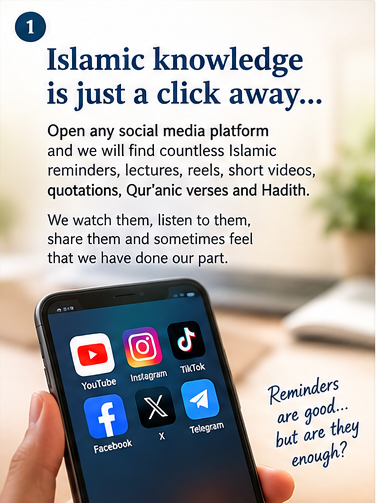
We live in an age where Islamic knowledge is available to us at our fingertips. Open any social media platform and we will find countless Islamic reminders, lectures, reels, short videos, quotations, Qur’anic verses, Hadith and discussions on almost every aspect of our Deen. We watch them, listen to them, share them and sometimes feel that we have done our part by consuming and circulating Islamic content. There is certainly a benefit in this. A reminder can awaken a sleeping heart. A short video can make a person think. A Qur’anic verse can change someone’s direction. A Hadith can correct a misunderstanding. Social media, therefore, can be an excellent medium for reminders and for reaching people who may otherwise never encounter Islamic teachings.
But there is an important question we need to ask ourselves: Can Islamic education itself be acquired merely through social media reminders? I believe the answer is no. We must understand the difference between being reminded about Islam and being educated in Islam. A reminder may take a few seconds or a few minutes. Education requires study, continuity, understanding, questioning, reflection and application. A person cannot become a doctor by watching medical reels, nor can someone become an engineer by watching engineering videos. Nobody would consider social-media clips a substitute for a structured academic education.
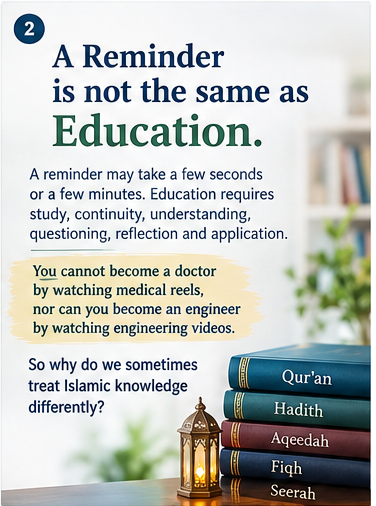
So why do we sometimes treat Islamic knowledge differently?
- Has anybody ever said, “I will learn mathematics through a few mathematics reels”?
- Has anybody said, “I don’t need to study science; I will simply watch science videos whenever they appear on my feed”?
- Has anybody seriously considered completing their academic education by watching random educational clips on social media?
Of course not.
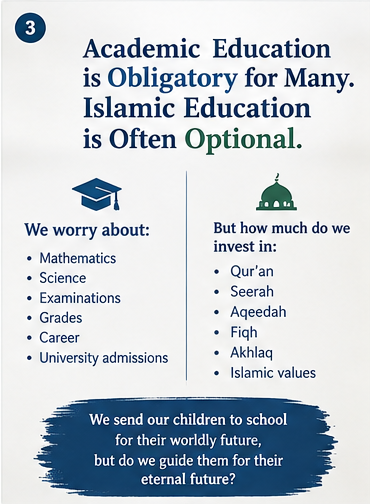
We understand that academic education requires a syllabus, teachers, books, examinations, discipline, progression and years of learning. But when it comes to Islamic education, many of us have unconsciously created a completely different standard. We send our children to school for years. We make sure they attend classes regularly. We monitor their examinations. We pay substantial fees for their education. We worry about their grades, qualifications and careers because we believe education is essential for their future.
But how much structured education do we provide them about their Creator?
- How much do they learn about Qur’an?
- How much do they understand about the life of the Prophet ﷺ?
- How much do they know about Aqeedah, Fiqh, Akhlaq, Seerah, Islamic history, rights and responsibilities, family life, financial dealings, relationships, morality and the purpose of human existence?
And perhaps the most important question:
Have we taught them how to live as Muslims, or have we merely taught them how to earn a living?
Somewhere along the way, academic education became obligatory in our minds, while Islamic education became optional. We worry if our child misses mathematics for a year. We worry if he or she falls behind in science. We worry about competitive examinations, professional qualifications and university admissions. But if the same child remains ignorant about the fundamentals of Deen, many of us do not experience the same sense of urgency.
This imbalance has consequences. We cannot expect a generation to make sound decisions based on knowledge it was never systematically taught. Many of the problems facing individuals, families and communities today are not merely problems of wealth, technology or opportunity. They are also problems of knowledge, values, character, responsibility and guidance.
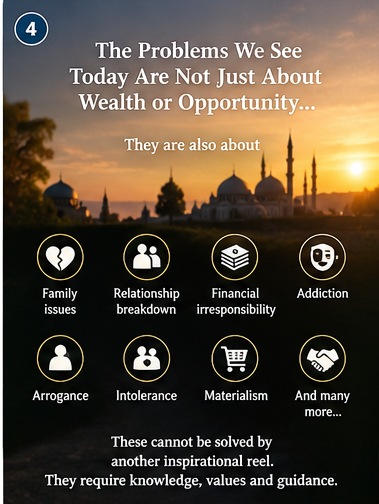
Marriage problems, family disputes, financial irresponsibility, breakdown of relationships, dishonesty, addiction, arrogance, intolerance, materialism and countless other social problems cannot be addressed merely by forwarding another inspirational reel.
A reminder may tell us what is right. Education teaches us why it is right, how to understand it, how to apply it and how to remain committed to it. There is another danger in depending entirely upon social media for Islamic knowledge. Our social-media feeds are not designed to provide us with a complete curriculum. They show us what attracts our attention. One day we may watch a video about Salah. The next day it may be about marriage. Then perhaps a clip about Jannah, another about punishment, another about a historical incident and another about a controversial issue.
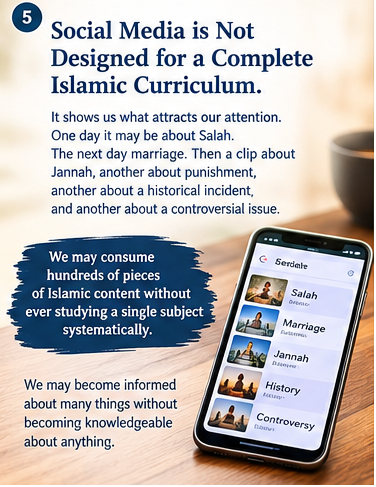
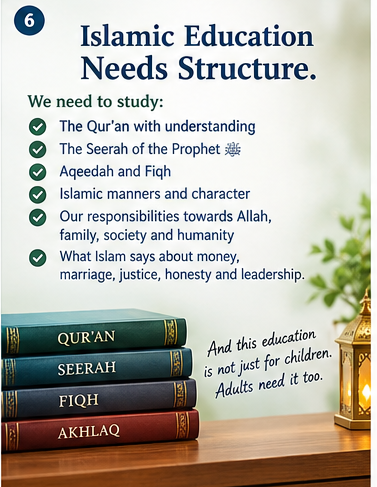
We may consume hundreds of pieces of Islamic content without ever studying a single subject systematically from beginning to end. We may therefore become informed about many things without becoming knowledgeable about anything. Islamic education cannot be reduced to isolated clips. We need structured learning. We need to study the Qur’an with understanding. We need to learn the Seerah. We need to understand the fundamentals of Aqeedah and Fiqh. We need to learn Islamic manners and character. We need to understand our responsibilities towards Allah, ourselves, our parents, spouses, children, neighbours and society. We need to understand what Islam says about money, marriage, justice, honesty, leadership, responsibility and human conduct.
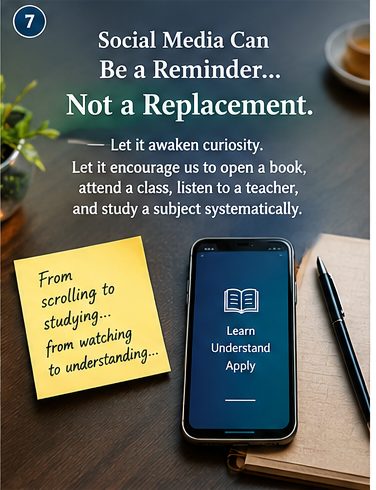
And this education cannot be restricted to children. Adults need Islamic education too. In fact, parents who have never systematically studied their Deen may find it difficult to provide meaningful Islamic education to their children. The solution is not to reject social media. The solution is to put social media in its proper place. Let social media be a reminder. Let it awaken curiosity. Let it encourage us to open a book, attend a class, listen to a qualified teacher, study a subject systematically and ask questions. A five-minute reel can inspire us to begin a journey of knowledge. But it should not become the journey itself.
The Ummah does not merely need more Islamic content. The Ummah needs more Islamic education. We have invested enormously in producing doctors, engineers, accountants, lawyers, scientists, managers and professionals. And there is nothing wrong with that. These professions are important and society needs them. But alongside professional education, we must produce Muslims who understand why they exist, whom they worship, what their responsibilities are and how they are expected to live.
The Qur’an begins with a command associated with knowledge: “Read.” Knowledge has never been an optional decoration in Islam. If we have made academic education a compulsory part of our children’s lives because we understand its importance to their worldly future, then we must ask ourselves why we have not shown the same urgency toward the knowledge that concerns their eternal future. Perhaps the real challenge before the Ummah is not the absence of Islamic content.
We have more Islamic content than ever before. The challenge is whether we are turning that content into knowledge, understanding, character and action. A reminder can reach the eye. A lecture can reach the ear. But education must ultimately reach the mind, the heart and the life of a person. Social media can remind us about Deen. It cannot replace learning Deen.
The Ummah must therefore move from scrolling to studying, from watching to understanding, and from collecting reminders to acquiring knowledge. Only then can Islamic education reclaim the place it deserves in the life of a Muslim.
I sometimes wonder how many people enter one of the most important contracts of their lives without first learning the Islamic knowledge necessary to fulfil it. How many couples prepare extensively for their wedding day but hardly prepare for the marriage itself? They may spend months planning the venue, clothes, invitations, food and celebrations, yet spend very little time learning the rights and responsibilities that Allah has placed upon a husband and wife.
How many enter marriage without knowing the basic fiqh of marriage? How many may unknowingly violate the rights of their spouse? How many may commit sins without even realising that what they are doing is wrong? This is not necessarily because they intend to disobey Allah. Sometimes it is simply because they were never taught.
And that is precisely why Islamic education matters. A reminder appearing on a social-media feed may tell someone that marriage is sacred. Another may remind them to treat their spouse kindly. Another may quote a beautiful Hadith about mercy and companionship. All of these reminders can be beneficial. But reminders cannot replace systematic learning.
Marriage has its own rulings. It has conditions, rights, responsibilities, boundaries and consequences. Knowing how to conduct a marriage Islamically is not merely useful information for those who are interested in religion; for a Muslim entering marriage, it is part of preparing to fulfil an important responsibility before Allah.
Perhaps we should therefore ask ourselves a simple question: Before asking young people whether they are ready to get married, have we taught them how to be married? And before expecting them to fulfil the rights of their spouse, have we taught them what those rights actually are? This is where the difference between Islamic reminders and Islamic education becomes critically important.
A reminder may reach us in thirty seconds. Knowledge requires us to stop, study, understand, ask questions, learn from qualified people and then implement what we have learned. The problem is not social media. The problem begins when social media becomes a substitute for education.