
Little Boy, Fat Man and the Invisible Bombs of Greed
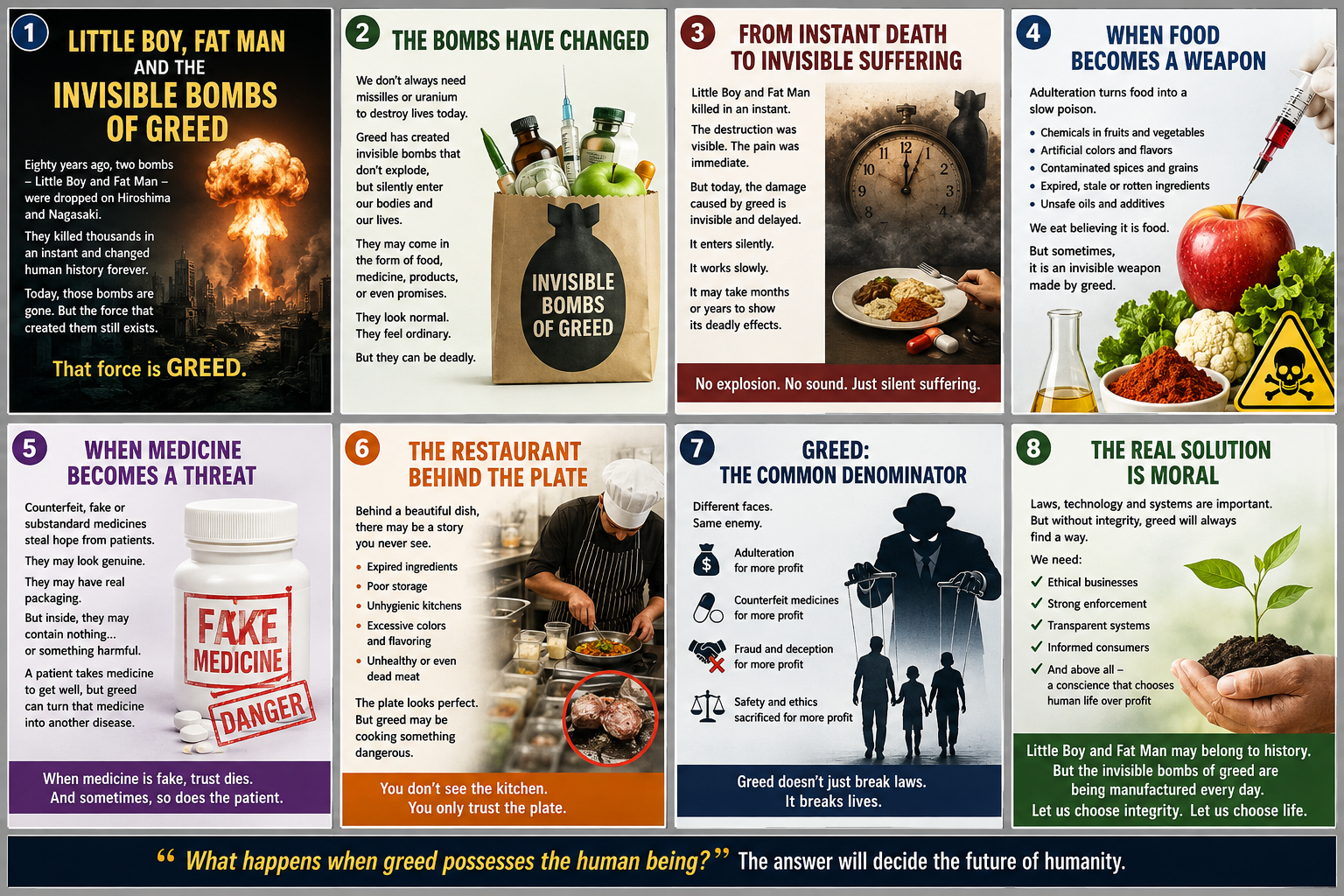
Eighty years ago, humanity witnessed an event that permanently changed the course of history. On 6 August 1945, an atomic bomb code-named Little Boy was dropped on Hiroshima. Three days later, another bomb, Fat Man, was dropped on Nagasaki. In moments, cities were devastated and tens of thousands of lives were lost. Many more people subsequently suffered burns, radiation sickness, cancers and the long-term consequences of exposure.
The names were deceptively simple.
Little Boy.
Fat Man.
Behind those names were weapons of unprecedented destruction. Eighty years later, those two bombs remain symbols of humanity’s terrifying ability to use knowledge, science and technology for destruction. But perhaps there is another lesson we should not overlook. The bombs may belong to history. The human weakness that made such destruction possible does not.
That weakness is greed.
The Bombs Have Changed
Today, we don’t necessarily need an aircraft carrying a nuclear weapon to destroy human lives. Some of the most dangerous threats may be much smaller.
- They may fit inside a packet of food.
- A bottle of medicine.
- A restaurant kitchen.
- A warehouse.
- A laboratory.
- A business transaction.
- They may not explode.
- They may not make a sound.
- They may simply enter our bodies, our homes and our lives.
These are the invisible bombs of greed. When profit becomes more important than human life, almost anything can become a weapon of harm.
- Food can be adulterated.
- Medicines can be counterfeited or made substandard.
- Products can be misrepresented.
- Weights and measurements can be manipulated.
- Expiry dates can be ignored.
- Unsafe ingredients can be used.
- Information can be deliberately concealed.
And consumers—often unaware and trusting—can become the victims.
From Instant Death to Invisible Suffering
There is an important difference between an atomic bomb and modern forms of harm caused by greed. Little Boy and Fat Man caused catastrophic destruction in an instant. The consequences were visible. Buildings disappeared. Fires raged. People knew that something terrible had happened.
The invisible bombs of greed can be completely different.
- A person buys a beautiful fruit.
- A family orders an expensive meal.
- A patient purchases medicine from what appears to be a legitimate source.
- A consumer buys a product because its packaging looks genuine.
There may be no warning.
- No explosion.
- No smoke.
- No alarm.
The harmful substance may enter the body silently. And the consequences may not appear immediately. That is what makes these modern dangers so disturbing. The weapon may be invisible, the perpetrator may be invisible, and even the connection between the product and the eventual illness may be difficult to establish.
When Food Becomes a Weapon
Food is meant to sustain life. Yet food adulteration can turn something essential into a potential source of harm. From time to time, authorities uncover and confiscate food products that violate safety standards. Unsafe ingredients, contaminated products, improper storage, misleading labelling and other forms of malpractice continue to concern food-safety regulators around the world.
Social media has also brought many disturbing examples of alleged food adulteration to public attention. Not every viral video is necessarily authentic, and sensational claims should always be verified. But the existence of documented food-safety violations is enough to remind us that vigilance is necessary. The tragedy is that the consumer often cannot see what is hidden.
- A fruit may look fresh.
- A vegetable may look perfect.
- A packet may appear genuine.
- A meal may be beautifully presented.
But appearance is not always proof of safety.
What we see is the product. What we don’t see is everything that happened before it reached our hands.
When Medicine Becomes a Threat
Perhaps the most disturbing form of greed is the exploitation of someone who is already vulnerable.
- A sick person does not buy medicine for pleasure.
- They buy it because they want to get better.
- A parent gives medicine to a child because they want to protect that child.
- A patient undergoing treatment places enormous trust in the pharmaceutical system.
- That trust can be betrayed when counterfeit, falsified or substandard medicines enter the supply chain.
- A medicine can look genuine while not containing what it is supposed to contain.
- The packaging may appear convincing.
- The name may be familiar.
- The tablet may look perfectly normal.
- Yet the patient may unknowingly receive something ineffective—or potentially harmful.
Think about the irony.
A person takes medicine because they are fighting for their life, while somewhere along the chain another person may have compromised that medicine for profit.
That is not merely a commercial crime. It is a betrayal of human trust.
The Restaurant behind the Beautiful Plate
We have also become increasingly dependent on eating food prepared outside our homes. Restaurants, hotels, cafés and food outlets feed millions of people every day. The vast majority of food businesses may strive to comply with safety requirements and provide good food. But wherever there is an opportunity to increase profit by reducing costs, temptation can arise.
- Cheap ingredients may replace better ones.
- Poor storage practices may be ignored.
- Food may be kept longer than it should be.
- Excessive colours or flavouring may be used to improve appearance or taste.
- And in serious cases, unsafe or contaminated ingredients may find their way into meals.
- The consumer sees the final dish.
- They don’t necessarily see the supply chain, storage conditions, preparation practices or kitchen processes.
The plate tells us what the food looks like. It doesn’t necessarily tell us how it was treated.
Greed: The Common Denominator
Food adulteration, counterfeit medicines, fraud and deception may appear to be separate problems.
But underneath many of them lies a common denominator:
Greed.
- Greed says: “How much more can I earn?”
- Integrity asks: “How can I serve without harming others?”
- Greed asks: “Can I get away with it?”
- Conscience asks: “Is it right?”
- Greed asks: “Will the customer notice?”
- Responsibility asks: “Would I give this to my own family?”
That last question may be one of the simplest tests of ethical business.
- Would you feed it to your own child?
- Would you give it to your own parent?
- Would you take the medicine yourself?
If the answer is no, why should it be acceptable for another human being?
Did People Really Live Longer Before?
It is tempting to say that people in earlier generations routinely lived beyond 100 years and that modern society is dying younger because of greed. History, however, is more complicated. Average life expectancy in earlier centuries was generally much lower because of infant mortality, infectious diseases, childbirth complications, malnutrition and the absence of modern medical care. At the same time, however, there is another truth worth reflecting upon.
Many people in earlier generations lived long, productive lives despite having far fewer medicines, technologies and conveniences than we have today.
Modern medicine has achieved extraordinary victories. Vaccines, antibiotics, surgery, diagnostics, emergency medicine and countless other advances have saved millions of lives. So the problem is not modern science.The problem is what happens when human intelligence is separated from human ethics.
- Science can preserve life.
- Science can also be exploited for profit.
- Technology can feed billions.
- Technology can also facilitate sophisticated fraud.
- Chemistry can produce life-saving medicines.
- Chemistry can also be misused to deceive consumers.
Knowledge is powerful. Character determines how that power is used. The Invisible Bomb Is Inside Us. Perhaps the most frightening aspect of greed is that it doesn’t always require an evil-looking person.
Greed can enter an ordinary human being.
- A farmer may be tempted to maximise production at the expense of safety.
- A manufacturer may be tempted to reduce quality to increase margins.
- A trader may be tempted to misrepresent a product.
- A restaurant owner may be tempted to cut corners.
- A pharmacist may be tempted to sell something questionable.
- A businessman may convince himself that “everyone does it.”
One compromise leads to another.
Eventually, the human being becomes so accustomed to putting profit first that the suffering of an unknown customer becomes irrelevant. That is how the invisible bomb is created. Not in a laboratory, but in the human heart.
The Real Battle Is Moral
The answer is not to fear every product we consume.
Nor should we believe every alarming video circulating on social media.
Fear is not the solution.
Awareness is.
- Strong food-safety systems are necessary.
- Effective pharmaceutical regulation is necessary.
- Transparent supply chains are necessary.
- Strict enforcement is necessary.
- Responsible businesses are necessary.
- And informed consumers are necessary.
But laws alone cannot eliminate greed. There will always be people who look for loopholes. There will always be people who calculate profit before consequences. There will always be people who ask, “Can I make more money?” before asking, “Will someone be harmed?” That is why the ultimate solution is not merely technological. It is moral.
What Happens When Greed Possesses the Human Being?
Eighty years after Hiroshima and Nagasaki, we continue to remember Little Boy and Fat Man as symbols of destruction. Their physical existence belongs to the history of warfare. But perhaps their deeper lesson belongs to every generation. Human beings possess extraordinary knowledge and power. The question is not simply what we can do. The question is what we should do. Little Boy and Fat Man demonstrated what happens when enormous power is placed in human hands. Today’s invisible bombs demonstrate something different:
What happens when greed is placed in the human heart.
- A nuclear bomb may destroy a city.
- Greed can corrupt an entire system.
- A bomb may kill in an instant.
- Greed can cause suffering slowly and silently.
- A bomb announces itself through an explosion.
- Greed can hide behind attractive packaging, convincing advertisements, respectable businesses and ordinary transactions.
And perhaps the most disturbing question of all is this: What happens when greed possesses the human being?
The answer is visible around us whenever profit becomes more valuable than people, when deception becomes more attractive than honesty, and when someone else’s health becomes merely another opportunity to make money. Little Boy and Fat Man may have disappeared into history. But the invisible bombs of greed are still being manufactured every day. And unlike nuclear weapons, they don’t require uranium, missiles or aircraft. All they require is a human being willing to place greed above conscience.