
Spouse Selection Roller-Coaster
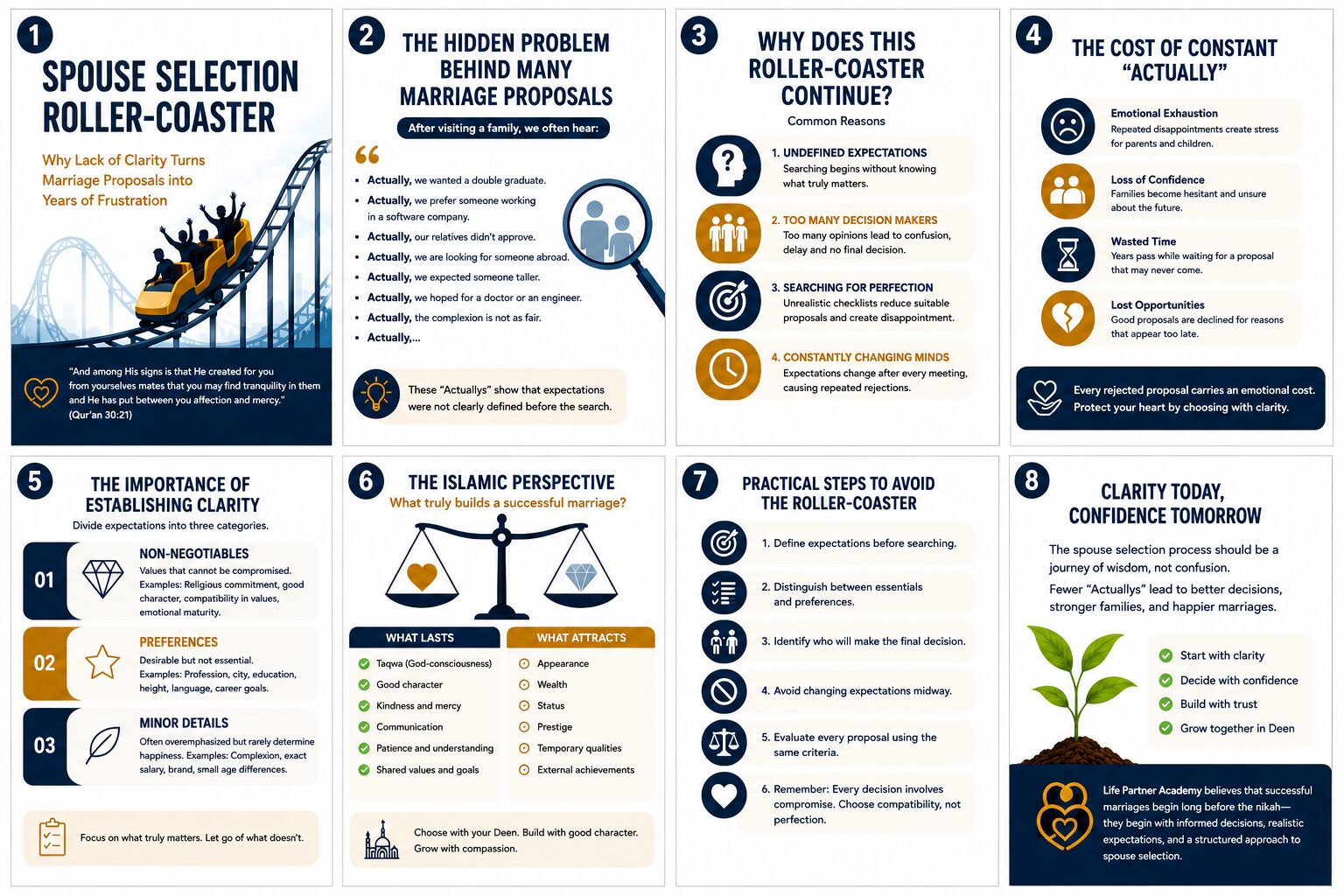
Why Lack of Clarity Turns Marriage Proposals into Years of Frustration
Marriage is one of the most significant decisions a person will ever make. It is not merely the union of two individuals but the coming together of two families, two life journeys, and two futures. Because of its importance, the process of spouse selection deserves careful thought, sincere consultation, and abundant Dua. However, careful planning should never be confused with endless indecision.
Across many communities today, countless families find themselves trapped in what can only be described as a “Spouse Selection Roller-Coaster.” What begins with hope and excitement often turns into months—or even years—of uncertainty, repeated disappointments, emotional exhaustion, and missed opportunities.
Ironically, the greatest obstacle is not always the lack of suitable proposals. More often, it is the lack of clarity before the search even begins. Families enter the process without clearly defining what they genuinely seek in a prospective spouse. As a result, expectations continue to change with every proposal, and decisions are repeatedly postponed.
The unfortunate consequence is that promising proposals are declined for reasons that surface only after families have already invested time, emotions, and effort into the process. Meanwhile, sons and daughters become increasingly frustrated, parents lose confidence, and the search becomes progressively more difficult.
Clarity does not guarantee the perfect proposal. However, it dramatically reduces confusion, prevents unnecessary delays, and enables families to make informed decisions with confidence and wisdom.
The Hidden Problem Behind Many Marriage Proposals
If one were to observe conversations that take place after families visit a prospective bride or groom, a familiar pattern quickly emerges.
Parents often say:
- “Actually, we wanted a double graduate.”
- “Actually, we prefer someone working in a software company.”
- “Actually, our relatives feel the proposal is not suitable.”
- “Actually, we are now looking for someone abroad.”
- “Actually, we expected someone taller.”
- “Actually, we hoped for a doctor or an engineer.”
- “Actually, we are looking for someone with a different complexion.”
The word “actually” appears again and again. The problem is not that families have preferences. Every family is entitled to have reasonable expectations. The real issue is that these expectations are discovered only after a proposal reaches an advanced stage. When this happens repeatedly, families unknowingly place themselves on a roller-coaster of endless searching.
Why Does This Roller-Coaster Continue?
There are several reasons why spouse selection becomes unnecessarily prolonged.
Undefined Expectations
Many parents begin searching before discussing their priorities. Questions such as these remain unanswered:
- What qualities are absolutely essential?
- Which expectations are flexible?
- Which preferences are simply desirable?
- What compromises are acceptable?
Without answering these questions first, every proposal becomes a new discussion from the beginning.
Too Many Decision Makers
- Seeking advice is encouraged.
- Seeking endless approvals is exhausting.
Many proposals are delayed because opinions are sought from numerous relatives, family friends, neighbours, and acquaintances.
- One uncle approves.
- An aunt disagrees.
- A cousin raises another concern.
- A distant relative suggests waiting for something better.
Eventually, no one feels responsible for making the decision. Consultation has value, but decision-making requires clarity regarding who has the final responsibility.
Searching for Perfection
One of the greatest myths in spouse selection is the belief that a perfect proposal exists. Families often create a checklist that includes:
- Excellent education
- High salary
- Prestigious profession
- Attractive appearance
- Ideal height
- Perfect family background
- Wealth
- Religious commitment
- Outstanding personality
- Similar lifestyle
- Preferred location
Individually, many of these expectations may appear reasonable. Collectively, they become nearly impossible. Every additional condition significantly reduces the number of suitable proposals. Eventually, years pass while waiting for someone who exists only in imagination.
The Cost of Constant “Actually”
- Every rejected proposal carries an emotional cost.
- Parents begin questioning their judgment.
- Children begin questioning their future.
- Families become hesitant to pursue new proposals.
- Hope slowly gives way to frustration.
- Perhaps the greatest loss is not merely time.
- It is emotional energy.
Repeated disappointments create anxiety, uncertainty, and unnecessary stress for everyone involved.
The Importance of Establishing Clarity
Before the first proposal is considered, families should spend time discussing their expectations honestly. A useful approach is to divide expectations into three categories.
Non-Negotiables: These are values that cannot be compromised.
Examples may include:
- Religious commitment
- Good character
- Compatibility in fundamental values
- Emotional maturity
- Respectful family environment
These qualities contribute directly to the long-term stability of marriage.
Preferences: These are desirable but not essential.
Examples include:
- Profession
- City of residence
- Educational qualifications
- Height
- Language
- Career aspirations
Preferences should guide the search, not control every decision.
Minor Details: Many issues that consume enormous attention today rarely determine marital happiness.
Examples include:
- Complexion
- Exact salary differences
- Brand-conscious lifestyles
- Small age differences
- Minor physical preferences
Allowing minor matters to outweigh major qualities often leads families away from otherwise excellent proposals.
The Islamic Perspective
Islam encourages believers to make thoughtful decisions while remembering that perfection belongs only to Allah. A successful marriage is not built upon flawless individuals.
It is built upon two imperfect people who share faith, good character, patience, mercy, and a willingness to grow together. External qualities may attract attention. Character sustains the marriage. Education may create opportunities. Taqwa creates blessings. Income may provide comfort. Good manners create peace.
When families reverse these priorities, they often struggle to recognise genuinely suitable proposals.
Practical Steps to Avoid the Roller-Coaster
Families can simplify spouse selection by following a structured process.
- First, define expectations before searching.
- Second, distinguish essentials from preferences.
- Third, identify who will make the final decision.
- Fourth, avoid changing expectations midway through the process.
- Fifth, evaluate every proposal against the same objective criteria.
Finally, remember that every decision involves compromise. Choosing a spouse is not about finding perfection. It is about finding compatibility.
A Question Every Parent Should Ask
Before meeting another family, pause and ask: “Have we clearly decided what we are looking for?”
Or will another sentence begin with: “Actually…”
If the answer keeps changing, the problem may not be the proposals. It may be the absence of clarity.
Conclusion
The spouse selection process should be a journey of wisdom—not confusion. Families who establish clear expectations before beginning their search save themselves months or even years of uncertainty. They communicate honestly, evaluate proposals fairly, and make decisions with greater confidence.
This does not mean every proposal will succeed. Rejections are sometimes necessary, and compatibility cannot be forced. However, when expectations are clear from the outset, proposals are assessed on consistent principles rather than shifting opinions.
Parents should also remember that every additional requirement narrows the pool of potential spouses. While it is entirely reasonable to seek compatibility in faith, character, values, and life goals, pursuing perfection in every area often leads to prolonged searches and unnecessary disappointment. The objective is not to find a flawless husband or wife.
The objective is to find a person of sound character, shared values, emotional maturity, and mutual compatibility with whom a peaceful and fulfilling marriage can be built.
The next time a marriage proposal arrives, resist the temptation to introduce another unexpected “Actually…” Instead, begin with clarity. Because clarity creates confidence. Confidence leads to timely decisions. And timely decisions often lead to happier marriages.