
THE CHALLENGE BEFORE THE UMMAH
The Two Doors
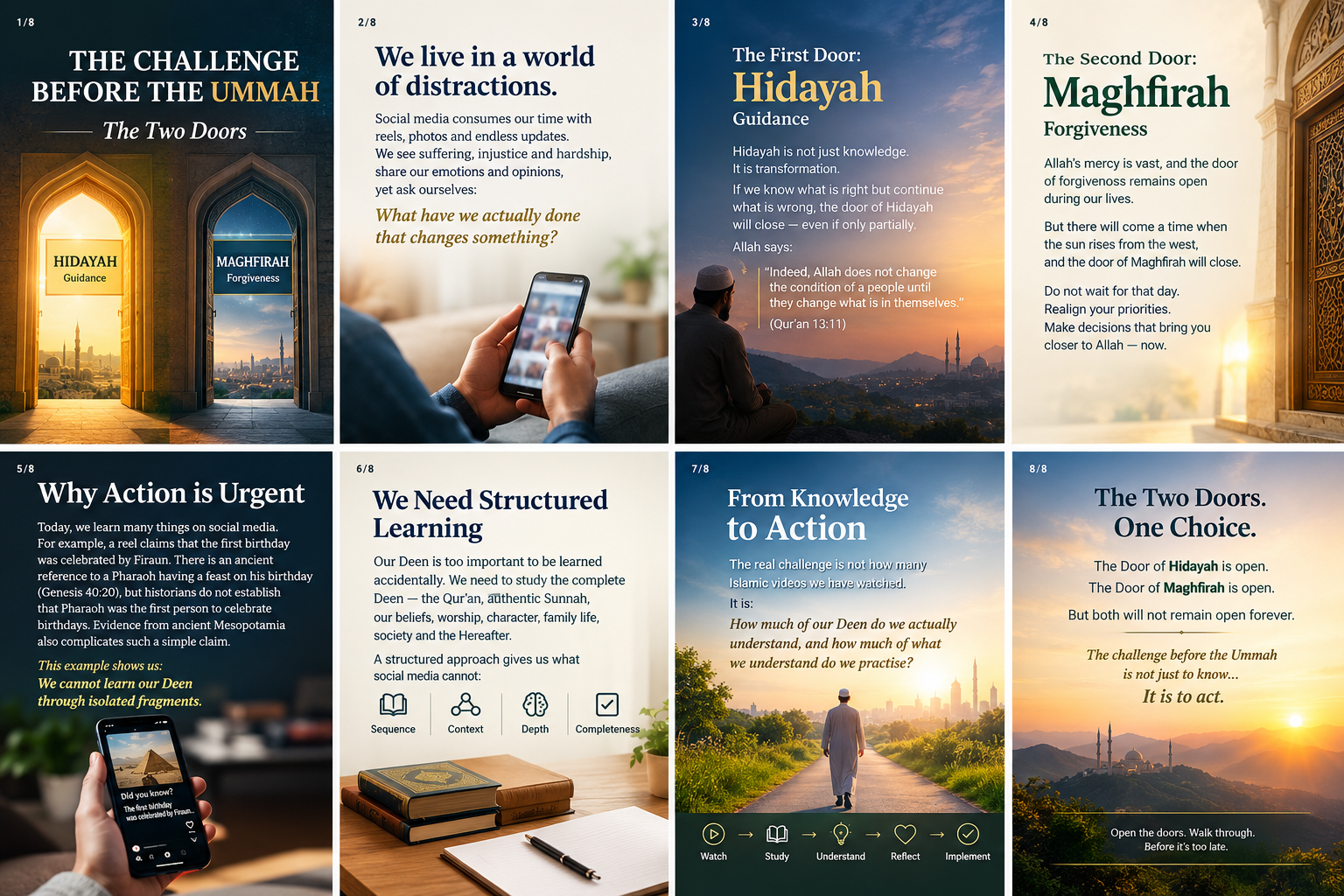
There are two doors before us.
One is the Door of Hidayah—the door of guidance. The other is the Door of Maghfirah—the door of forgiveness. Both doors are open to us today. Both represent opportunities that Allah has given us during our lifetime. Yet the challenge before the Ummah is whether we will recognise these opportunities, respond to them and act upon them, or continue with our lives as though there is no urgency to change.
We live in a time when an extraordinary amount of our attention is consumed by social media. We spend hours watching reels, sharing photographs, forwarding messages and commenting on events taking place around us and across the world. We see suffering, poverty, wars, injustice, broken families, struggling children and countless other problems. We express our emotions, share posts, offer opinions and sometimes even become deeply disturbed by what we see. Yet after all the viewing, sharing and discussing, an important question remains unanswered:
What have we actually done that changes something?
Seeing suffering is not the same as relieving suffering. Sharing a message is not the same as implementing its message. Expressing concern is not the same as taking responsibility. Commenting on the problems of society does not necessarily make us part of the solution. There comes a point when we have to stop asking, “What is happening to the world?” and start asking, “What am I doing to change myself, my family and the part of society that is within my responsibility?”
This brings us to the first door—the Door of Hidayah.
Hidayah is not merely the possession of knowledge. We may read the Qur’an, listen to lectures, attend religious gatherings, follow scholars, read Islamic books and consume countless reminders through social media. We may know what is permissible and what is prohibited. We may know our responsibilities towards Allah, our parents, spouses, children, relatives, neighbours and society. But knowledge becomes meaningful only when it produces a change in our lives. The real measure is therefore not how much Islamic content we consume, but how much of what we know has actually transformed us. If we know something is wrong and continue doing it, knowledge has not yet transformed us. If we know our responsibilities but continue neglecting them, reminders have not yet transformed us. If we know the rights of others but continue violating them, our knowledge has not yet become action.
Hidayah demands action.
It demands that we examine ourselves honestly. It demands that we have the courage to acknowledge our shortcomings. It demands that we change what needs to be changed, even when that change is uncomfortable.
Allah says in the Qur’an: “Indeed, Allah does not change the condition of a people until they change what is in themselves.” Qur’an 13:11
This verse places a profound responsibility upon us. We cannot continuously complain about society while refusing to examine ourselves. We cannot demand change from our children while refusing to change ourselves. We cannot blame the younger generation for problems that we ourselves have allowed to continue. We cannot expect the Ummah to transform while every individual waits for somebody else to begin. Perhaps one of the most important questions we need to ask ourselves is whether the door of Hidayah is truly open in our lives. Have we become so comfortable with our habits that we no longer want to change? Have we become so attached to cultural practices that we resist Islamic teachings whenever they challenge our traditions? Have we become so occupied with the lives of others that we have stopped examining our own? Have we become consumers of Islamic reminders rather than practitioners of Islamic guidance?
Sometimes the door of Hidayah may not appear to be completely closed. We may still listen. We may still read. We may still agree with what we hear. But perhaps something within us prevents that knowledge from becoming action. We hear the reminder, acknowledge it and then return to exactly the same life. The purpose of Hidayah is not merely to make us informed Muslims. It is to make us transformed human beings.
This is where the challenge before the Ummah becomes much greater than simply identifying its problems.
We have already identified many problems. We know that families are struggling. We know that marriages are facing serious challenges. We know that children are growing up in an environment filled with competing influences. We know that materialism and consumerism have affected our priorities. We know that social media has changed the way people communicate, think and spend their time. We know that many young people are searching for identity, purpose and direction. But identifying problems is only the beginning.
The real challenge is what we do about them.
- If marriages are becoming difficult, what are we doing to prepare people for marriage?
- If families are breaking down, what are we doing to teach responsibility, communication, patience, forgiveness and compassion?
- If children are struggling with identity, what are we doing inside our homes to give them a strong foundation?
- If materialism is consuming our lives, are we examining our definition of success?
- If social media is consuming hours of our lives, are we asking what valuable things we are sacrificing for it?
We cannot change everything happening in the world. But we can change what happens within ourselves. We can influence what happens within our homes. We can contribute to what happens within our communities. And we can decide what values, habits and examples we leave behind for the next generation.
That is the opportunity represented by the first door. But there is another door.
The second is the Door of Maghfirah
—the door of forgiveness. Allah’s mercy is immense, and the opportunity for repentance remains available to us during our lives. No matter how far a person may have travelled in the wrong direction, the opportunity to turn back to Allah remains open while life continues.
But Islam also reminds us that this opportunity is not without an end. The Qur’an tells us that there will come a time when some of the major signs of the Hour appear and faith will no longer benefit those who had not believed before or had not earned good through their faith. Allah says:
“The Day some of the signs of your Lord come, no soul will benefit from its faith if it had not believed before or earned through its faith some good.” Qur’an 6:158. Among the signs described in authentic hadith is the rising of the sun from the west. The Prophet ﷺ taught that when this occurs, belief will no longer benefit a person who had not believed beforehand.
The message is therefore one of urgency.
- Do not wait for the final sign before beginning to change.
- Do not wait until regret becomes our teacher.
- Do not wait until circumstances force us to recognise what we should have recognised willingly.
- Do not wait until opportunities disappear before appreciating their value.
- Today, the opportunity remains.
- Today, we can repent.
- Today, we can seek forgiveness.
- Today, we can repair relationships.
- Today, we can change our priorities.
- Today, we can abandon what we know is wrong.
- Today, we can begin practising what we already know is right.
- Today, we can change the environment in our homes.
- Today, we can raise our children differently.
- Today, we can make decisions that may benefit generations we may never live to see.
This is the challenge before the Ummah.
- It is not merely a challenge of knowledge. It is a challenge of action.
- It is not merely a challenge of identifying what is wrong. It is a challenge of having the courage to correct it.
- It is not merely a challenge of telling the next generation what Islam teaches. It is a challenge of demonstrating those teachings through our own lives.
Perhaps we need to ask ourselves a difficult question: What are we waiting for?
- Are we waiting for another crisis?
- Another broken family?
- Another generation to suffer the consequences?
- Another reminder?
- Another lecture?
- Another viral video?
- Another tragedy?
Or are we prepared to act now?
The Ummah does not need to wait for perfect circumstances before beginning to change. Change can begin with one individual, one family, one decision, one correction and one sincere return to Allah. The greatest danger is perhaps not that we do not know what needs to be changed. The greater danger is that we know, but keep postponing the change. Every day gives us another opportunity to open the Door of Hidayah wider. Every day gives us another opportunity to seek the Door of Maghfirah. Every day also brings us closer to the point at which opportunities that appear permanent today will no longer be available.
We often speak about the legacy we want to leave behind. We think about our homes, businesses, wealth, education, photographs and possessions. But perhaps the more important question is what kind of human beings we are leaving behind.
- Will our children inherit only our material possessions, or will they inherit our character?
- Will they inherit our arguments, or our wisdom?
- Will they inherit our prejudices, or our principles?
- Will they inherit our unresolved problems, or the tools to solve them?
- Will they inherit a collection of Islamic reminders, or a living example of Islam?
The future of the Ummah will not be shaped only by what we say today. It will be shaped by what we do today and what our children learn from what they see us doing. The challenge before the Ummah, therefore, is not simply to keep talking about change. It is to begin changing.
- The Door of Hidayah is open. Are we willing to walk through it?
- The Door of Maghfirah is open. Are we willing to return?
There will come a time when these opportunities will no longer remain as they are today. Until then, we have been given something extraordinarily valuable: time, awareness, choice and the ability to act. Perhaps this is the moment for every one of us to pause and look within.
- Is the door of Hidayah fully open in our lives?
- Has it become partially closed because of our unwillingness to change?
- Are our priorities aligned with what we claim to believe?
- Are we preparing the next generation to become better human beings, better Muslims and responsible members of society?
- And while the Door of Maghfirah remains open, are we willing to seek forgiveness for what we have done and make a genuine effort to change what we continue to do?
The challenge before the Ummah is ultimately a personal challenge before every individual.
- The world may not change because we shared another reel.
- Society may not change because we forwarded another message.
- Our families may not change because we complained about them.
- Our future generations may not change because we told them what they should do.
- Change begins when we decide that we will change what is within us.
The two doors are before us.
One is the Door of Hidayah. The other is the Door of Maghfirah.
- Both are opportunities.
- Both demand a response.
And both remind us of one fundamental truth: