
THE MARRIAGE GEARBOX PRINCIPLE
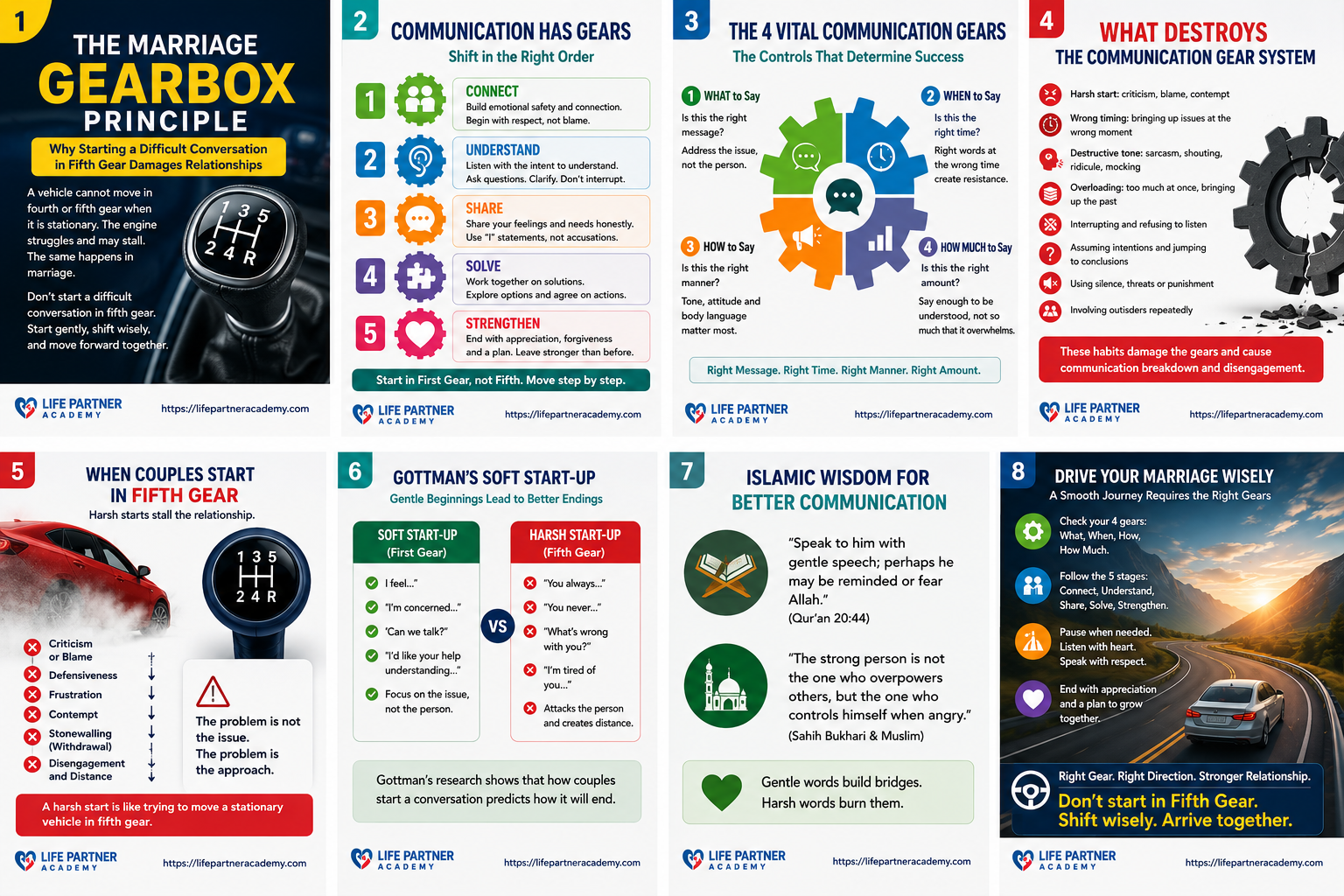
Why Starting a Difficult Conversation in Fifth Gear Damages Relationships — and What Destroys the Communication Gear System
A marriage can be compared to a long journey. Two people begin together with dreams, expectations, responsibilities, hopes, and the desire to build a life that brings peace and happiness. But like every journey, marriage has its smooth roads, steep climbs, unexpected obstacles, traffic jams, and moments when the vehicle needs to slow down. There is another similarity that is often overlooked: communication in marriage is like a vehicle’s gearbox. A skilled driver knows that a vehicle cannot be driven efficiently by remaining in one gear. More importantly, a vehicle that is stationary should not normally be forced to move in fourth or fifth gear. The engine struggles, the vehicle may jerk, and eventually it may stall.
The same thing happens in relationships. A difficult conversation that begins with criticism, accusation, anger, sarcasm, or contempt is like trying to move a stationary vehicle in fifth gear. The relationship has not yet gained emotional traction, yet we expect it to carry the weight of a highly charged conversation.
The result is often predictable: the conversation struggles, emotions rise, defensiveness appears, and what could have been a simple discussion becomes a major conflict. This is the essence of what I call The Marriage Gearbox Principle: Don’t start a difficult conversation in fifth gear. Start gently, shift wisely, and move forward together.
Communication Is More Than What We Say
When people talk about communication, they often focus only on words. But effective communication involves much more than vocabulary. A message can be technically correct and still damage a relationship because it was delivered at the wrong time, in the wrong manner, or in excessive quantity. Every important conversation therefore has four vital communication gears:
What to say. When to say it. How to say it. How much to say.
These four questions act like the controls of a communication gearbox.
Before speaking, we should ask ourselves: What exactly needs to be said? Is this genuinely necessary? Am I addressing the issue, or am I attacking the person? A statement such as “You are irresponsible” labels the individual. A statement such as “I was concerned when this responsibility was not completed” addresses the behaviour. The difference may appear small, but emotionally it can be enormous.
Then comes the second gear: When should I say it?
Timing can determine whether a message is received or rejected. The right words spoken when a spouse is exhausted, angry, distracted, rushing somewhere, or emotionally overwhelmed may produce the wrong result. A wise communicator understands that not every correct message needs to be delivered immediately.
Then comes How should I say it?
Tone, facial expression, body language, volume, choice of words, and attitude all communicate something beyond the literal sentence. “Can we talk about what happened?” creates a very different emotional environment from “We need to talk. You always do this!”
Finally, there is How much should I say?
This is one of the most neglected aspects of communication. Sometimes couples turn one disagreement into a historical trial. A discussion about today’s problem suddenly includes events from five years ago, old disappointments, family complaints, financial disagreements, and everything else that has been stored in emotional memory.
The original issue becomes buried under accumulated grievances.
Good communication does not mean saying everything that comes to mind. It means saying enough to be understood without saying so much that the other person becomes emotionally overwhelmed.
What Destroys the Communication Gear System?
A gearbox is designed to transfer power smoothly. But gears can be damaged when they are misused, neglected, or forced beyond their capacity.
Communication works the same way.
- The first destroyer is a harsh start. When a conversation begins with criticism, blame, accusation, or contempt, the other person is likely to become defensive before the real issue has even been discussed.
- The second destroyer is poor timing. A serious conversation introduced at the wrong moment can transform a manageable issue into an unnecessary confrontation.
- The third destroyer is a destructive tone. Sarcasm, shouting, ridicule, mocking, and contempt communicate disrespect even when the underlying issue is legitimate.
- The fourth destroyer is overloading the conversation. When one conversation contains too many complaints, examples, accusations, and historical grievances, the emotional system becomes overloaded.
There are other forces that damage the gearbox as well: constant interruption, refusing to listen, assuming intentions, bringing outsiders into every disagreement, using silence as punishment, threatening separation during arguments, and repeatedly reopening issues that have already been resolved.
Over time, these behaviours create something even more dangerous than occasional conflict: disengagement. The couple may stop arguing because they have stopped communicating.
One spouse stops sharing because every conversation becomes an argument. The other stops asking because there is no meaningful response. Eventually, emotional distance replaces emotional connection. The relationship may continue physically while communication has already stalled emotionally.
Why Gottman’s Soft Start-Up Matters
The work of marriage researcher John Gottman provides an important foundation for understanding this principle. Gottman’s research has emphasized the importance of how couples approach conflict, including the concept of the soft start-up: beginning difficult conversations without criticism or hostility.
The idea is remarkably compatible with the gearbox analogy. Imagine a car standing still. The driver selects fifth gear and attempts to move forward. The engine is forced to perform a task for which that gear is unsuitable at that moment. Now imagine a spouse emotionally at rest—or already emotionally vulnerable—and suddenly hearing:
- “You never listen to me.”
- “You always embarrass me.”
- “I am tired of you.”
- “You don’t care about this family.”
The relationship has effectively been forced into high gear. The emotional engine begins to struggle. Defensiveness appears. Then frustration. Then counterattack. Then withdrawal. The original issue may be forgotten completely. The couple is no longer trying to solve a problem. They are trying to protect themselves.
The Gears Must Move Together
The Communication Gear System is not about avoiding difficult conversations. Healthy marriages must discuss difficult subjects. Silence is not the same as peace. The objective is to learn how to shift gears wisely.
A conversation may begin with connection, move toward understanding, progress into sharing, reach problem-solving, and finally end with strengthening the relationship. But throughout that journey, the four communication gears—what, when, how, and how much—must remain engaged.
The driver who understands a vehicle listens to the engine and knows when to change gears.
A wise spouse learns to listen to the emotional “engine” of the relationship.
- Is my spouse ready to hear this?
- Is this the right moment?
- Am I speaking to be understood or simply to win?
- Am I addressing the issue or attacking the person?
- Have I said enough?
- Should I pause?
These questions can prevent a small disagreement from becoming a major rupture.
The Islamic Wisdom of Gentle Speech
This principle is also deeply consistent with Islamic teachings. When Allah sent Musa and Harun (peace be upon them) to Pharaoh, He instructed them: “Speak to him with gentle speech; perhaps he may be reminded or fear Allah.” (Qur’an 20:44)
The significance is profound. If gentleness was commanded when addressing Pharaoh, how much more should gentleness be practiced when speaking to one’s spouse—the person with whom one has chosen to share life? The Prophet Muhammad ﷺ also taught that true strength is demonstrated through self-control, particularly during anger. Marriage therefore does not require the absence of strong emotions. It requires the wisdom to control how those emotions are communicated.
Don’t Start in Fifth Gear
Every marriage will experience difficult conversations. There will be disagreements about money, children, parents, responsibilities, expectations, careers, intimacy, priorities, and countless everyday matters. The goal is not to eliminate every disagreement. The goal is to prevent disagreement from becoming destruction. Before beginning your next difficult conversation, remember the gearbox.
Ask yourself:
- What should I say?
- When should I say it?
- How should I say it?
- How much should I say?
Then remember the most important rule: Never start a stationary relationship in fifth gear.
- Is my spouse ready to hear this?
- Is this the right moment?
- Am I speaking to be understood or simply to win?
- Am I addressing the issue or attacking the person?
- Have I said enough?
- Should I pause?
And when the conversation is over, try to leave your spouse with something that strengthens the relationship rather than something that adds another wound. A skilled driver does not merely know how to accelerate. A skilled driver knows how to select the right gear for the road. Likewise, a wise spouse does not merely know what to say. A wise spouse knows what to say, when to say it, how to say it, and how much to say. Because in marriage, communication is not simply about getting your message across. It is about ensuring that the relationship survives the journey. Right Message. Right Time. Right Manner. Right Amount. Shift your communication gears wisely—and your marriage can travel much farther together.
Life Partner Academy: Preparing couples not merely for marriage, but for a peaceful and purposeful married life.