
The Three Worlds
Which World Are You Living In?
There is a question that every human being should ask at some point in life: Who am I?
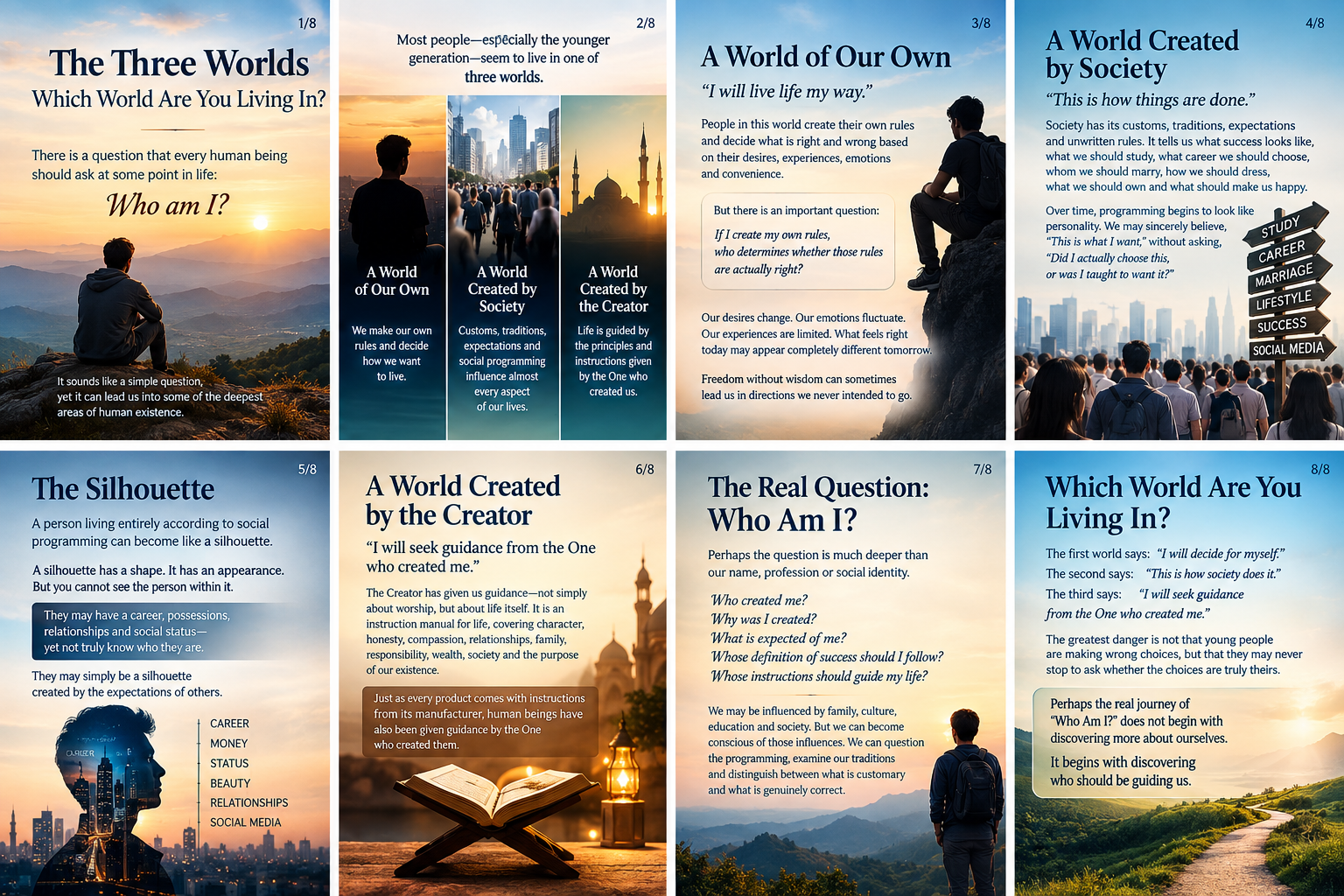
It sounds like a simple question, yet it can lead us into some of the deepest areas of human existence. We usually answer it by mentioning our name, profession, education, family, nationality, achievements or personality. But are these things really who we are? Or are they merely the visible layers of an identity that has been shaped by many forces around us? When we look closely at human life, we can see that most people—especially the younger generation—seem to live in one of three worlds.
There is a world of our own creation, where we make our own rules and decide how we want to live. There is a world created by society, where customs, traditions, expectations and social programming influence almost every aspect of our lives. And then there is a world created by the Creator, where life is guided by the principles and instructions given by the One who created us.
- The first world is perhaps the easiest to recognize. A person may say, “I want to live life on my own terms.” They make their own decisions, establish their own values and follow their own understanding of what is right and wrong. Independence, individuality and freedom of thought are valuable qualities. But there is an important question behind them: If I create my own rules, who determines whether those rules are actually right?
Our desires change. Our emotions fluctuate. Our experiences are limited. What seems right at one stage of life may appear completely different at another. Freedom without wisdom can sometimes lead us in directions we never intended to go.
- The second world is much more difficult to recognize because it often feels like our own world. It is the world created by society. Society has its customs, traditions, expectations and unwritten rules. It tells us what success looks like, what we should study, what career we should pursue, what kind of home we should build, whom we should marry, how we should dress, what we should own and even what should make us happy.
From childhood, we are surrounded by messages that gradually shape our thinking.
- “Study this.”
- “Become successful.”
- “Earn more.”
- “Look like this.”
- “Live like them.”
- “Get married by this age.”
- “Buy this.”
- “People will think badly of you if you don’t.”
- Over time, something fascinating happens. Programming begins to look like personality.
A person may sincerely believe, “This is what I want,” without ever asking, “Did I actually choose this, or was I taught to want it?” This becomes even more powerful in the age of social media. Millions of young people are continuously exposed to carefully constructed images of beauty, wealth, relationships, lifestyles and success. Algorithms learn what attracts our attention and then show us more of it. What begins as exposure can gradually become expectation, and expectation can eventually become identity.
This is where the idea of the silhouette becomes important. A silhouette has a recognizable outline, but you cannot see the person within it. A human being can similarly have a career, qualifications, possessions, social status, fashionable clothes, relationships and a large social-media presence—and yet not truly know who they are. They may simply be a silhouette created by the expectations of others. Every aspect of their life may have been programmed: what they should desire, what they should admire, what they should reject, what they should pursue and what they should consider successful. The most dangerous part is that they may be completely convinced that what they are doing is right and perfect. After all, everyone around them is doing the same thing. And when millions of people follow the same path, questioning the path itself can seem almost rebellious.
But popularity is not proof of truth. A tradition is not automatically a principle. Something being socially accepted does not automatically make it morally correct. And something being fashionable does not make it meaningful. The question we should therefore ask is not merely, “What is everyone doing?”
It is: “Why am I doing what I am doing?”
- This brings us to the third world—the world created by the Creator. If we believe that human beings have been created by Allah, then another profound question naturally follows: Would the One who created us leave us without guidance on how to live?
Every manufactured product comes with instructions from its manufacturer. The manufacturer knows the product, its purpose, its capabilities and its limitations better than anyone else. Human beings are far more complex than any manufactured product. We have emotions, desires, intellect, relationships, responsibilities, weaknesses and spiritual needs.
Who understands us better than the One who created us?
The Creator has therefore given humanity guidance—not simply about rituals and worship, but about life itself. Guidance concerning character, honesty, justice, relationships, family, marriage, responsibility, compassion, wealth, society and the purpose of our existence. It can be understood as an instruction manual for life.
The tragedy is that we often spend enormous amounts of time learning how to operate machines, software, businesses and financial systems, yet rarely pause to understand the divine guidance for operating the most important creation of all: ourselves.
This brings us back to the question: Who am I? Perhaps the question is much deeper than our name, profession, education or social identity.
Perhaps we should ask:
- Who created me?
- Why was I created?
- What is expected of me?
- Whose definition of success should I follow?
- Whose instructions should ultimately guide my life?
- The first world says, “I will decide for myself.”
- The second says, “This is how society does it.”
- The third says, “I will seek guidance from the One who created me.”
None of us can completely escape the influence of family, culture, education, society or our surroundings. The objective is not to become completely uninfluenced. The objective is to become conscious of what influences us. We must learn to recognize the programming, question the assumptions and distinguish between what is merely customary and what is genuinely correct.
This is particularly important for the younger generation. They are growing up in a world where information is unlimited, influence is constant and comparison is almost unavoidable. They need more than instructions about how to succeed in the world. They need opportunities to pause and ask what success actually means. Perhaps the greatest danger is not that young people are making wrong choices. It is that they may never stop to ask whether the choices are truly theirs. A person can spend an entire lifetime perfecting a silhouette created by others without ever discovering the person within it. The journey of self-awareness begins when we become courageous enough to step outside the expectations surrounding us and examine our lives honestly.
- Look at your ambitions.
- Look at your relationships.
- Look at your definition of success.
- Look at the things you desire.
- Look at the decisions you have made.
Then ask yourself: “Are these truly my choices, or have I inherited them?”
And beyond that: “Am I living according to my desires, according to society’s programming, or according to the guidance of my Creator?” Perhaps the real journey of “Who Am I?” does not begin with discovering more about ourselves. Perhaps it begins with discovering who should be guiding us. Because once we understand the source of our guidance, we may finally begin to understand the true purpose of our existence. And perhaps then, for the first time, we will stop living as a silhouette—and begin living as the person we were created to be.